
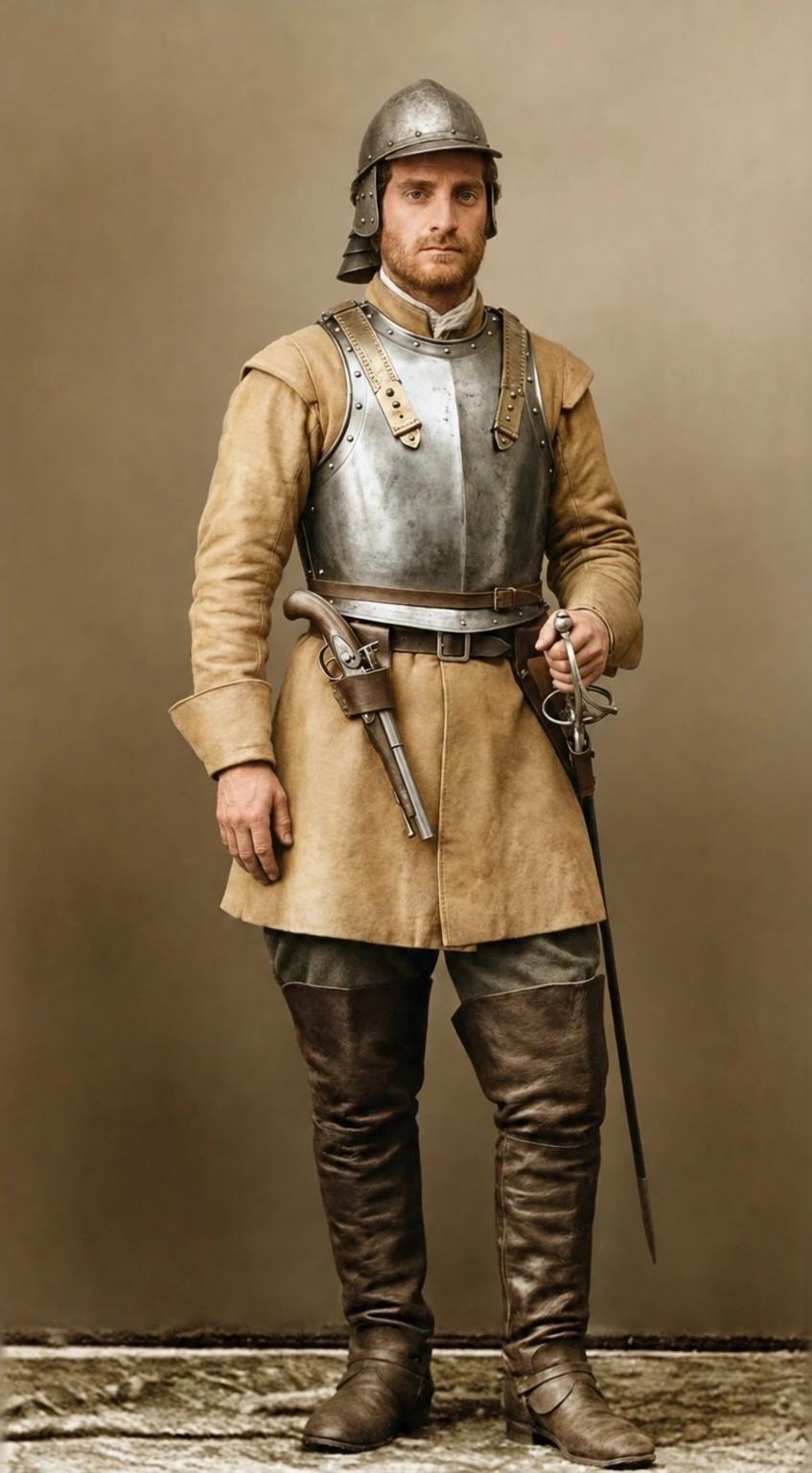
Uniform and equipment
| Uniform | Buff leather coat with steel breastplate, wool breeches, riding boots |
|---|---|
| Dress uniform | N/A |
| Headgear | Iron pot helmet |
| Equipment | Sword, pistols |
| Insignia and standard | None; no unit insignia |
Service record
| First appeared | 17th Century |
|---|---|
| Peak strength | 3,000 men |
| Recruited from | Finnish Cavalrymen |
| Primary tactic | Close Range Pistol & Charge |
| Signature engagement | Battle of Breitenfeld (1631) |
| Motto or battle cry | Hakkaa päälle! (Cut them down!) |
| Obsolescence | End of 30 Years War |
Timeline
- 1618: Outbreak of Thirty Years' War. Religious conflict erupts in Europe; Sweden prepares its military reforms.
- 1630: Swedish Intervention. Gustavus Adolphus lands in Pomerania; Finnish cavalry regiments are deployed to German soil.
- 1631: Legend of Breitenfeld. The Hakkapeliitta earn their reputation by defeating the Imperial heavy cavalry.
- 1632: Death of the King. Gustavus Adolphus dies at Lützen; the unit continues under Stålhandske's command.
- 1648: Peace of Westphalia. The war ends. The Hakkapeliitta return to Finland as heroes or settle in conquered lands.
- 1655: Second Northern War. Veterans and new recruits are mobilized again for campaigns in Poland and Denmark.
- 1679: Introduction of the Allotment System. Military reforms eventually phase out the specific 'Hakkapeliitta' identity in favor of standardized Carolinian cavalry.
Battles
Battle of Breitenfeld
The unit's legendary breakout. When the Saxon allies fled, the Hakkapeliitta held the flank against Pappenheim's heavy cuirassiers. They absorbed seven charges before counter-attacking, shattering the Imperial cavalry and securing the first major Protestant victory.
Battle of Lützen
Fought in thick fog. Despite the death of King Gustavus Adolphus, the Finnish cavalry fought with berserker fury on the right wing. They broke the Imperial left but suffered horrendous casualties, proving their loyalty was absolute even in the face of disaster.
Battle of Wittstock
Outnumbered and exhausted, the Swedish army, spearheaded by Stålhandske's Finns, executed a daring flanking maneuver. The Hakkapeliitta charged into the Imperial rear, turning a stalemate into a decisive rout.
Commanders
Gustavus Adolphus
The Lion of the North and architect of the Swedish military machine. He rejected the passive caracole tactics of the era, training his Finnish riders to charge home with cold steel. He often rode at the head of the cavalry, sharing their dangers until his death at Lützen.
Torsten Stålhandske
A commander of immense physical strength and reckless courage. Stålhandske ('Steel Glove') rose to lead the Finnish cavalry, becoming the terror of the Imperial forces. He treated his men like family and his enemies with ruthless efficiency, embodying the raw aggression of the unit.
Tactics
Aggressive Shock Charge
Unlike continental cavalry that trotted, the Finns attacked at a gallop, knee-to-knee, relying on the sheer kinetic impact of horses and men to break enemy lines.
Point-Blank Salvo
Riders held fire until the last possible second (often 3 paces away), fired two pistols into the enemy's eyes, and immediately drew swords.
Psychological Warfare
The war cry 'Hakkaa päälle!' (Cut them down!) was screamed in unison to terrify superstitious opponents who believed the Finns practiced witchcraft.