
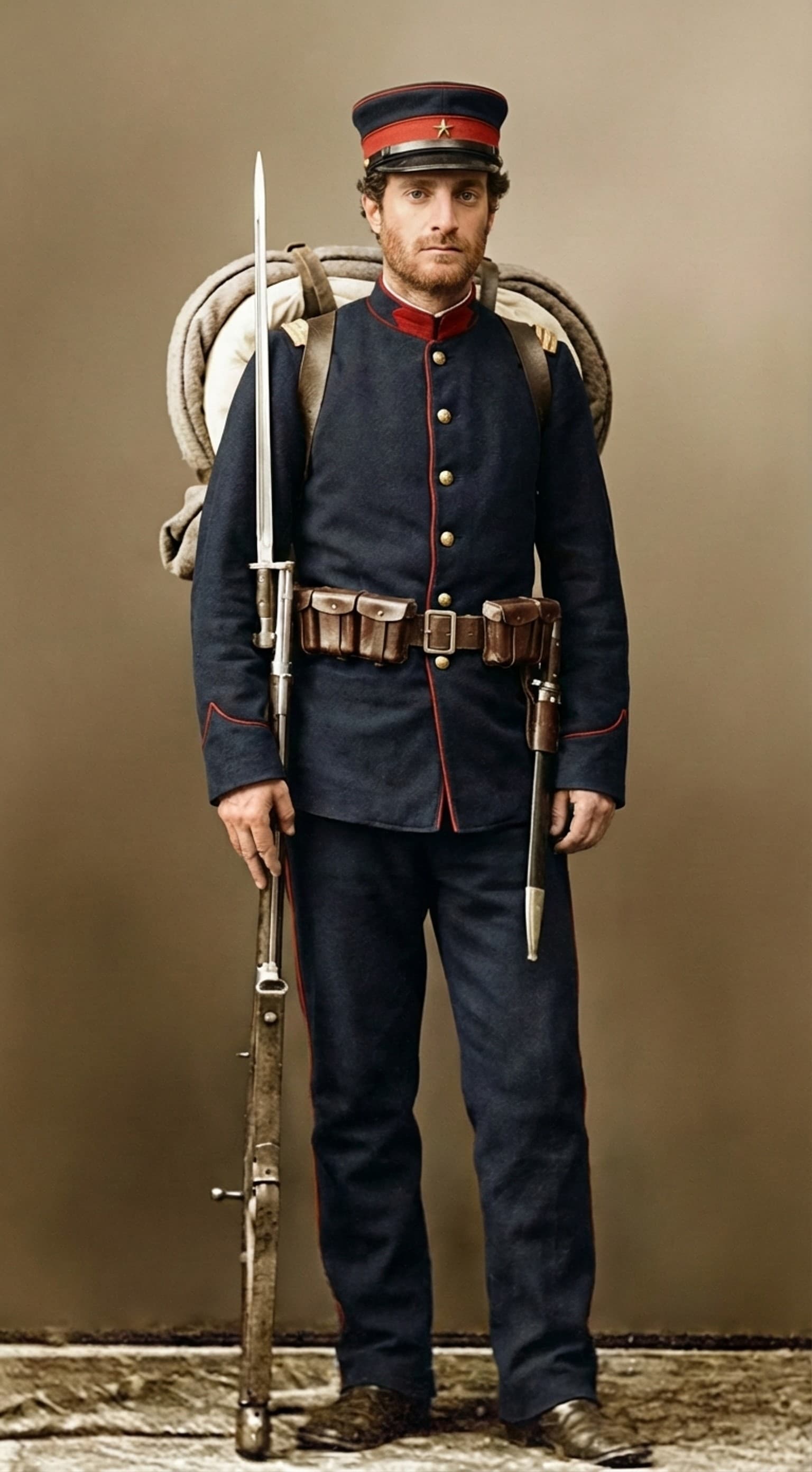
Uniform and equipment
| Uniform | Dark blue tunic, trousers |
|---|---|
| Dress uniform | Blue with yellow/red facings |
| Headgear | Peaked cap |
| Equipment | Murata rifle, bayonet |
| Insignia and standard | Gold five-pointed star cap badge |
Service record
| First appeared | 1870s |
|---|---|
| Peak strength | Hundreds of thousands |
| Recruited from | Universal Conscription |
| Primary tactic | Aggressive Infantry Assault |
| Signature engagement | Russo-Japanese War (1905) |
| Motto or battle cry | Tenno Heika Banzai! (Long live the Emperor) |
| Obsolescence | Evolution to WWII IJA |
Timeline
- 1873: Conscription Law Enacted. The Meiji government mandates universal military service, replacing the samurai class with a peasant-based national army.
- 1877: Suppression of Satsuma Rebellion. The new army faces its first major test, defeating Saigō Takamori's rebel samurai and solidifying Imperial control.
- 1880: Adoption of the Murata Rifle. Major Tsuneyoshi Murata designs Japan's first domestic military rifle, reducing reliance on foreign arms.
- 1894: First Sino-Japanese War. The IJA invades Korea and Manchuria, exposing the weakness of the Qing Dynasty and seizing Taiwan.
- 1900: Boxer Rebellion Relief. Japanese troops form the largest contingent of the Eight-Nation Alliance, earning begrudging respect from Western powers.
- 1904: Outbreak of Russo-Japanese War. Japan launches a surprise attack on Russia, initiating the first major war where an Asian power defeated a European empire.
- 1905: Treaty of Portsmouth. The war ends. Japan gains control of Korea and influence in Manchuria, but the high cost of victory sparks riots at home.
Battles
Battle of Shiroyama
The final stand of the Samurai. The new Imperial conscript army, wielding rifles and artillery, annihilated the traditional warrior caste, proving that modernization was the only path forward for Japan.
Battle of the Yalu River
A decisive engagement of the First Sino-Japanese War. The IJA crossed the river under fire, shattering the Chinese Beiyang Army and signaling Japan's arrival as a premier Asian power.
Siege of Port Arthur
A grueling five-month siege foreshadowing the horrors of WWI. Japanese infantry launched relentless human wave attacks against Russian machine guns and concrete bunkers, suffering over 57,000 casualties to take the port.
Battle of Mukden
The largest land battle prior to World War I. Over 600,000 troops clashed in the freezing Manchurian winter. The IJA outmaneuvered the Russians, forcing a retreat that led to the end of the war.
Commanders
Ōyama Iwao
A field marshal of immense capability, Ōyama commanded the Japanese armies in Manchuria during the Russo-Japanese War, orchestrating complex maneuvers that humbled the Russian Empire at Mukden.
Yamagata Aritomo
The architect of the modern Imperial Japanese Army. He ruthlessly transformed a feudal collection of samurai into a centralized, conscripted war machine modeled on Prussian discipline and efficiency.
Nogi Maresuke
Known as 'The Silent General,' Nogi embodied the tragic transition of the Samurai spirit into modern warfare. He led the bloody siege of Port Arthur, sacrificing thousands—including his own sons—to secure a vital victory for the Empire.
Tactics
Hakuhyei-shugi (Bayonet Doctrine)
An offensive doctrine emphasizing the 'spirit of the bayonet.' Commanders believed that aggressive morale could overcome superior enemy firepower.
Night Infiltration
To negate Russian machine-gun superiority, IJA infantry specialized in silent night approaches to close the distance for hand-to-hand combat.
Human Wave Assault
Frontal assaults by massed infantry columns, intended to overwhelm defensive positions through sheer weight of numbers and disregard for casualties.