
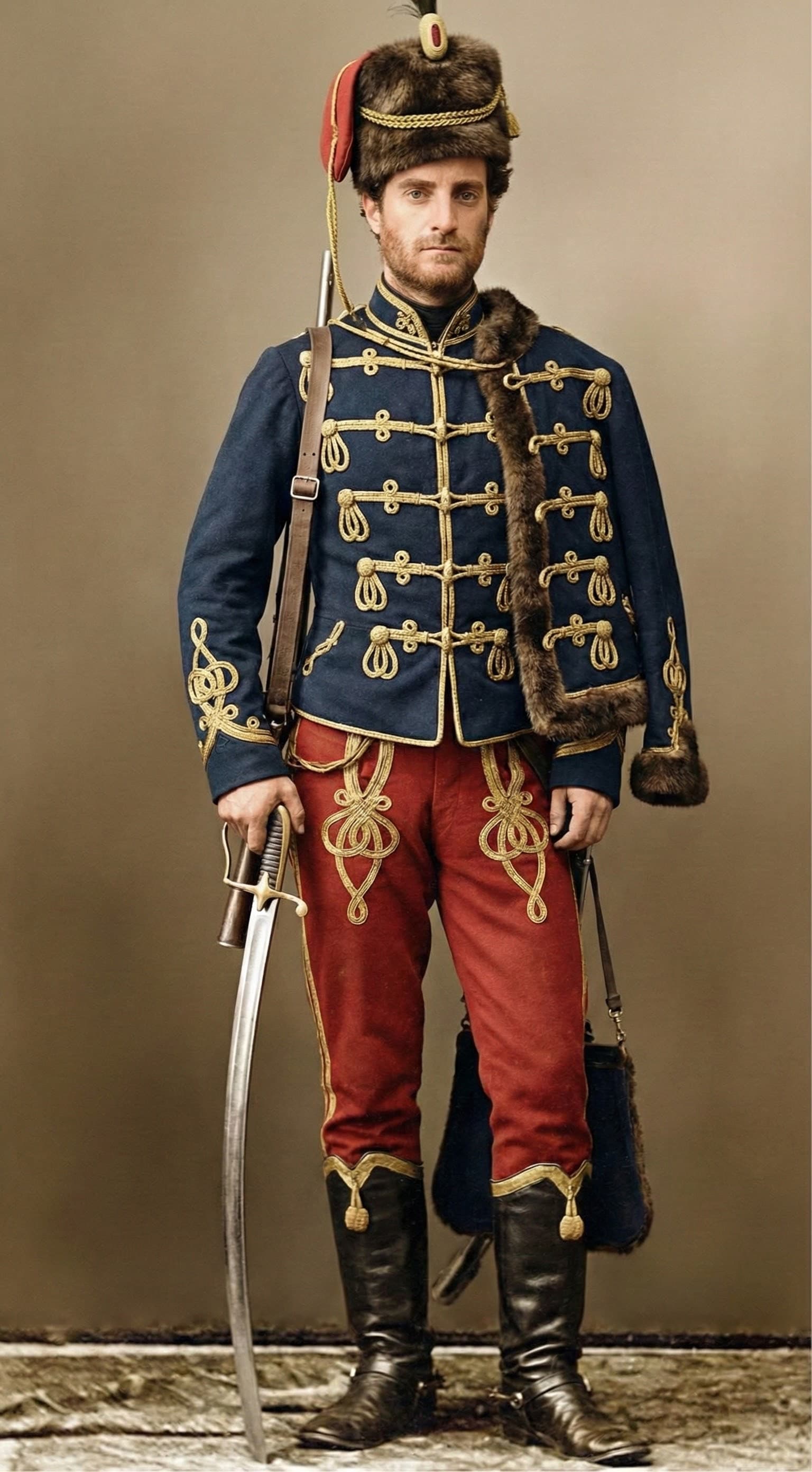
Uniform and equipment
| Uniform | Dolman and pelisse in regimental colors, elaborate braiding |
|---|---|
| Dress uniform | Heavily braided, fur-trimmed, silver/gold cords |
| Headgear | Fur kolpak with bag and plume |
| Equipment | Curved sabre, carbine, pistols |
| Insignia and standard | Hungarian arms (double cross on three hills) on sabretache |
Service record
| First appeared | 1680s |
|---|---|
| Peak strength | 20,000 men |
| Recruited from | Hungarian Horsemen |
| Primary tactic | Reconnaissance / Harassment |
| Signature engagement | Seven Years' War Raids |
| Motto or battle cry | Vitam et sanguinem (Life and blood) |
| Obsolescence | Trench Warfare |
Timeline
- 1688: Regularization. The first regular hussar regiments are officially integrated into the Imperial Austrian Army, transitioning from irregular bandits to elite light cavalry.
- 1741: Insurrectio. Maria Theresa calls for the 'Insurrectio', rallying Hungarian nobility and their hussars to save the dynasty during the War of the Austrian Succession.
- 1757: The Berlin Raid. The zenith of hussar fame; Hadik occupies Berlin, cementing the unit's reputation for unmatched strategic mobility.
- 1805: Napoleonic Decline. At Austerlitz, the traditional hussar tactics struggle against the disciplined mass of the French Grande Armée, marking a shift in cavalry warfare.
- 1848: Revolutionary Split. During the Hungarian Revolution, many hussar regiments defect to fight for Hungarian independence against the Austrian Empire.
Battles
Raid on Berlin
In a masterstroke of humiliation, Hadik slipped past Frederick the Great's armies to seize the Prussian capital. He demanded a ransom of 200,000 thalers and two dozen pairs of gloves for the Empress, proving that hussars could strike the enemy's heart with impunity.
Battle of Kolín
A desperate, bloody engagement where Austrian hussars relentlessly harassed the Prussian flanks. Their constant pressure and screening shattered Prussian cohesion, handing Frederick the Great his first major defeat and saving the Habsburg Monarchy from collapse.
Commanders
Count András Hadik
The archetype of the hussar daredevil. Rising from humble origins to Field Marshal, Hadik possessed a genius for irregular warfare. His audacious capture of Berlin in 1757 with a small raiding party remains the gold standard of light cavalry operations, blending tactical brilliance with sheer bravado.
Dagobert Sigmund von Wurmser
A hardened veteran who cut his teeth in the Seven Years' War. Known for his aggressive instincts and refusal to yield, he led hussars with a grim determination against Revolutionary France, embodying the old-world cavalier spirit in the face of modern warfare.
Tactics
Kleinkrieg (Little War)
A strategy of attrition focusing on raiding supply lines, ambushing convoys, and terrorizing enemy encampments to bleed an army dry without a pitched battle.
The Swarm
Dispersing into a loose cloud to surround enemy infantry, firing carbines and pistols to provoke a formation break before closing in with the sabre.
Screening
Forming a living curtain ahead of the main army to deny the enemy intelligence while gathering crucial reconnaissance on troop movements.