
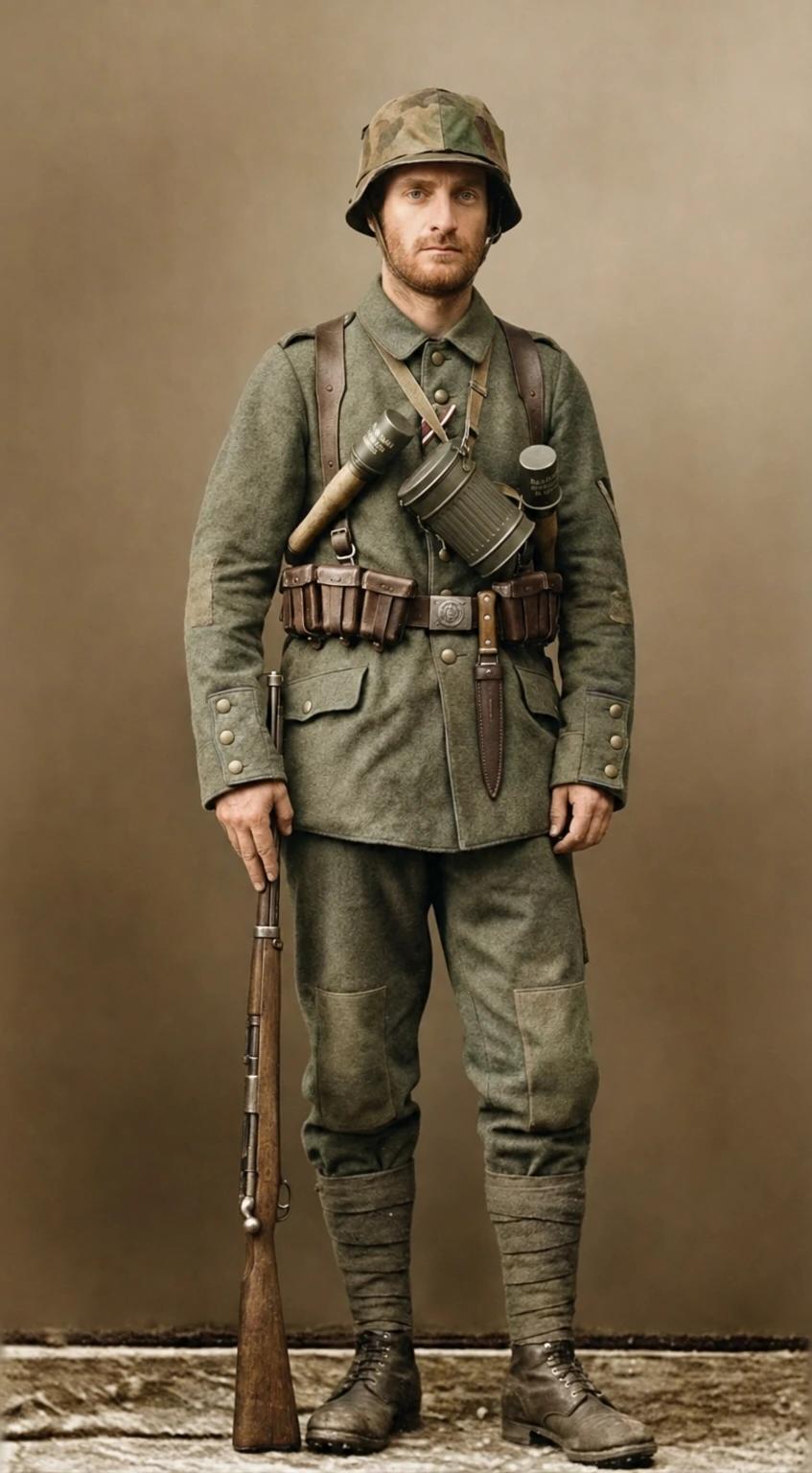
Uniform and equipment
| Uniform | Field grey, reinforced knees/elbows |
|---|---|
| Dress uniform | N/A |
| Headgear | Stahlhelm |
| Equipment | Carbine, grenades (bags of them), trench knife |
| Insignia and standard | None (insignia removed for secrecy) |
Service record
| First appeared | 1915 |
|---|---|
| Peak strength | Elite Battalions |
| Recruited from | Selected Veterans |
| Primary tactic | Infiltration Tactics (Hutier) |
| Signature engagement | Kaiserschlacht (1918) |
| Motto or battle cry | Hinein! (Into them!) |
| Obsolescence | End of WWI |
Timeline
- 1915: Formation of Sturm-Abteilung Calsow. The first experimental assault detachment is formed but misused as standard infantry, suffering heavy casualties.
- 1915: Rohr Takes Command. Captain Willy Rohr assumes command, introducing lightweight cannon, body armor, and shock tactics, creating Sturm-Bataillon No. 5.
- 1916: Verdun Deployment. Stormtroopers see their first major deployment, validating the utility of the flamethrower and grenade-focused assault squads.
- 1917: Battle of Riga. General von Hutier successfully tests infiltration tactics on the Eastern Front, capturing the city with minimal losses.
- 1918: Spring Offensive. Stormtroopers spearhead the massive Kaiserschlacht offensive, breaking the stalemate of trench warfare temporarily.
- 1918: Disbandment. Following the Armistice, units dissolve, though many members join the Freikorps, carrying their brutal tactics into post-war struggles.
Battles
Battle of Verdun
The crucible of the Stormtroopers. Sturm-Bataillon No. 5 proved the efficacy of flamethrowers and hand grenades in clearing fortifications, though the wider offensive bogged down into a horrific war of attrition.
Battle of Caporetto
A masterclass in infiltration. German Stormtroopers, aiding Austro-Hungarian forces, shattered the Italian lines by advancing through mountain valleys in fog, bypassing defenses and capturing thousands.
Operation Michael (Kaiserschlacht)
The zenith of Stormtrooper deployment. Elite units obliterated the British 5th Army front, achieving the greatest advance in the West since 1914, though the strategic breakthrough ultimately failed due to logistical exhaustion.
Commanders
General Oskar von Hutier
A brilliant strategist who integrated Stormtrooper tactics at the army level. His 'Hutier Tactics' emphasized bypassing strongpoints to sever enemy communications, a doctrine successfully proved at Riga and later on the Western Front.
Leutnant Ernst Jünger
A highly decorated platoon leader and author of 'Storm of Steel'. He embodied the ferocious spirit of the trench raider, surviving multiple wounds and earning the Pour le Mérite for his leadership during the 1918 offensives.
Hauptmann Willy Rohr
The father of the Stormtroopers. He transformed the experimental 'Calsow' detachment into the elite Sturm-Bataillon No. 5, developing the specific weapons, body armor, and small-unit shock tactics that defined the Stosstruppen.
Tactics
Infiltration Tactics
Avoiding enemy strongpoints to penetrate deep into rear areas, disrupting command and artillery, leaving isolated pockets for follow-up infantry.
Stoßtrupp (Shock Troop) Organization
Decentralized command where NCOs led small, autonomous squads armed with automatic weapons and grenades, adapting instantly to battlefield conditions.
Rolling Barrage Coordination
Infantry advancing immediately behind a creeping wall of artillery fire (Feuerwalze) to catch defenders before they could emerge from dugouts.