
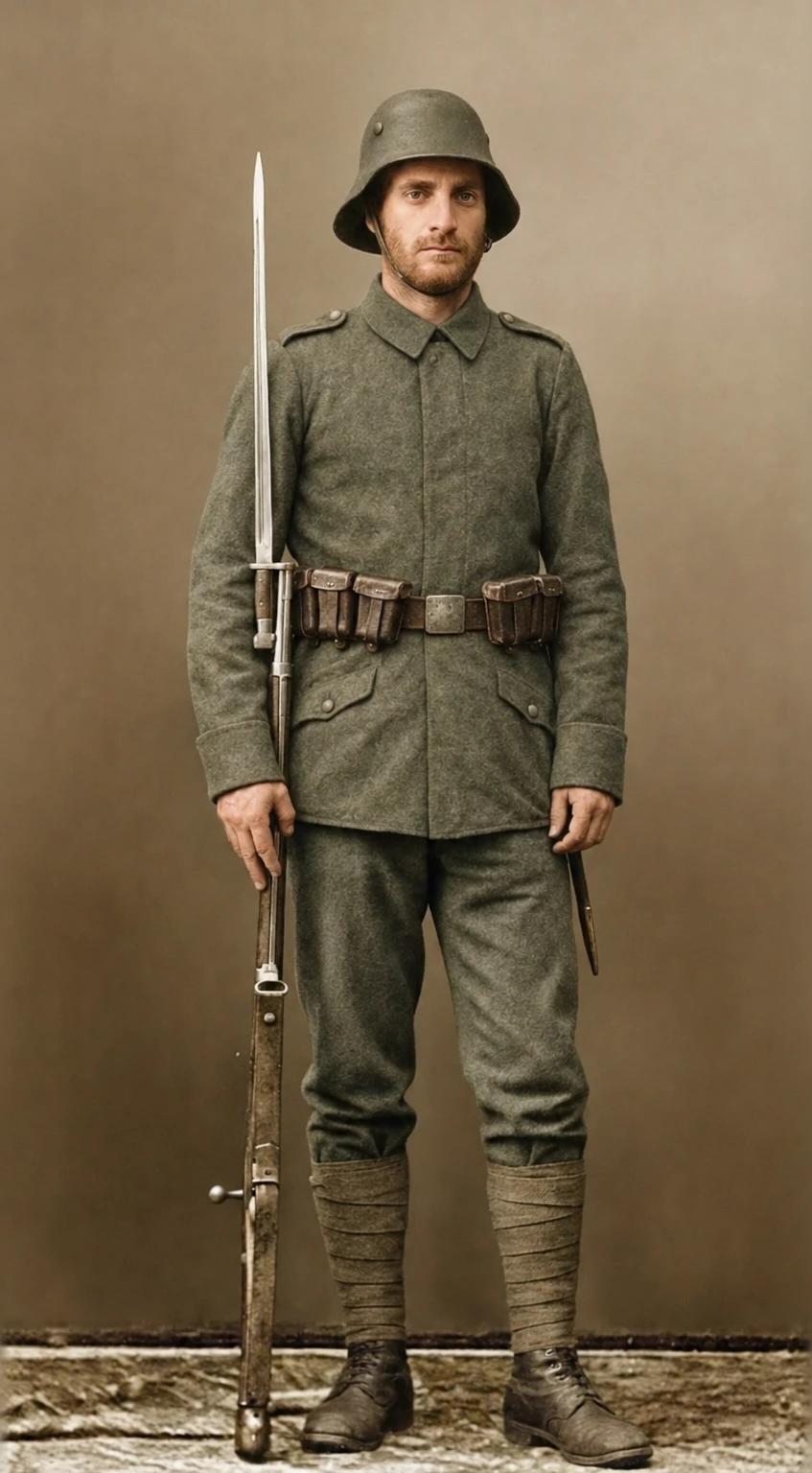
Uniform and equipment
| Uniform | Field-grey M1915 field blouse |
|---|---|
| Dress uniform | N/A |
| Headgear | Plain field-grey M1916 steel helmet |
| Equipment | Mauser, MG08, stick grenade |
| Insignia and standard | Skull or oak leaves (varied) |
Service record
| First appeared | 1918 |
|---|---|
| Peak strength | 500,000 |
| Recruited from | WWI Veterans |
| Primary tactic | Urban Counter-Insurgency |
| Signature engagement | Spartacist Uprising (1919) |
| Motto or battle cry | Nur Tote kehren nicht zurück (Only the dead don't return) |
| Obsolescence | Absorbed into Reichswehr |
Timeline
- 1918: Formation. Following the Armistice, frontline officers form volunteer units from demobilized soldiers to protect the eastern borders and maintain internal order.
- 1919: Spartacist Suppression. Freikorps units are deployed by the SPD government to violently suppress the communist uprising in Berlin.
- 1919: Baltic Campaign. The Iron Division and other units fight in Latvia and Lithuania to prevent Soviet expansion and retain German influence.
- 1920: Kapp Putsch. Brigade Ehrhardt marches on Berlin to overthrow the Weimar Republic. The coup fails due to a general strike, not military defeat.
- 1920: Ruhr Uprising. After the failed Putsch, Freikorps units are redeployed to the Ruhr to ruthlessly crush the Red Ruhr Army.
- 1921: Silesian Uprisings. Freikorps volunteers flock to Upper Silesia to fight Polish insurgents, culminating in the victory at Annaberg.
- 1923: Final Disbandment. Under Allied pressure and internal stabilization, the last units are officially dissolved, though many members join underground factions.
Battles
Spartacist Uprising
In a brutal display of urban warfare, Freikorps units retook Berlin from communist revolutionaries. Using artillery and stormtrooper tactics in the city center, they crushed the uprising, securing the Weimar government's survival at the cost of street-level carnage.
Liberation of Munich
30,000 Freikorps troops, including the Ehrhardt Brigade, encircled and stormed Munich to overthrow the Bavarian Soviet Republic. The fighting was vicious and merciless, effectively ending the communist experiment in Bavaria through overwhelming force.
Battle of Cēsis
The Baltische Landeswehr and Iron Division clashed with Estonian and Latvian forces. Overextended and fighting a multi-front war far from home, the German paramilitaries were forced to retreat, marking the beginning of the end for their Baltic ambitions.
Battle of Annaberg
German irregulars stormed the strategic Annaberg hill against Polish insurgents. Despite being outnumbered and officially disavowed by Berlin, the Freikorps utilized superior WWI trench experience to seize the high ground in their final major engagement.
Commanders
Hermann Ehrhardt
A charismatic and uncompromising naval commander who led the fierce Marinebrigade Ehrhardt. Known for his vehement anti-republican stance, he commanded one of the most disciplined and feared units, playing a central role in the Kapp Putsch.
Waldemar Pabst
The ruthless General Staff officer of the Garde-Kavallerie-Schützen-Division. He orchestrated the crushing of the Spartacist Uprising in Berlin, prioritizing order over law in the chaotic vacuum of post-war Germany.
Rüdiger von der Goltz
A Prussian General who refused to lay down arms after 1918. As commander of the 'Iron Division' in the Baltics, he waged a private war against Bolsheviks and nationalists alike, envisioning a German-dominated East.
Tactics
Stoßtrupptaktik (Stormtrooper Tactics)
Adapted from WWI, small, heavily armed squads infiltrated enemy lines to destroy command centers and heavy weapons, bypassing strongpoints for follow-up waves.
Urban Counter-Insurgency
Ruthless house-to-house clearing operations utilizing flamethrowers, grenades, and armored cars to dismantle barricades and neutralize revolutionary cells.
Motorized Raids
The use of trucks and armored cars (Panzerwagen) to rapidly deploy firepower across city districts, outmaneuvering static insurgent mobs.