
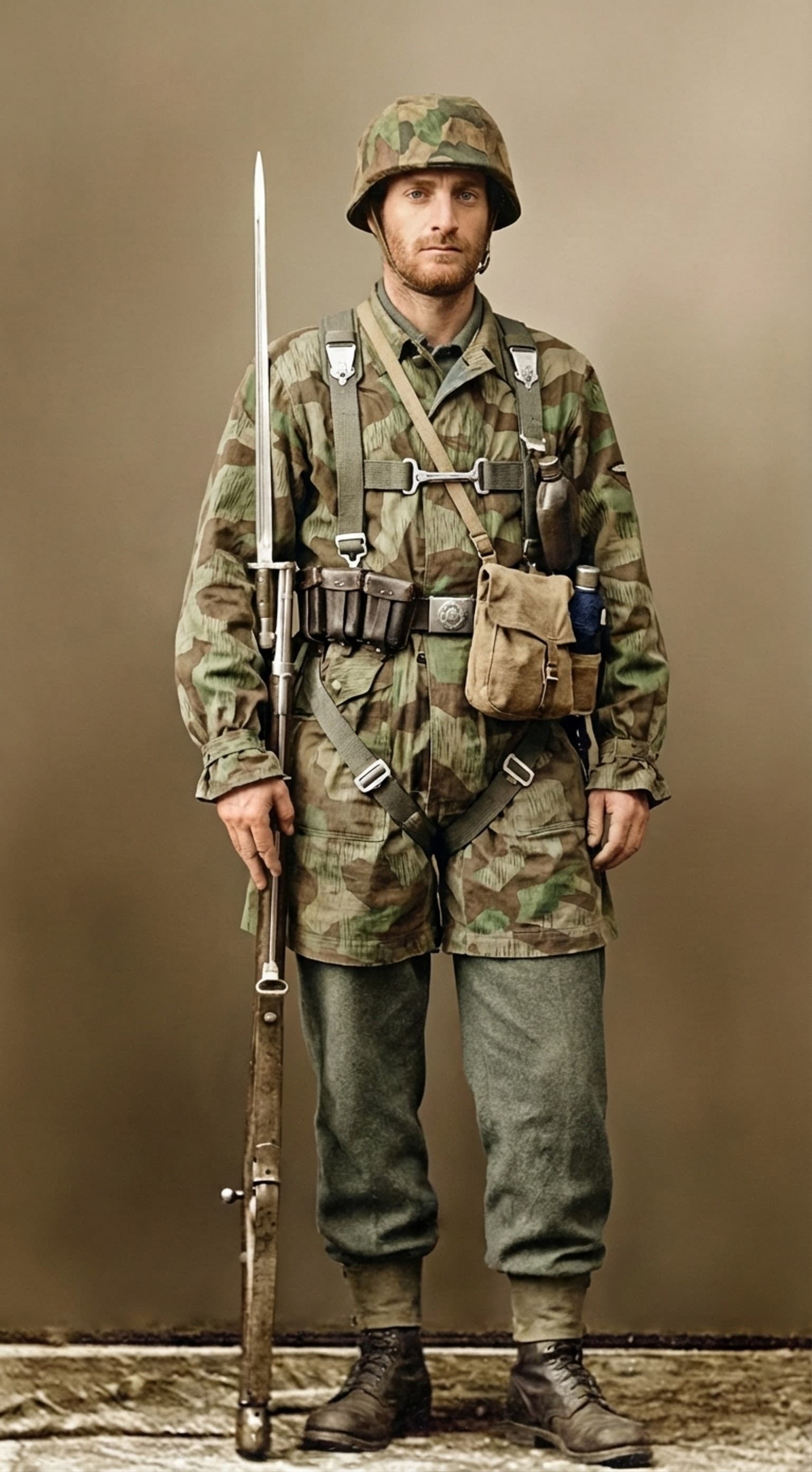
Uniform and equipment
| Uniform | Field-gray jump smock (Knochensack) over tunic, paratrooper boots |
|---|---|
| Dress uniform | Smarter tunic with badges, paratrooper qualification insignia |
| Headgear | Distinctive paratrooper steel helmet with reduced brim |
| Equipment | Rifle (Kar98k) or MP40, grenades, fighting knife, parachute gear |
| Insignia and standard | Diving eagle jump badge |
Service record
| First appeared | 1938 |
|---|---|
| Peak strength | ~100,000 men |
| Recruited from | Volunteers (Luftwaffe Elite) |
| Primary tactic | Airborne Assault / Light Infantry |
| Signature engagement | Battle of Crete (1941) |
| Motto or battle cry | Treue um Treue (Loyalty for Loyalty) |
| Obsolescence | Loss of Air Superiority / Helicopter Assault |
Timeline
- 1936: Formation. General Kurt Student begins the organization of the first German parachute infantry units.
- 1940: Western Campaign. Fallschirmjäger execute shock glider assaults in Belgium and the Netherlands, proving the efficacy of airborne troops.
- 1941: Operation Mercury. The invasion of Crete results in a strategic victory but horrific losses, shifting the unit's role from airborne to elite ground infantry.
- 1943: Gran Sasso Raid. A daring glider rescue of Benito Mussolini showcases the unit's continued capability for special operations.
- 1944: Defense of Normandy. The 6th Fallschirmjäger Regiment engages US paratroopers at Carentan in brutal hedgerow fighting.
- 1945: Dissolution. Remaining units surrender as the Third Reich collapses, having fought on all fronts.
Battles
Battle of Fort Eben-Emael
In a stunning display of glider-borne warfare, a small force of Fallschirmjäger neutralized the 'impregnable' Belgian fortress in hours, blowing open the path for the Blitzkrieg into the West.
Battle of Crete (Operation Mercury)
The first ever large-scale airborne invasion. While the island was captured, the catastrophic casualty rate among the elite jumpers shocked Hitler, effectively ending major German airborne operations for the war.
Battle of Monte Cassino
Fighting as elite ground infantry, the Fallschirmjäger held the ruined monastery against repeated Allied assaults for months, earning the nickname 'Green Devils' for their ferocious defensive tenacity.
Commanders
Kurt Student
The architect of Germany's airborne forces. A visionary strategist who pioneered vertical envelopment, Student led the Fallschirmjäger from their inception. Though his career was marred by the heavy losses at Crete, his doctrine revolutionized modern warfare.
Hermann-Bernhard Ramcke
A tenacious and aggressive commander known for holding impossible positions. From the sands of North Africa to the fortress of Brest, Ramcke's leadership epitomized the 'Green Devils' reputation for stubborn, elite infantry defense.
Tactics
Vertical Envelopment
Dropping troops directly onto or behind key objectives (bridges, forts) to seize them before the enemy can react or destroy them.
Glider Insertion
Using silent gliders to land heavy equipment and shock troops with pinpoint accuracy, often at dawn to achieve total surprise.
Weapon Canisters
Dropping primary weapons in separate canisters to reduce jump weight, forcing troops to aggressively sprint to gear upon landing.
Elastic Defense
Utilized later in the war; yielding ground to stretch enemy lines before snapping back with ferocious counter-attacks.