
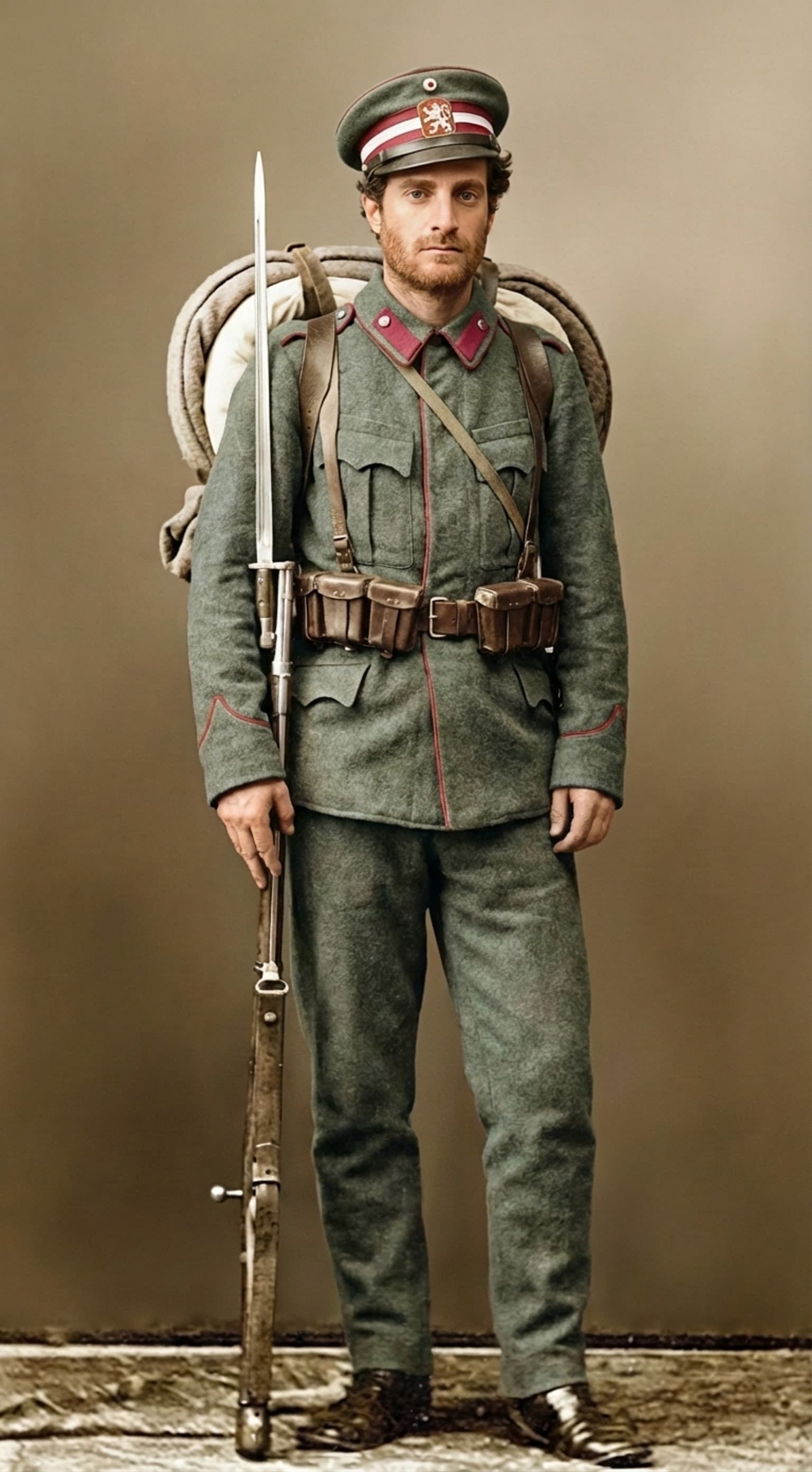
Uniform and equipment
| Uniform | Mixed Russian/French uniforms |
|---|---|
| Dress uniform | N/A |
| Headgear | Russian cap or French bonnet |
| Equipment | Mosin-Nagant, Maxim gun |
| Insignia and standard | Red Hussite chalice badge |
Service record
| First appeared | 1914 |
|---|---|
| Peak strength | 60,000 men |
| Recruited from | POWs / Volunteers |
| Primary tactic | Armored Train Warfare |
| Signature engagement | Trans-Siberian Railway Control |
| Motto or battle cry | Věrni zůstaneme (We shall remain faithful) |
| Obsolescence | Return to Czechoslovakia (1920) |
Timeline
- 1914: Formation of Česká družina. A small unit of Czech volunteers is formed within the Imperial Russian Army to fight Austria-Hungary.
- 1917: Battle of Zborov. The unit expands to a brigade and proves its combat effectiveness, leading to the removal of recruitment limits.
- 1918: Revolt of the Legions. Following the Treaty of Brest-Litovsk and the Chelyabinsk Incident, the Legion turns against the Bolsheviks to secure passage to Vladivostok.
- 1918: Railway Control. By late summer, the Legion controls the entire length of the Trans-Siberian Railway, effectively ruling Siberia.
- 1920: Evacuation. After an armistice with the Bolsheviks, the last Legionnaires evacuate from Vladivostok, completing their 'Anabasis' around the world.
Battles
Battle of Zborov
The Legion's baptism of fire. Despite being outnumbered, three Czech regiments overran Austro-Hungarian positions that had stalled the Russians. This victory legitimized the Czechoslovak independence movement in the eyes of the Entente and boosted recruitment.
Battle of Bakhmach
A desperate defensive action. The Legion held off superior German forces for several days to secure the vital railway junction, allowing their evacuation trains to escape eastward into Russia before the German encirclement could close.
Capture of Kazan
In a stunning offensive, the Legion seized Kazan from the Red Army. Crucially, they captured the Imperial Russian Gold Reserve, which became a massive bargaining chip in the chaotic politics of the Russian Civil War and funded their continued operations.
Chelyabinsk Incident
A brawl between Legionnaires and Hungarian POWs escalated into open conflict with local Bolsheviks. The Legion seized the city's artillery and railway station, marking the start of the open revolt and the campaign to control the Trans-Siberian Railway.
Commanders
Radola Gajda
A charismatic and aggressive tactician, Gajda led the eastern push along the Trans-Siberian Railway. His daring maneuvers secured key cities like Irkutsk and Yekaterinburg. Though controversial for his ambition, his leadership was pivotal in linking the fragmented Legion groups.
Stanislav Čeček
Commander of the Penza Group, Čeček famously declared that the Legion's path to Prague lay through Vladivostok. He orchestrated the initial uprising against the Bolsheviks in the Volga region, turning a desperate retreat into a disciplined military campaign.
Jan Syrový
Known as the 'One-Eyed Žižka,' Syrový lost his right eye at the Battle of Zborov. Rising from a humble architect to General, he commanded the entire Legion during the arduous Siberian Anabasis, balancing military necessity with the political survival of a nation not yet on the map.
Tactics
Armored Train Warfare
The Legion improvised heavily armed trains (like the 'Orlík') with artillery and machine guns, using them as mobile fortresses to dominate the vast Russian steppes along the railway lines.
Echelon Defense
Units lived and fought from 'echelons' (troop trains). Tactics involved rapid deployment from carriages to repel attacks on the tracks and combat engineering to repair sabotaged rails under fire.
Mobile Skirmishing
Lacking heavy cavalry, they utilized aggressive infantry skirmishing tactics to flank static Red Army positions, often striking communication lines before fading back to the railway.