
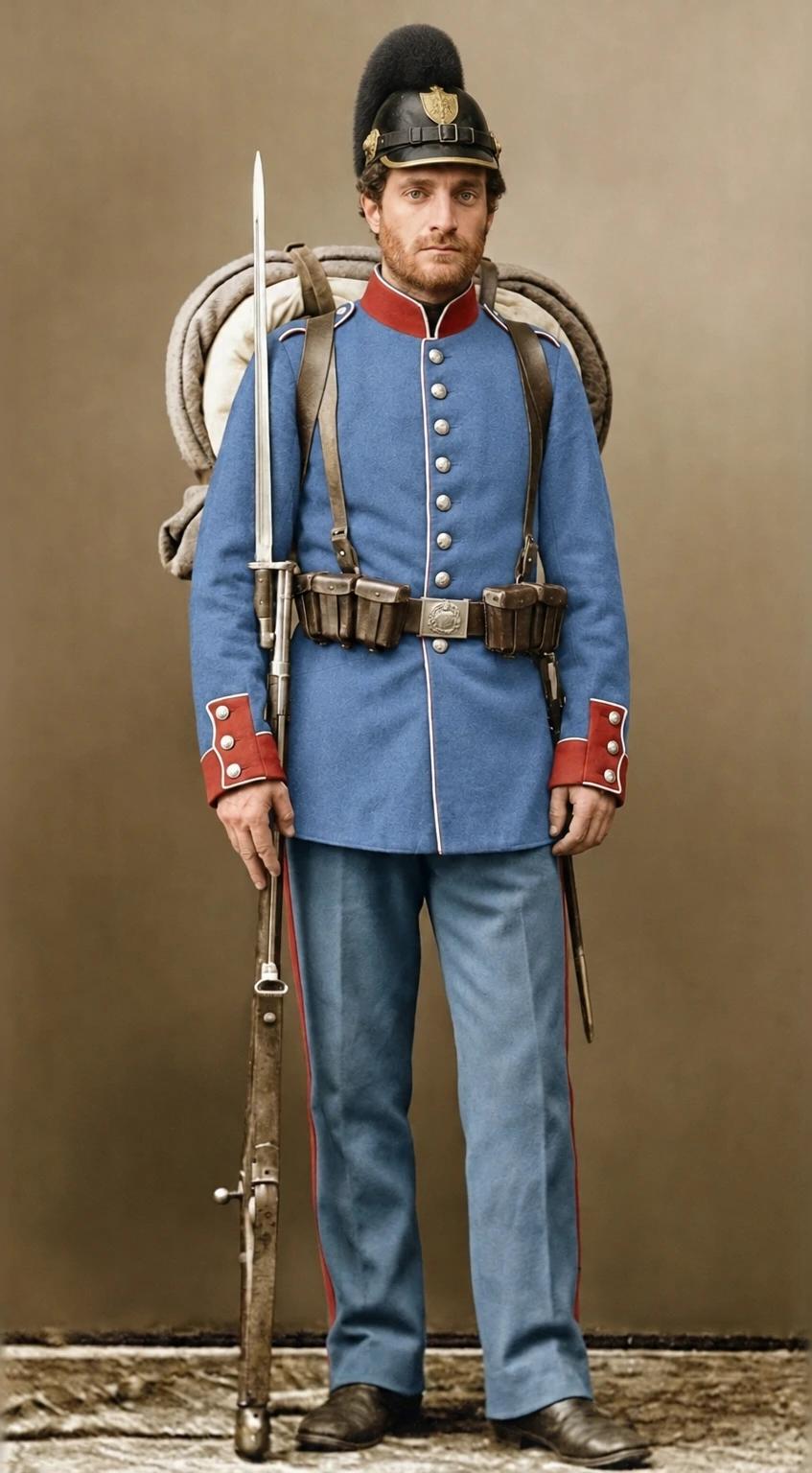
Uniform and equipment
| Uniform | Light blue coat, red facings, white trousers |
|---|---|
| Dress uniform | Light blue coat with rich silver lace, white belts, parade sash |
| Headgear | Raupenhelm crested helmet with woolen crest |
| Equipment | Musket, bayonet, officer sword |
| Insignia and standard | Crowned double-L cypher or crown |
Service record
| First appeared | 1814 |
|---|---|
| Peak strength | ~3,000 men |
| Recruited from | Elite Bavarian Conscripts |
| Primary tactic | Line Infantry Shock |
| Signature engagement | Franco-Prussian War (1870) |
| Motto or battle cry | In Treue Fest (Firm in Fidelity) |
| Obsolescence | End of Monarchy (1918) |
Timeline
- 1814: Formation. Established as the Grenadier-Garde-Regiment, the precursor to the Royal household guard.
- 1826: Royal Designation. Officially renamed the 'Infanterie-Leib-Regiment' by King Ludwig I, cementing its status as the King's Own.
- 1866: Austro-Prussian War. Fought against Prussia; a bitter defeat that led to military reforms and the adoption of breech-loading rifles.
- 1870: Franco-Prussian War. The regiment earns legendary status at Wörth and Sedan, leading to the proclamation of the German Empire.
- 1915: Alpenkorps Integration. Transformed from line infantry into elite mountain troops, deploying to the Dolomites and Serbia.
- 1919: Dissolution. Following the fall of the Bavarian monarchy and the end of WWI, the regiment is demobilized.
Battles
Battle of Wörth
The regiment's baptism of fire in the Franco-Prussian War. Despite suffering horrific casualties from French Chassepot fire, the Bavarians stormed the heights of Fröschwiller with fixed bayonets, breaking the French line through sheer grit and momentum.
Battle of Sedan
The decisive engagement where the Leibregiment helped seal the encirclement of Napoleon III's army. They held the critical Bazeilles sector against desperate French marine counter-attacks, fighting house-to-house in a brutal display of urban warfare.
Battle of Caporetto
Re-trained as mountain troops within the Alpenkorps, the Leibregiment spearheaded the breakthrough against Italian lines. Utilizing infiltration tactics in rugged terrain, they captured key peaks and thousands of prisoners, proving their elite adaptability.
Commanders
Crown Prince Rupprecht of Bavaria
A soldier-prince who served in the ranks of the Leibregiment before commanding army groups. A tactical pragmatist, he led Bavarian troops through the meat-grinder of the Western Front, maintaining the regiment's prestige even as the old world crumbled.
Prince Regent Luitpold of Bavaria
The beloved patriarch of the Bavarian Army. Though a royal figurehead, his patronage transformed the Leibregiment into an elite praetorian guard. He embodied the regiment's spirit: fierce loyalty to the Wittelsbach crown and unyielding discipline under fire.
Tactics
Bayonet Shock Charge
A 19th-century staple where the regiment utilized massed formations and aggression to overrun defensive positions, famously used at Wörth.
Alpine Infiltration
Adopted in WWI; small, autonomous stormtrooper units utilized terrain cover to bypass strongpoints and attack rear areas.
Rapid Volley Fire
Leveraging the Werder rifle's falling-block mechanism to produce a higher volume of fire than contemporary bolt-action systems.