
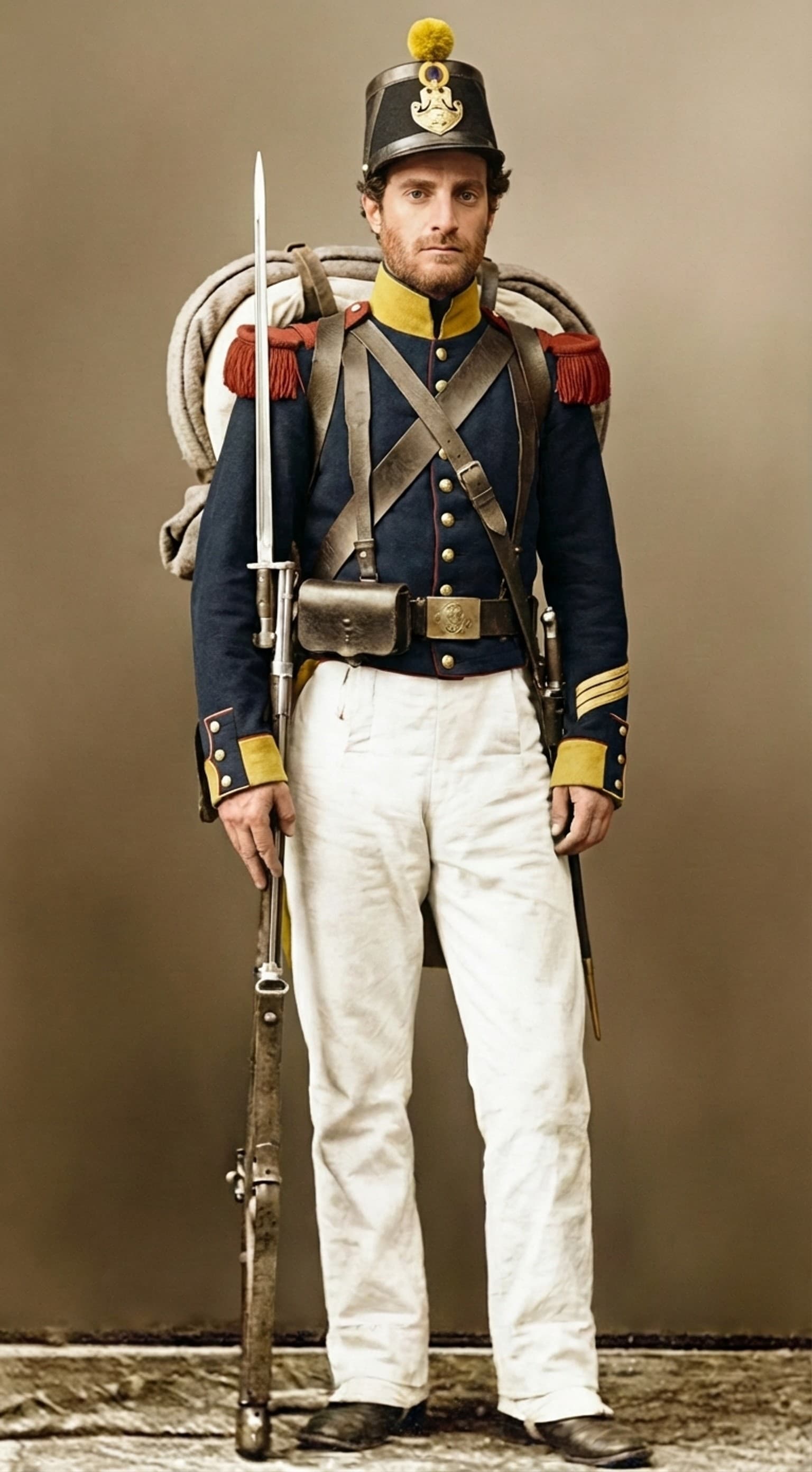
Uniform and equipment
| Uniform | Blue coat, yellow collar/epaulettes |
|---|---|
| Dress uniform | Blue with yellow facings |
| Headgear | Shako with yellow plume |
| Equipment | Dragoon musket (lighter), short sword |
| Insignia and standard | Brass hunting horn on shako and collar |
Service record
| First appeared | 1804 |
|---|---|
| Peak strength | One company per battalion |
| Recruited from | Small, agile men |
| Primary tactic | Skirmish Screen |
| Signature engagement | Battle of Wagram (1809) |
| Motto or battle cry | Vive l'Empereur! (Long live the Emperor) |
| Obsolescence | Post-Napoleonic Changes |
Timeline
- 1804: Formation. Napoleon decrees the creation of Voltigeur companies to be attached to every Light and Line infantry battalion, intended to vault onto cavalry horses for rapid deployment.
- 1805: Battle of Austerlitz. Voltigeurs prove their worth not as horse-mounted infantry, but as supreme foot skirmishers, harassing the Allies on the Pratzen Heights.
- 1808: Peninsular War Deployment. Voltigeurs are heavily committed to Spain, where their independent fighting style is tested against British Rifles and Spanish guerrillas.
- 1812: Russian Campaign. The unit suffers catastrophic losses due to cold and attrition but remains the cohesive backbone of the rearguard during the retreat.
- 1815: Disbandment. Following Napoleon's final defeat at Waterloo and the Second Bourbon Restoration, the Imperial Voltigeur companies are dissolved.
Battles
Battle of Friedland
Ney's corps, spearheaded by aggressive Voltigeur skirmishing, stormed the town of Friedland. Their ability to navigate the broken terrain and urban environment was crucial in trapping the Russian army against the Alle River.
Battle of Wagram
In a massive clash of artillery and infantry, Voltigeurs formed dense skirmish clouds to screen Macdonald's famous column. They absorbed withering Austrian fire, allowing the heavy infantry to break the enemy center.
Battle of Waterloo
Voltigeurs fought desperately in the woods of Hougoumont and the streets of Plancenoit. Despite their tactical brilliance in cover, they were eventually overwhelmed by the sheer weight of Allied numbers and the arrival of the Prussians.
Commanders
Marshal Michel Ney
Known as 'The Bravest of the Brave,' Ney relied heavily on the agility of Voltigeurs during the harrowing Retreat from Moscow. He often commanded the rearguard personally, rifle in hand, utilizing these skirmishers to hold back swarms of Cossacks.
Marshal Nicolas Oudinot
A master of elite infantry tactics, Oudinot frequently aggregated Voltigeur companies into ad-hoc elite battalions. His aggressive leadership style suited the Voltigeur spirit, leading them into the thickest fighting at Wagram and Berezina.
Tactics
Skirmish Screen (La Chaîne)
Deployed in loose pairs ahead of the main line, Voltigeurs utilized terrain for cover to harass enemy formations, targeting officers and artillery crews to disrupt cohesion before the main assault.
Grand Bandes
In later years, commanders would strip Voltigeur companies from their parent battalions to form massive ad-hoc light infantry divisions capable of swarming enemy positions with overwhelming fire.
Independent Fire
Unlike line infantry who fired in volleys, Voltigeurs were trained to fire at will (feu de billebaude), prioritizing accuracy and target selection over massed weight of shot.