
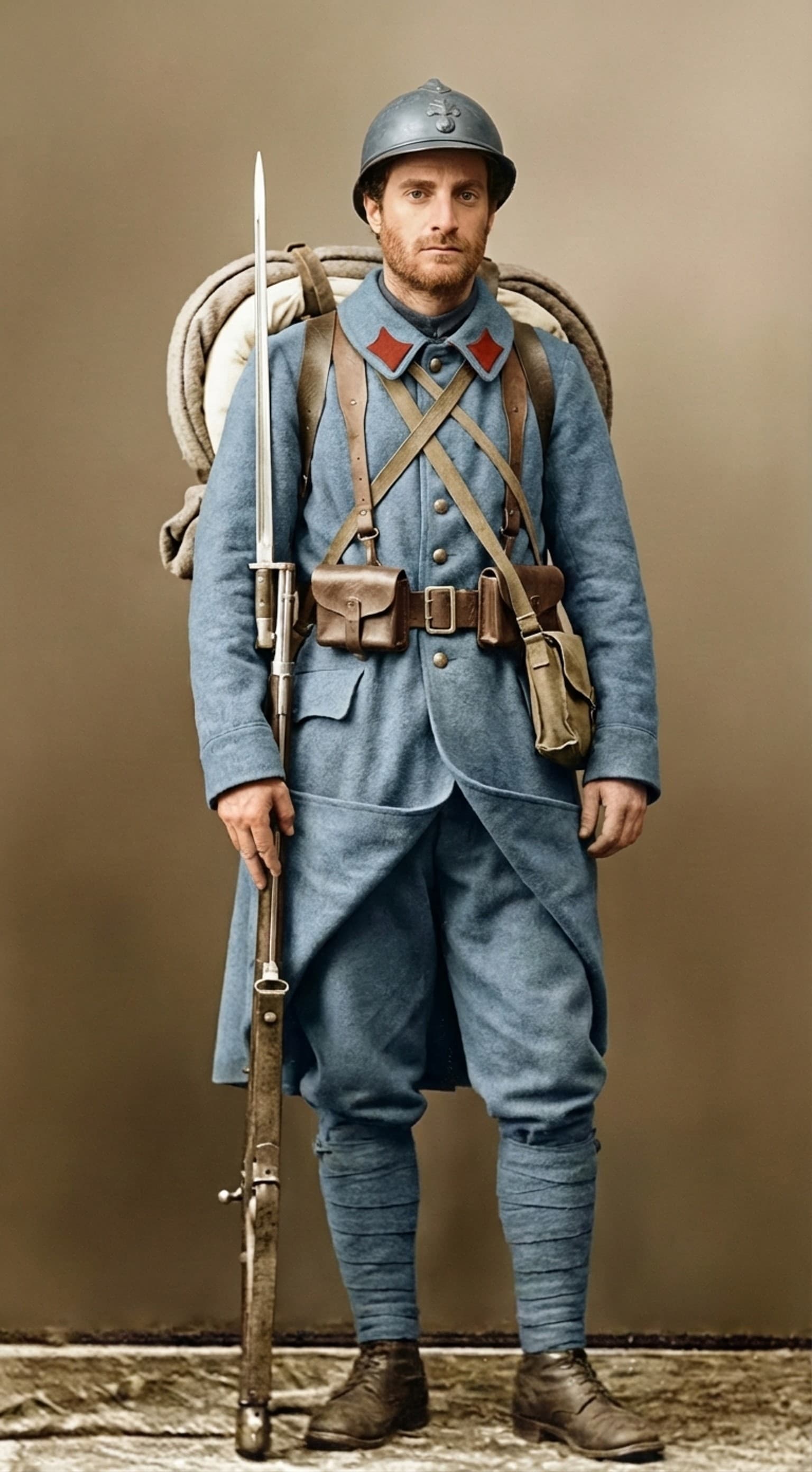
Uniform and equipment
| Uniform | Horizon Blue coat and trousers |
|---|---|
| Dress uniform | N/A |
| Headgear | Adrian Helmet |
| Equipment | Lebel rifle, bayonet (Rosalie) |
| Insignia and standard | Adrian helmet flaming grenade with RF |
Service record
| First appeared | 1914 |
|---|---|
| Peak strength | Millions |
| Recruited from | Conscripts |
| Primary tactic | Trench Defense / Assault |
| Signature engagement | Battle of Verdun (1916) |
| Motto or battle cry | Ils ne passeront pas! (They shall not pass!) |
| Obsolescence | End of WWI |
Timeline
- 1914: General Mobilization. France calls up millions of reservists; soldiers march to war in antiquated red trousers expecting a short conflict.
- 1914: Race to the Sea. The solidification of the Western Front into a continuous line of trenches from the Swiss border to the North Sea.
- 1915: Uniform Reform. Adoption of the 'Horizon Blue' uniform and Adrian helmet to modernize the army's appearance and camouflage.
- 1916: The Hell of Verdun. The French army is rotated through the Verdun sector, exposing nearly every division to the intense attrition.
- 1917: Army Mutinies. Following the failed Nivelle Offensive, soldiers refuse to attack, demanding better conditions and an end to wasted lives.
- 1918: Armistice. Germany signs the armistice; the Poilu emerges victorious but scarred, having suffered the highest casualty rate of the Allies.
Battles
First Battle of the Marne
A desperate counter-attack that halted the German advance on Paris. The Poilus, exhausted from retreat, turned and fought with ferocious determination, ending the Schlieffen Plan and saving the capital.
Battle of Verdun
The longest battle of the war. Under the mantra 'Ils ne passeront pas' (They shall not pass), the French army endured ten months of hellish artillery bombardment to hold their historic fortresses against the German onslaught.
Second Battle of the Aisne
The disastrous Nivelle Offensive. Promised a breakthrough, the Poilus were massacred by machine guns on the steep slopes. The futility of the attack sparked widespread mutinies across the French army.
Commanders
Philippe Pétain
Known as the 'Lion of Verdun,' Pétain masterminded the rotation system (Noria) that kept the French army from collapsing under German artillery. He later restored morale after the 1917 mutinies by improving conditions for the common soldier.
Joseph Joffre
Affectionately called 'Papa Joffre,' his calm demeanor during the catastrophic opening months of the war rallied the retreating French forces to turn the tide at the Miracle of the Marne.
Ferdinand Foch
The Supreme Allied Commander who embodied the offensive spirit. His coordination of the Allied armies during the Hundred Days Offensive finally broke the stalemate and led to the German surrender.
Tactics
Rolling Barrage
Infantry advanced immediately behind a moving curtain of artillery fire to suppress enemy defenses before they could man their machine guns.
Trench Raiding
Small, heavily armed groups (Nettoyeurs de tranchées) infiltrated enemy lines at night to capture prisoners, gather intelligence, and sow terror.
Elastic Defense
A doctrine adopted later in the war involving a lightly manned front line to absorb shock, with the main resistance force held in reserve for counter-attacks.