
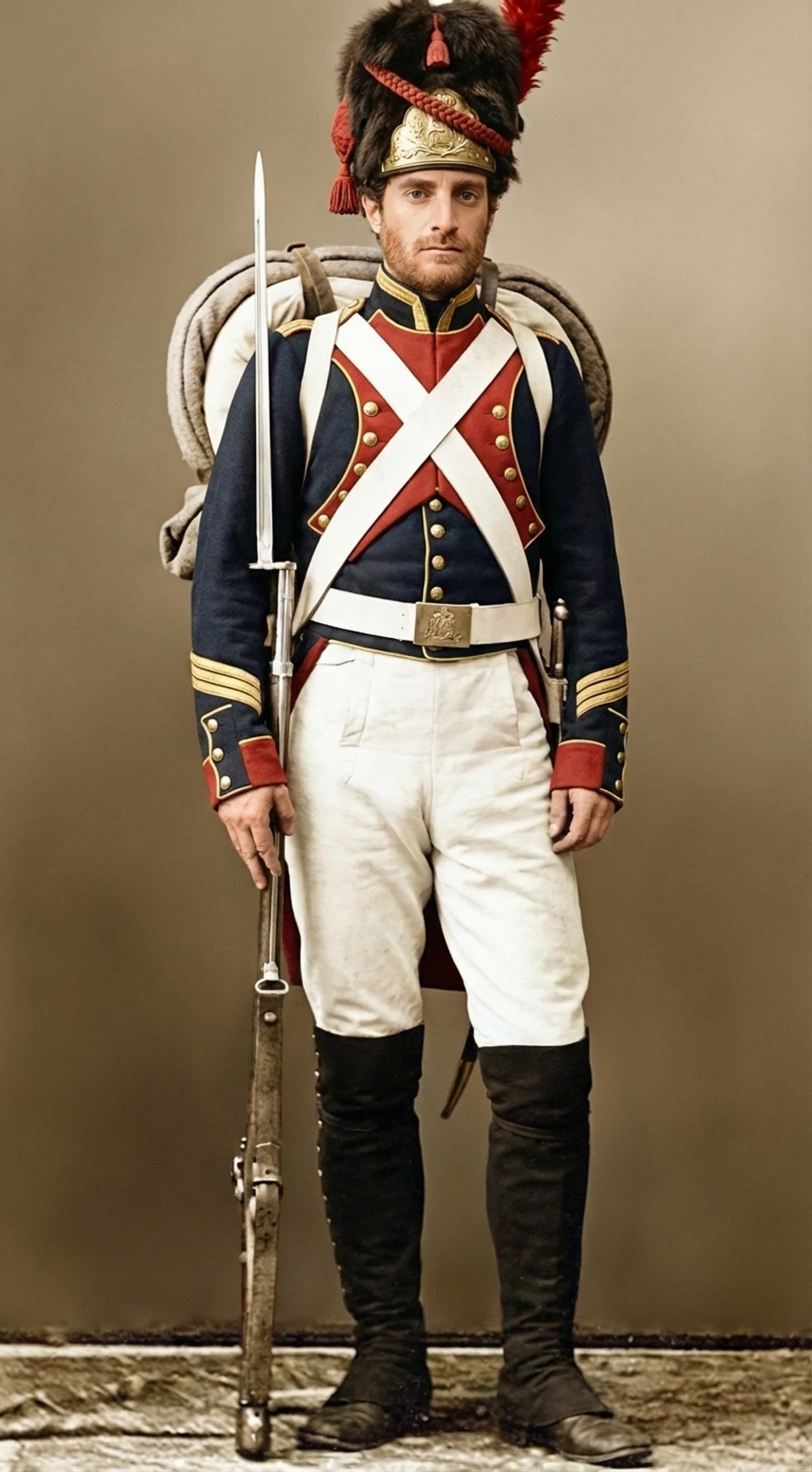
Uniform and equipment
| Uniform | Dark blue tunic, orange facings, white belts |
|---|---|
| Dress uniform | Blue tunic with extensive gold embroidery, orange sash, medals |
| Headgear | Tall bearskin with orange plume |
| Equipment | Rifle, bayonet, short sword for NCOs |
| Insignia and standard | Flaming grenade with W |
Service record
| First appeared | 1829 |
|---|---|
| Peak strength | ~1,500 men |
| Recruited from | Selected Volunteers |
| Primary tactic | Ceremonial / Elite Reserve |
| Signature engagement | Ten Days' Campaign (1831) |
| Motto or battle cry | Je Maintiendrai (I will maintain) |
| Obsolescence | N/A (Still Active) |
Timeline
- 1829: Formation. The Grenadiers and Jagers are officially established as a distinct Guard formation under King William I.
- 1830: Belgian Revolution. The unit is deployed to Brussels to quell riots, facing urban combat and hostile crowds.
- 1831: Ten Days' Campaign. The Grenadiers spearhead the invasion of Belgium, achieving rapid victories before French intervention.
- 1832: Defense of Antwerp. Elements of the Guard defend the Citadel of Antwerp against the French Army of the North.
- 1849: Royal Funeral. The Grenadiers provide the honor guard for the funeral of their beloved commander, King William II.
- 1995: Amalgamation. Historical lineage continues as the Garderegiment Grenadiers en Jagers is formed from older regiments.
Battles
Ten Days' Campaign
A lightning offensive where Dutch Grenadiers crushed Belgian volunteer armies. They spearheaded assaults at Hasselt and Leuven, displaying ruthless efficiency and restoring Dutch military prestige after the initial revolution.
Battle of Ravels
An early engagement of the Ten Days' Campaign where the Grenadiers routed Belgian forces in the woods, demonstrating their superiority in skirmishing and close-quarters bayonet fighting.
Siege of Antwerp
A heroic defense against a massive French expeditionary force. Outnumbered and under heavy artillery bombardment, the Grenadiers held the citadel for weeks in appalling conditions, surrendering only when the fortress was reduced to rubble.
Commanders
King William II (The Prince of Orange)
Known as the 'Hero of Waterloo', he commanded the Dutch forces during the Ten Days' Campaign. A charismatic and daring leader, he often exposed himself to enemy fire to inspire his Grenadiers, embodying the reckless courage expected of the Guard.
Duke Bernhard of Saxe-Weimar-Eisenach
A seasoned veteran of Waterloo who commanded the Dutch forces during the Belgian Revolution. His iron discipline and tactical acumen turned the Grenadiers into a bulwark against the Belgian rebels, ensuring the unit's reputation for unyielding defense.
Tactics
Shock Column
Utilizing their physical size and morale, Grenadiers formed dense columns to punch through enemy lines after softening them with volley fire.
Controlled Volley
Strict fire discipline allowed them to unleash devastating close-range volleys, often holding fire until they could see the whites of the enemy's eyes.
Elite Reserve
Held back during the initial phases of battle, they were deployed at the critical moment to turn the tide or cover a retreat.