
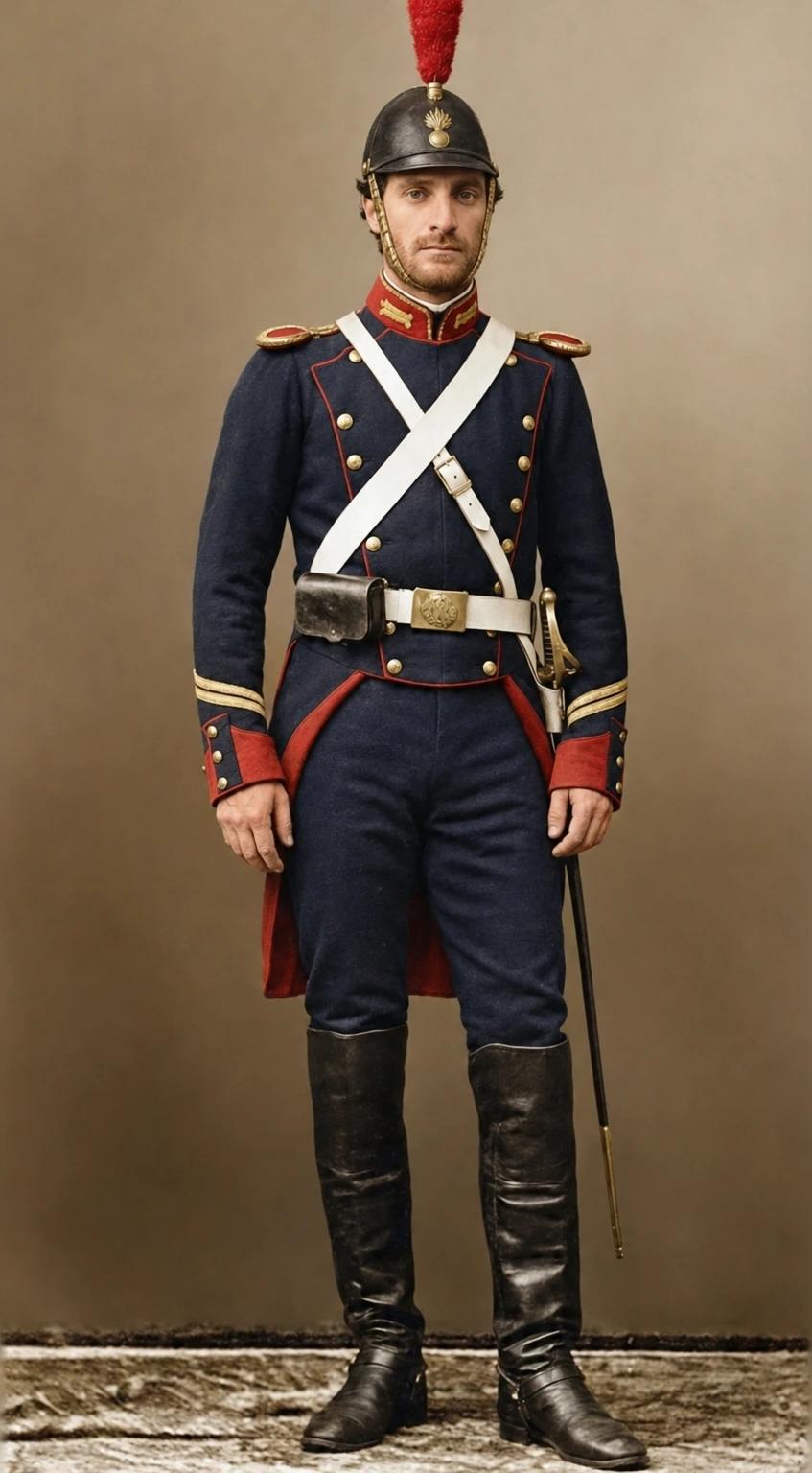
Uniform and equipment
| Uniform | Dark blue coatee with red facings, white crossbelts |
|---|---|
| Dress uniform | Napoleonic-style dark blue with red, white breeches, high boots |
| Headgear | Simple peaked helmet with grenade badge, scaled chinstraps and scarlet plume |
| Equipment | Sabre, carbine, lance in some periods |
| Insignia and standard | Brass flaming grenade on tall leather helmet |
Service record
| First appeared | 1812 |
|---|---|
| Peak strength | 1,000–1,500 men |
| Recruited from | Patriot Volunteers |
| Primary tactic | Shock Charge |
| Signature engagement | Battle of San Lorenzo (1813) |
| Motto or battle cry | Seamos libres, que lo demás no importa (Let us be free; the rest does not matter) |
| Obsolescence | Mechanization (Role Shifted to Ceremonial) |
Timeline
- 1812: Regiment Formation. San Martín establishes the regiment in Buenos Aires, implementing rigid discipline and a strict code of honor.
- 1813: Baptism of Fire. The unit achieves its first victory at the Battle of San Lorenzo, securing the Paraná River banks.
- 1817: Crossing of the Andes. The regiment leads the Army of the Andes through the highest mountain range in the Americas to liberate Chile.
- 1824: Final Campaigns. The Grenadiers fight in the decisive battles of Junín and Ayacucho, ending Spanish rule in South America.
- 1826: Return and Disbandment. The surviving 78 veterans return to Buenos Aires. The unit is disbanded as no recruits are deemed worthy to replace the fallen.
- 1903: Reconstitution. The regiment is reformed as the Presidential Guard of Argentina, a role it maintains to this day.
Battles
Battle of San Lorenzo
The regiment's baptism of fire. In a dawn raid, San Martín's cavalry crushed a Spanish landing force. The battle is legendary for the heroism of Sergeant Cabral, who died saving San Martín after the commander's horse was pinned.
Battle of Chacabuco
Following the grueling Crossing of the Andes, the Grenadiers executed a decisive pincer movement. Their charge broke the Royalist infantry squares, securing the liberation of Santiago and validating San Martín's continental strategy.
Battle of Riobamba
A brilliant display of cavalry superiority. Under Lavalle, 96 Grenadiers defeated over 400 Royalist horsemen in a series of charges, demonstrating that skill and morale could overcome overwhelming numerical odds.
Battle of Junín
Known as the 'Battle of the Silent Sabres'. Fought entirely on horseback with cold steel and no shots fired, the Grenadiers turned a near-defeat into a crushing victory in the freezing highlands of Peru.
Commanders
Mariano Necochea
A cavalry commander of reckless bravery. Known for his seven wounds sustained at the Battle of Junín, he was a master of the shock charge, leading the Grenadiers through the campaigns of Chile and Peru with ferocious tenacity.
Juan Lavalle
Starting as a cadet in the regiment, he rose to become the 'Lion of Riobamba'. His aggressive leadership style embodied the Grenadier spirit, famously leading a suicidal charge against superior royalist cavalry in Ecuador.
José de San Martín
The Liberator of the South. A strict disciplinarian who forged the Grenadiers into an elite fighting force. He led by example, risking his life in the front lines at San Lorenzo, establishing a code of honor that defined the regiment's soul.
Tactics
The Silent Charge
San Martín forbade shouting during the approach. The unit would gallop in eerie silence, unleashing a terrifying roar only moments before impact to shatter enemy morale.
Sable en Mano
A doctrine emphasizing the use of the sabre over firearms. Officers were instructed to close distance rapidly to negate enemy musketry.
Double Envelopment
Used at San Lorenzo, the cavalry split into two columns to hit the enemy flanks simultaneously, cutting off retreat.