
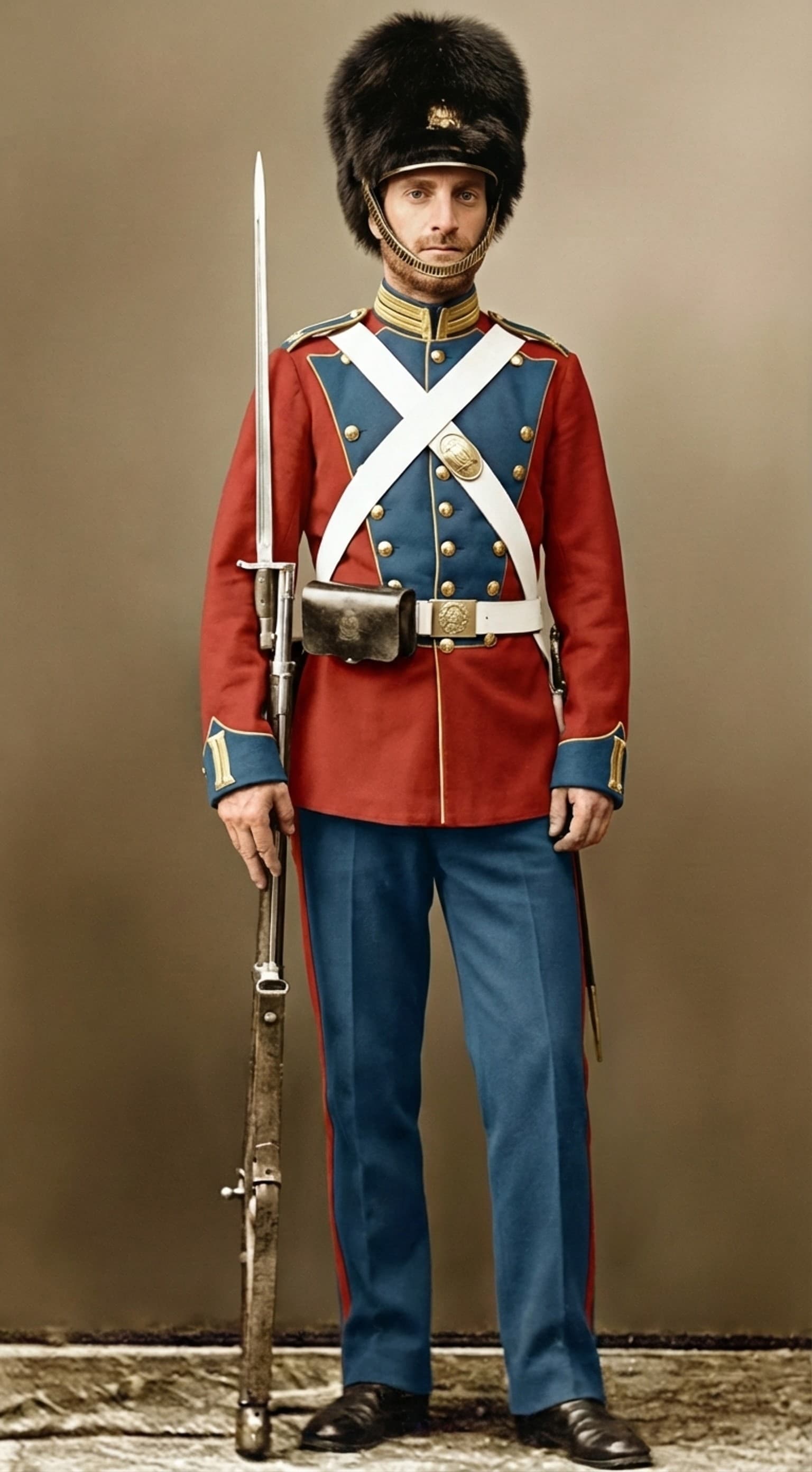
Uniform and equipment
| Uniform | Dark blue tunic, light blue trousers, white belts |
|---|---|
| Dress uniform | Dark blue tunic with red facings, tall bearskin, medals |
| Headgear | Tall black bearskin with badge |
| Equipment | Rifle with bayonet, ceremonial sword for officers |
| Insignia and standard | Sunburst bearskin badge with royal arms |
Service record
| First appeared | 1658 |
|---|---|
| Peak strength | ~1,500 men |
| Recruited from | Conscripts (Selection/Lottery) |
| Primary tactic | Infantry Defense / Ceremony |
| Signature engagement | Assault on Copenhagen (1659) |
| Motto or battle cry | Pro Rege et Grege (For King and People) |
| Obsolescence | N/A (Still Active) |
Timeline
- 1658: Formation. King Frederick III establishes the Royal Life Guards to ensure the safety of the monarch and the capital.
- 1659: The Storm of Copenhagen. The regiment earns its legendary status by repelling the Swedish assault on the city ramparts.
- 1676: Scanian War. The unit sees heavy combat in Scania, particularly at the devastating Battle of Lund.
- 1709: Great Northern War. Deployment in the campaign to regain lost territories from Sweden, fighting at Helsingborg.
- 1848: First Schleswig War. The Guards participate in the suppression of the insurrection in the duchies.
- 1864: Second Schleswig War. The unit suffers heavy losses against Prussian needle-guns at Dybbøl.
- 1943: German Disarmament. The Guards fight back against German forces at Amalienborg Palace before the Danish military is dissolved.
- 1945: Re-establishment. Following the liberation of Denmark, the Guards resume their duties at the royal palaces.
Battles
Assault on Copenhagen
The defining moment of the Guards. On a freezing night, Swedish troops attempted to storm the city across frozen moats. The Guards held the ramparts in brutal hand-to-hand combat, repelling the assault and saving the Danish sovereignty.
Battle of Lund
One of the bloodiest battles in Scandinavian history. While the Danish army suffered a crushing defeat, the Royal Life Guards refused to yield, holding the center line against overwhelming odds until they were nearly annihilated.
Battle of Dybbøl
Facing superior Prussian artillery, the Guards fought a gritty defensive action in the muddy trenches. Though the position fell, their stubborn resistance under heavy shelling cemented their reputation for stoicism.
Defense of Amalienborg
During Operation Safari, the Guards engaged German Wehrmacht forces attempting to seize the King. They fought a sharp firefight at the palace gates, suffering casualties but upholding their oath to protect the monarch before being ordered to stand down.
Commanders
General Hans Schack
A seasoned field commander who worked in tandem with the Royal Life Guards during the desperate defense of Copenhagen. His tactical acumen combined with the Guards' discipline repelled the Swedish storming parties on the frozen moats.
King Frederick III
The founder of the regiment and the defiant soul of Denmark during the Swedish siege. He refused to flee Copenhagen, famously declaring he would 'die in his nest,' and personally oversaw the defense of the ramparts alongside his Guards.
Tactics
Rampart Defense
Specialized defensive drills utilized during the Siege of Copenhagen, focusing on repelling ladder assaults with pike, shot, and grenades from elevated fortifications.
Massed Volley Fire
The discipline to hold fire until the enemy was within close range, delivering a devastating wall of lead to break the opponent's morale.
Bayonet Charge
Aggressive shock tactic used to clear positions or break enemy lines after a volley, relying on the physical imposition of the Guardsmen.