
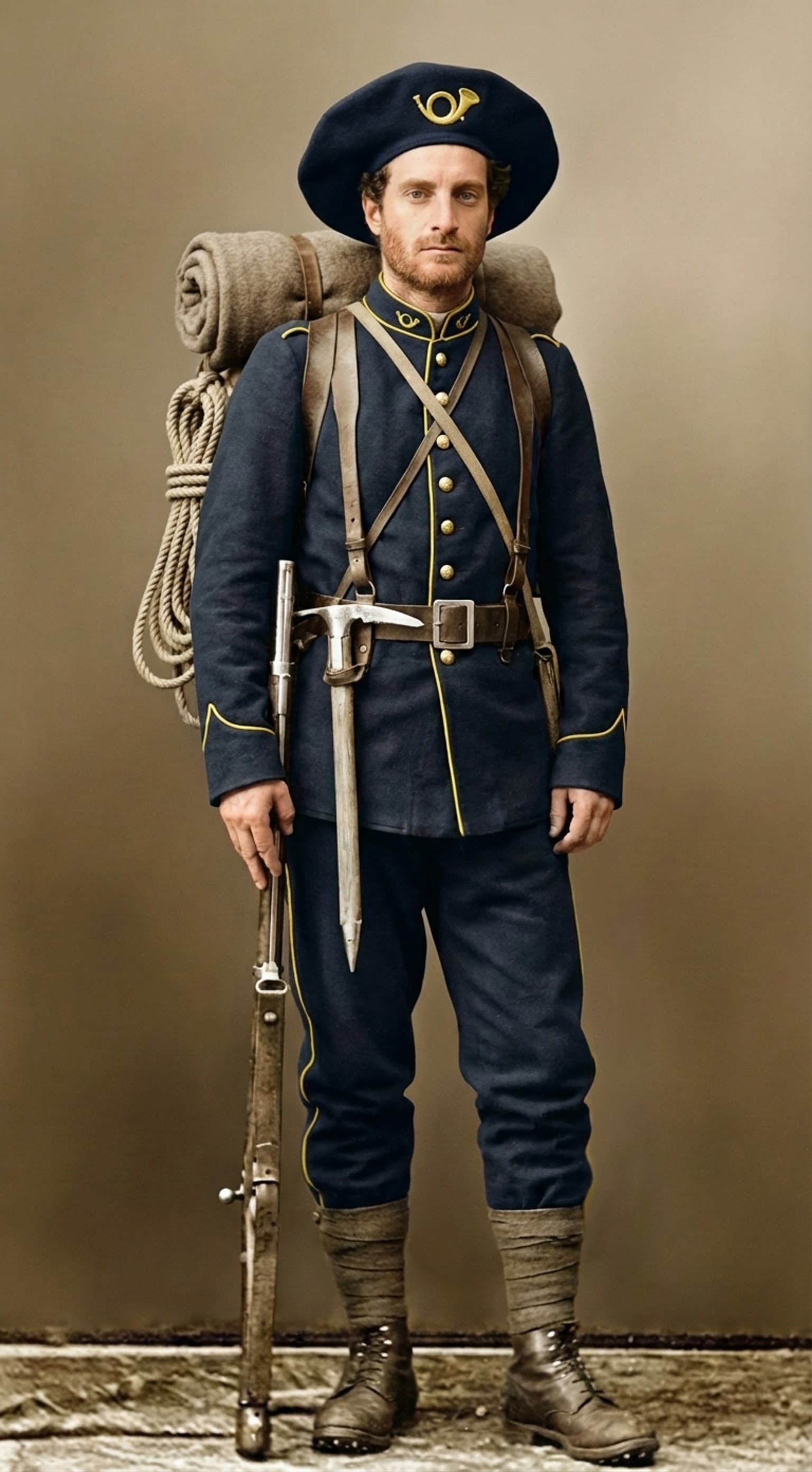
Uniform and equipment
| Uniform | Dark blue jacket and trousers, puttees; officers with additional braid |
|---|---|
| Dress uniform | Blue uniform with large collar patches, decorative trumpet badges |
| Headgear | Large dark beret (tarte) worn low, with badge |
| Equipment | Rifle, bayonet, ice axes or climbing gear, bugles |
| Insignia and standard | Oversized hunting horn on tarte beret |
Service record
| First appeared | 1888 |
|---|---|
| Peak strength | 30,000 men |
| Recruited from | Mountain Dwellers / Volunteers |
| Primary tactic | High Altitude Warfare |
| Signature engagement | Battle of the Vosges (WWI) |
| Motto or battle cry | Jamais être pris vivant (Never be taken alive) |
| Obsolescence | Helicopter Assault (Role Shifted) |
Timeline
- 1888: Formation. France officially creates the 'Troupes de montagne' to counter the newly formed Italian Alpini regiments.
- 1914: Deployment to the Vosges. The Chasseurs are rushed to the Alsace front to seize key peaks, beginning years of high-altitude trench warfare.
- 1915: The Battle of the Summits. Intense fighting at Lingekopf and Hartmannswillerkopf defines the unit's gritty legacy.
- 1940: Norwegian Campaign. The unit demonstrates its expeditionary capability with a victory at Narvik against German mountain troops.
- 1944: Liberation of the Alps. Reconstituted Chasseurs units fight alongside the Resistance to drive German forces out of the French Alps.
Battles
Battle of Hartmannswillerkopf
Known as the 'Man-Eater', this peak changed hands repeatedly. The Chasseurs fought in freezing blizzards and trench deadlock, earning the nickname 'Diables Bleus' from the Germans for their ferocity and dark uniforms.
Battle of Narvik
In the first Allied victory of WWII, Chasseurs Alpins executed a daring amphibious and mountain assault in the Arctic Circle, driving elite German Gebirgsjäger out of the strategic port before being recalled to defend France.
Battle of the Alps
A skeleton force of Chasseurs and fortress troops held off a massive Italian invasion force of over 300,000 men. Utilizing terrain and weather, they inflicted heavy casualties and prevented an Italian breakthrough.
Commanders
Albert Severin Roche
Known as the 'First Soldier of France', Roche was a relentless warrior who embodied the spirit of the Blue Devils. Though he began as a private, his tactical brilliance led to the capture of 1,180 Germans and 9 wounds, earning him legendary status among the mountain troops.
General Louis de Maud'huy
Commanding the Army of the Vosges during the desperate early days of WWI, de Maud'huy utilized the Chasseurs' mobility to hold the critical mountain passes against superior German numbers, cementing the unit's reputation for stubborn mountain defense.
Tactics
Vertical Envelopment
Using expert climbing skills to scale 'impassable' cliffs, flanking enemy positions that were only defended from the valley floor.
Ski Mobility
Conducting lightning-fast raids and reconnaissance on skis, allowing them to strike and vanish into the whiteout before the enemy could react.
Counter-Slope Defense
Digging positions on the reverse slope of a mountain to protect against direct artillery fire while ambushing infantry as they crested the peak.