
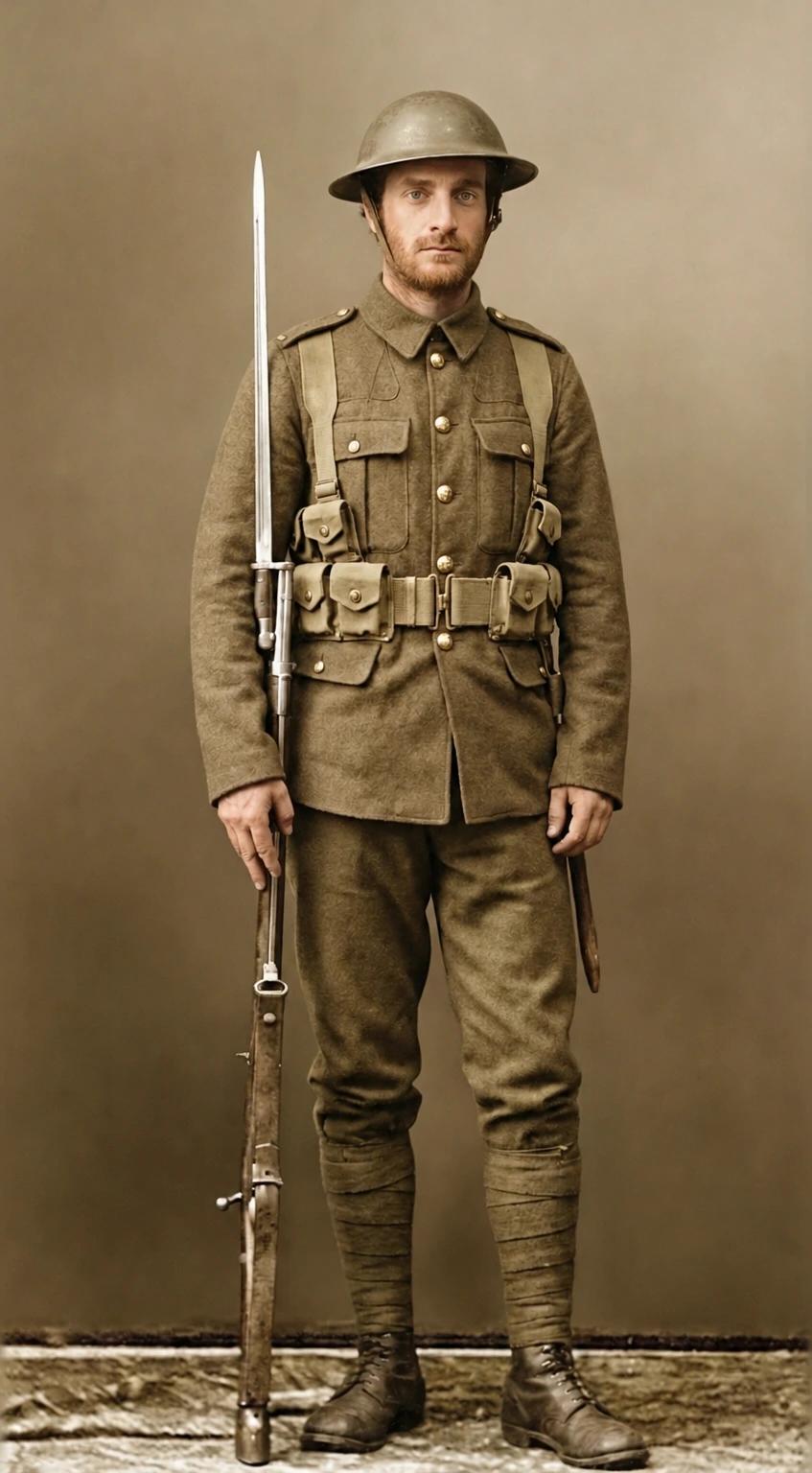
Uniform and equipment
| Uniform | Khaki service dress |
|---|---|
| Dress uniform | N/A |
| Headgear | Brodie Helmet |
| Equipment | SMLE Rifle, webbing |
| Insignia and standard | Regimental cap badge (varies) |
Service record
| First appeared | 1914 |
|---|---|
| Peak strength | Millions |
| Recruited from | Volunteers (Kitchener) / Conscripts |
| Primary tactic | Over the Top |
| Signature engagement | Battle of the Somme (1916) |
| Motto or battle cry | For King and Country! |
| Obsolescence | End of WWI |
Timeline
- 1914: Deployment of the BEF. The British Expeditionary Force lands in France, engaging the Germans at Mons and Le Cateau.
- 1915: Introduction of Gas. At the Second Battle of Ypres, British troops face the first large-scale chemical weapon attack.
- 1916: The Somme Offensive. Kitchener's New Army of volunteers sees its first major action, suffering catastrophic losses.
- 1917: Passchendaele. The Third Battle of Ypres becomes synonymous with mud, misery, and the limits of human endurance.
- 1918: Hundred Days Offensive. The British Army, now a combined-arms juggernaut, breaks the Hindenburg Line and forces the Armistice.
Battles
Battle of Mons
The first engagement of the BEF. Though forced to retreat, the professional Tommies' rapid rifle fire was so intense the Germans believed they were facing massed machine guns.
Battle of the Somme
The defining tragedy of the British Army. On the first day alone, 19,240 men fell. It was a brutal baptism of fire for the volunteer 'Pals Battalions' that hardened the survivors into a grim fighting force.
Battle of Amiens
The 'Black Day of the German Army.' Spearheaded by tanks and coordinated artillery, this battle marked the beginning of the Hundred Days Offensive and the end of trench deadlock.
Commanders
Field Marshal Douglas Haig
Commander-in-Chief of the BEF from 1915. A polarizing figure, he presided over the bloody attrition of the Somme and Passchendaele, yet his logistical mastery and final offensive strategies in 1918 ultimately broke the German Army.
General Herbert Plumer
Commander of the Second Army, known for his meticulous planning and care for his men. His use of mines at Messines Ridge resulted in one of the war's most successful, if explosive, set-piece victories.
Tactics
Creeping Barrage
A wall of artillery fire that moved forward in timed increments, allowing infantry to advance just behind the explosions to catch defenders before they could man their posts.
Trench Raiding
Small, stealthy groups armed with clubs, knives, and grenades would infiltrate enemy lines at night to gather intelligence, capture prisoners, and destroy morale.
The Mad Minute
A pre-war training standard where a rifleman aimed to fire 15 aimed rounds in 60 seconds, creating a volume of fire that suppressed enemy advances.
Bite and Hold
Seizing a small, manageable section of enemy territory and immediately digging in to repel the inevitable counter-attack with massed artillery.