
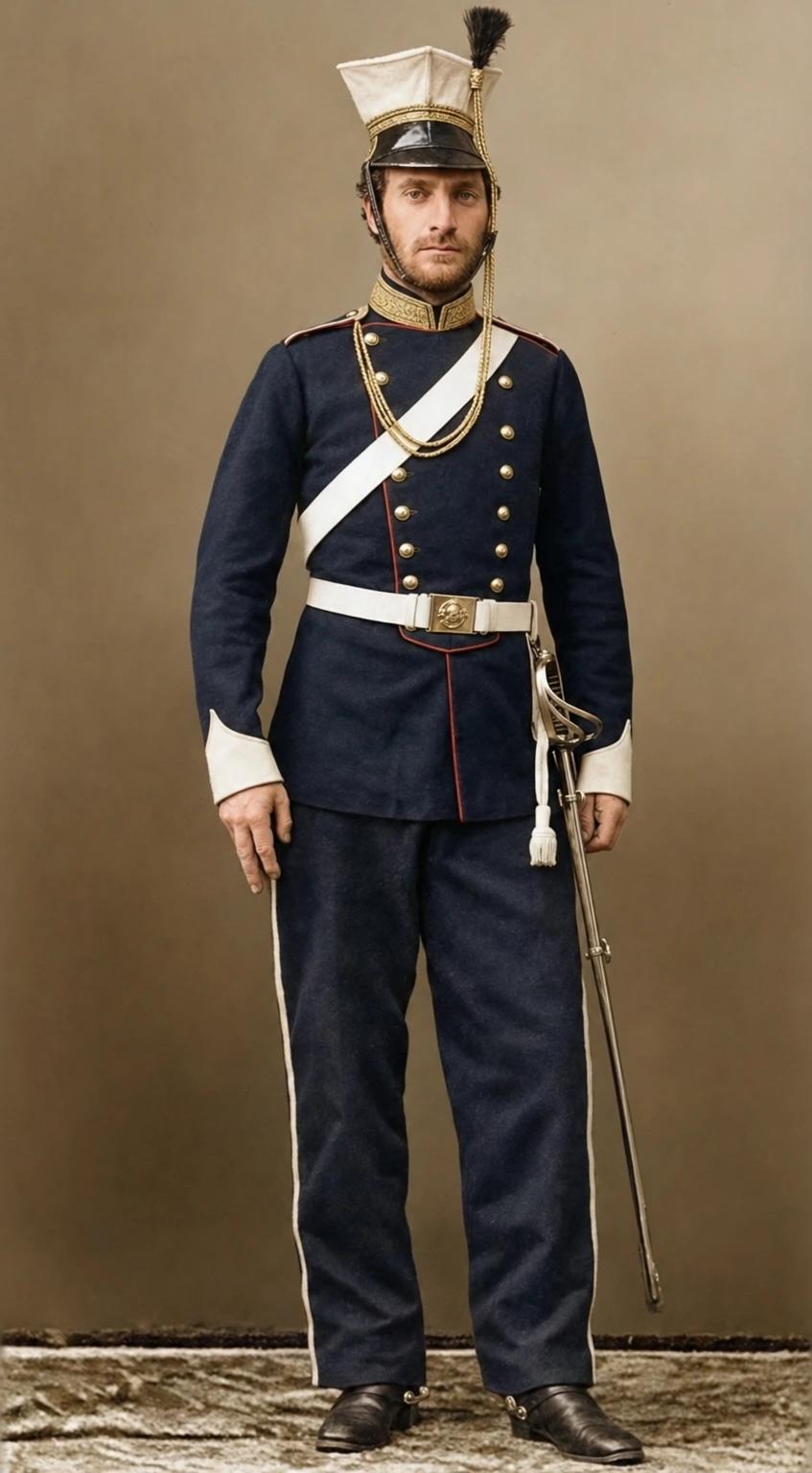
Uniform and equipment
| Uniform | Dark blue lancer tunic with white facings, overalls with stripes |
|---|---|
| Dress uniform | Dark blue kurtka with plastron, white facings, skull-and-crossbones badges |
| Headgear | Square-topped lance cap (czapka) with white plume |
| Equipment | Lance with pennon, sabre, pistols |
| Insignia and standard | Death's Head skull and crossbones over scroll 'OR GLORY' |
Service record
| First appeared | 1759 |
|---|---|
| Peak strength | 600 men |
| Recruited from | Volunteers |
| Primary tactic | Lance Charge |
| Signature engagement | Charge of the Light Brigade (1854) |
| Motto or battle cry | Death or Glory |
| Obsolescence | Barbed Wire / Trench Warfare |
Timeline
- 1759: Formation. Raised by Colonel John Hale in Hertfordshire as the 18th Light Dragoons, soon renumbered to 17th.
- 1775: American Service. Deployed to Boston, becoming the first cavalry regiment sent to America during the Revolution.
- 1822: Lancer Conversion. Re-designated as a Lancer regiment, adopting the lance and the Polish-style Czapka.
- 1854: The Charge. Participated in the suicidal charge at Balaclava, cementing the 'Death or Glory' reputation.
- 1879: Zulu War. Deployed to South Africa, culminating in the decisive charge at the Battle of Ulundi.
- 1922: Amalgamation. Merged with the 21st Lancers to form the 17th/21st Lancers.
Battles
Battle of Bunker Hill
Fighting as the 17th Light Dragoons, they provided critical reconnaissance and support. It was a bloody introduction to the gritty reality of colonial warfare against entrenched American militia.
Battle of Balaclava
The Charge of the Light Brigade. The 17th rode into the 'Valley of Death,' facing direct artillery fire. Though they reached the guns, the regiment was decimated, immortalizing their courage in a tactical disaster.
Battle of Ulundi
The 17th delivered the decisive blow against the Zulu impis. As the Zulus wavered, the Lancers executed a thunderous charge, their reach breaking the enemy lines and ending the Anglo-Zulu War.
Commanders
Colonel John Hale
A grief-stricken friend of General Wolfe, Hale raised the regiment in 1759. He chose the skull and crossbones 'Death or Glory' motif, demanding his men fight with a fatalistic bravery that would become legendary.
Captain William Morris
Commanded the 17th during the Charge of the Light Brigade. A gritty survivor, he led his lancers into the Russian guns, suffering severe saber wounds to the head but refusing to fall until the retreat.
Tactics
The Shock Charge
Riding knee-to-knee at a full gallop, utilizing the momentum of the horse to drive the lance point through enemy lines.
The Reach Advantage
Exploiting the 9-foot lance to strike infantry or swordsmen before they could close the distance to parry.
Pursuit
Running down broken and fleeing infantry formations after the main battle line had shattered.