
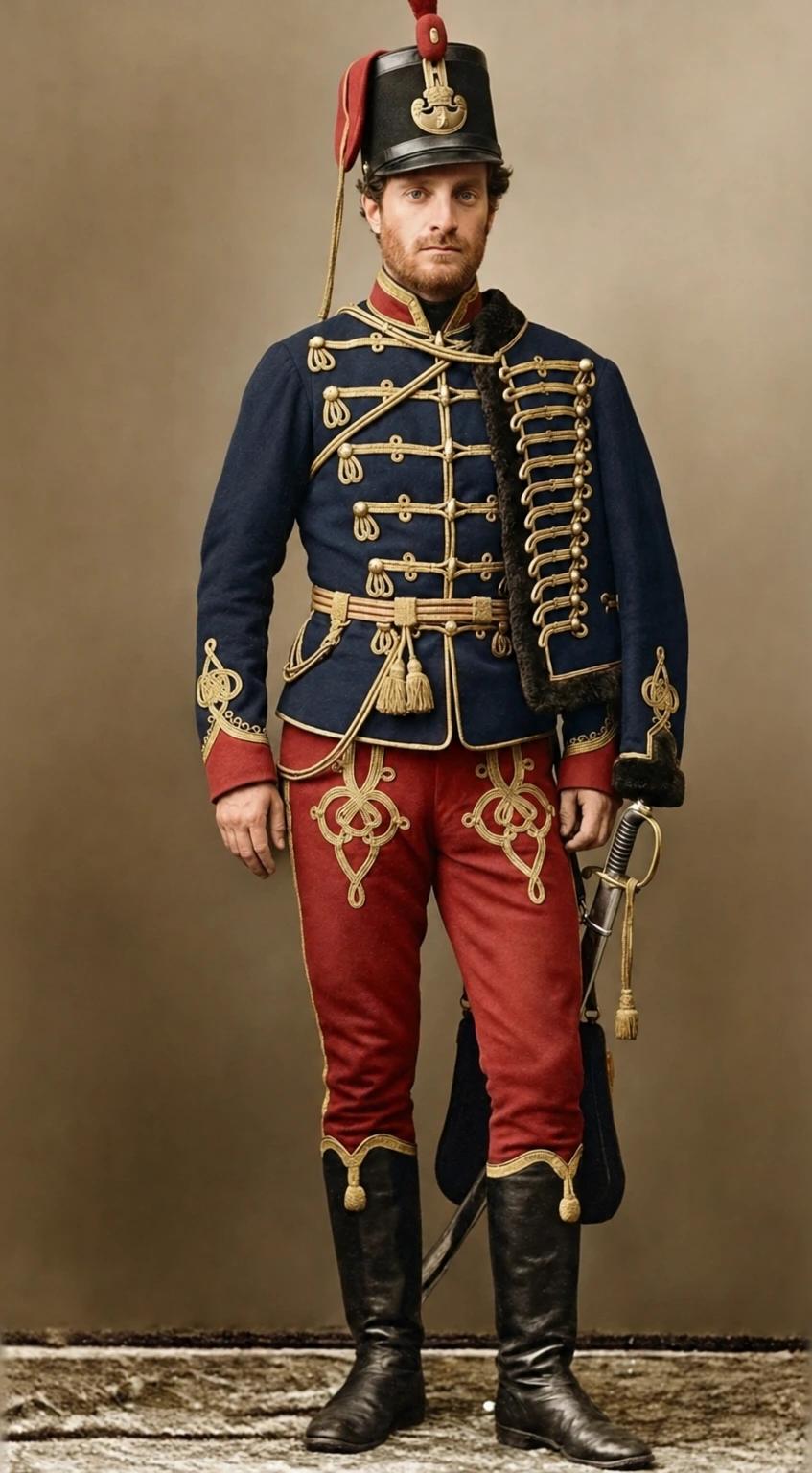
Uniform and equipment
| Uniform | Dolman, pelisse, tight breeches |
|---|---|
| Dress uniform | Richly braided uniform |
| Headgear | Shako |
| Equipment | Sabre, pistols |
| Insignia and standard | Hungarian coat of arms (double cross on three hills with Crown of St. Stephen) |
Service record
| First appeared | 1848 |
|---|---|
| Peak strength | Regiments |
| Recruited from | National Guard |
| Primary tactic | Hussar Charge |
| Signature engagement | Hungarian Revolution of 1848 |
| Motto or battle cry | Éljen a Haza! (Long live the Homeland!) |
| Obsolescence | Defeat by Austria/Russia |
Timeline
- 1848: Formation of the Honvédség. Following the March Revolution, the Hungarian government establishes the National Guard, integrating old Imperial Hussar regiments into the new national army.
- 1848: Battle of Schwechat. Hussars attempt to aid the Vienna Uprising but are repulsed; the first major engagement against regular Imperial troops.
- 1849: The Spring Campaign. A series of brilliant victories (Hatvan, Tápióbicske, Isaszeg) where Hussar mobility liberated much of central Hungary.
- 1849: Recapture of Buda. While infantry stormed the castle, Hussars patrolled the perimeter, cutting off Austrian relief attempts.
- 1849: Russian Intervention. Tsar Nicholas I sends 200,000 troops; the Hussars are now fighting a two-front war against two empires.
- 1849: Surrender at Világos. Görgei surrenders to the Russians. The Hussar regiments are disbanded, and many officers are executed or conscripted into the Austrian army.
Battles
Battle of Pákozd
The baptism of fire for the new Honvéd army. Hussars secured the flanks, preventing Ban Jelačić's Croatian forces from advancing on Pest. It was a morale-boosting triumph that proved the revolution could defend itself.
Battle of Isaszeg
The crowning glory of the Spring Campaign. Amidst burning forests, Hussar regiments charged the Austrian center, turning a confused melee into a decisive rout that forced Windisch-Grätz to retreat toward the capital.
Battle of Temesvár
The tragic end. Exhausted and outnumbered by the combined Austrian and Russian armies, the Hussars launched desperate, suicidal charges to cover the retreat, but the revolution was effectively crushed.
Commanders
Artúr Görgei
A chemist turned general, Görgei was the cold, rational intellect behind the Honvéd army. Though controversial for his eventual surrender, his tactical brilliance during the Spring Campaign allowed the Hussars to outmaneuver superior Austrian forces repeatedly.
Józef Bem
A Polish general fighting for Hungarian liberty, 'Father Bem' was adored by his troops. He masterfully coordinated Hussar charges with mobile artillery in Transylvania, achieving miraculous victories against overwhelming odds.
János Damjanich
A Serb by birth but a Hungarian patriot by choice, Damjanich led the famous 'Red Caps'. Known for his imposing stature and fearlessness, he often led cavalry assaults personally, breaking the Austrian morale through sheer ferocity.
Tactics
The Hussar Charge
A shock tactic delivered at a full gallop. Unlike heavy cavalry, Hussars relied on speed and the psychological terror of their shouting and sabre-waving to break infantry squares.
Hit-and-Run Skirmishing
Utilizing light saddles and agile horses to harass enemy supply lines and flanks, firing pistols and retreating before the enemy could form up.
Screening and Reconnaissance
Acting as the 'eyes' of the army, Hussars ranged miles ahead of the main force to locate enemy positions and mask the movements of their own infantry.