
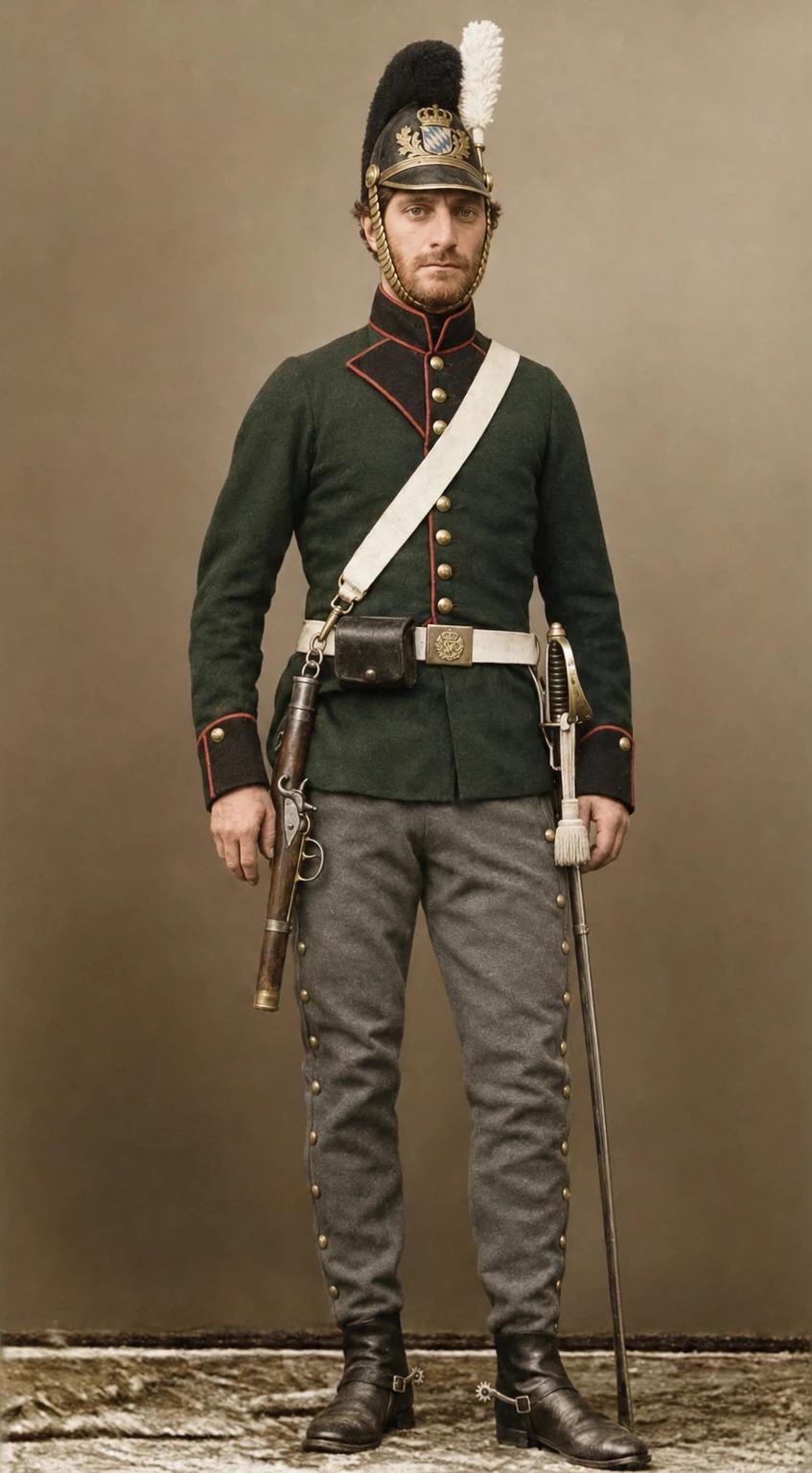
Uniform and equipment
| Uniform | Dark green coat with regimental facings, grey overalls |
|---|---|
| Dress uniform | Polished buttons, colored plumes, ornate saddlecloths |
| Headgear | Raupenhelm (caterpillar crest helmet) with plume |
| Equipment | Sabre, carbine, sometimes lance |
| Insignia and standard | Bavarian lion with sword/arms on helmet |
Service record
| First appeared | 1790s |
|---|---|
| Peak strength | ~4,000 riders |
| Recruited from | Rural Conscripts |
| Primary tactic | Skirmish / Reconnaissance |
| Signature engagement | Battle of Eckmühl (1809) |
| Motto or battle cry | In Treue Fest (Steadfast in Loyalty) |
| Obsolescence | End of Monarchy (1918) |
Timeline
- 1799: Reorganization. Elector Maximilian IV Joseph reforms the disparate light horse units into organized Chevauleger regiments.
- 1805: French Alliance. Bavaria sides with France; the Chevaulegers adopt French organizational standards and tactics.
- 1809: Campaign of 1809. The unit distinguishes itself against the Austrian Empire, particularly at the Battle of Eckmühl.
- 1812: Russian Campaign. The regiments suffer catastrophic losses due to freezing temperatures and starvation during the retreat from Moscow.
- 1813: Treaty of Ried. Bavaria switches sides to the Sixth Coalition; the Chevaulegers turn their sabres against Napoleon.
- 1919: Disbandment. Following World War I and the fall of the Bavarian monarchy, the Royal Bavarian Cavalry is dissolved.
Battles
Battle of Eckmühl
The defining moment for the unit. Bavarian cavalry charged Austrian positions with ferocity, securing a vital victory for Napoleon's coalition. Their mobility and shock action in the rolling terrain cemented their reputation as elite light horsemen.
Battle of Polotsk
Deep in Russia, the Chevaulegers fought a grueling engagement to protect the Grande Armée's northern flank. Fighting amidst dust and heat, they executed repeated charges against Russian infantry, suffering heavy casualties but holding the line.
Battle of Hanau
A tragic but heroic stand where the Chevaulegers, now fighting for the Allies, attempted to block Napoleon's retreat. Despite being outmaneuvered by the French Imperial Guard, they fought with desperate courage against their former comrades.
Commanders
Maximilian I Joseph
The first King of Bavaria and a seasoned soldier who commanded the respect of his troops. He modernized the Bavarian army, transforming the Chevaulegers into a premier light cavalry force that balanced loyalty to Napoleon with Bavarian sovereignty.
Carl Philipp von Wrede
A fearless and often reckless field marshal who led the Bavarian corps. Known for his aggressive posturing, he commanded the Chevaulegers through the bloody campaigns of 1809 and the desperate rearguard actions of Russia, eventually turning against France at Hanau.
Tactics
Vedette Screen
Deploying pairs of mounted sentries forward of the main army to observe enemy movements and prevent surprise attacks.
Skirmish Line
A loose formation where troopers utilized carbines to harass enemy infantry flanks before retreating or charging.
Echelon Charge
Attacking in staggered waves to exploit gaps in the enemy line while maintaining a reserve force for exploitation.