
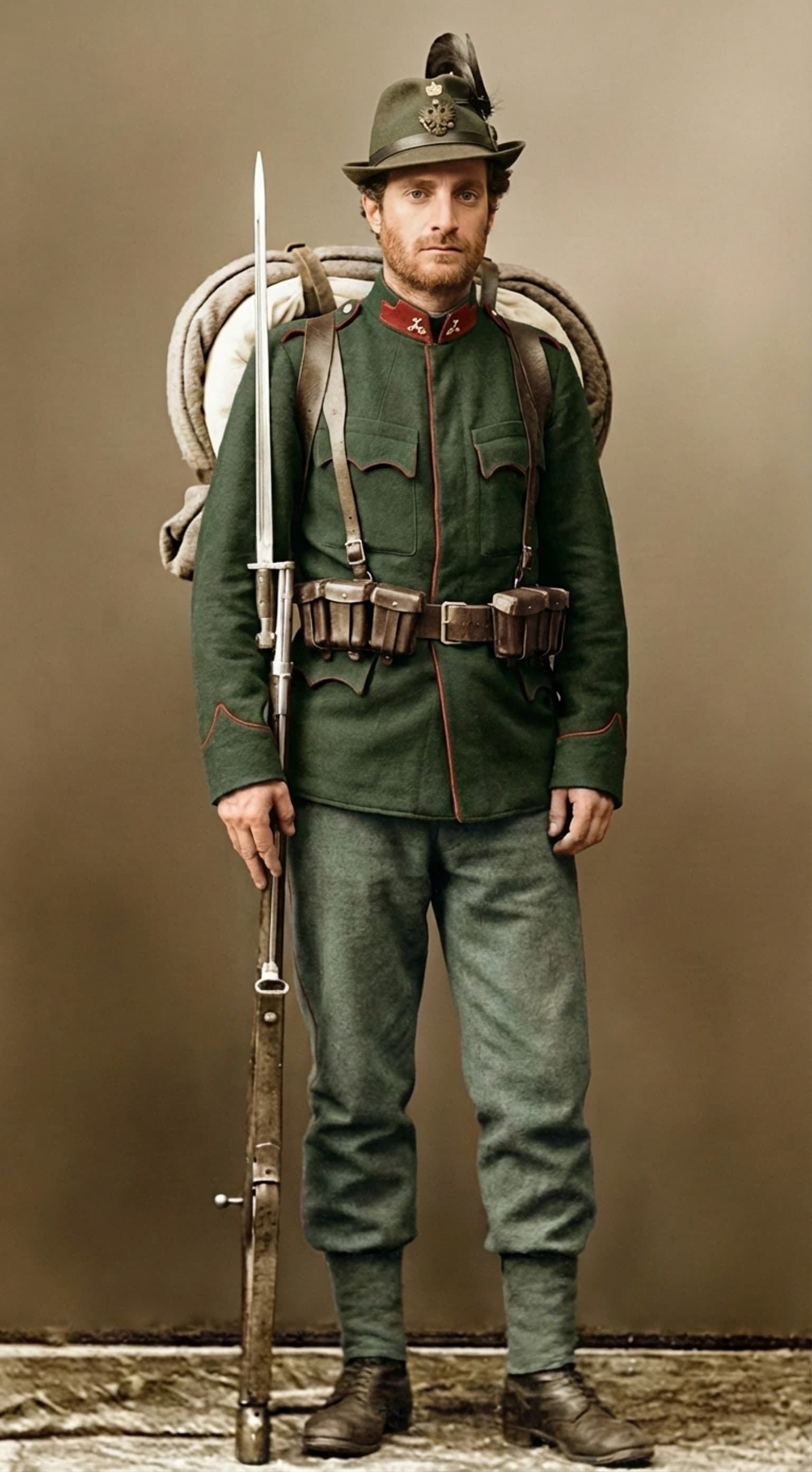
Uniform and equipment
| Uniform | Dark green tunic, light blue facings, grey trousers |
|---|---|
| Dress uniform | Green tunic with silver lace, white gloves, sashes |
| Headgear | Wide-brimmed felt hat with cock feather |
| Equipment | Rifle, bayonet, hunting knife |
| Insignia and standard | Edelweiss cap badge |
Service record
| First appeared | 1801 |
|---|---|
| Peak strength | ~20,000 men |
| Recruited from | Tyrolean Conscripts/Volunteers |
| Primary tactic | Mountain Warfare |
| Signature engagement | Battle of Asiago (1916) |
| Motto or battle cry | Für Gott, Kaiser und Vaterland (For God, Emperor, and Fatherland) |
| Obsolescence | Dissolution of Empire (1918) |
Timeline
- 1816: Formation. Emperor Francis I officially establishes the Tyrolean Jäger Regiment, integrating local sharpshooters into the regular army.
- 1848: Italian Campaigns. The unit distinguishes itself in suppressing revolutions across the Italian provinces, earning the title 'Great Regiment'.
- 1895: Expansion. The Kaiserjäger are expanded into four regiments, solidifying their role as the core of Austria's mountain defense.
- 1914: Galician Front Deployment. Deployed against Russia on the plains of Galicia, the unit suffers catastrophic casualties, losing much of its pre-war cadre.
- 1915: Return to the Alps. Following Italy's declaration of war, the Kaiserjäger are rushed to the Southern Front to defend their Tyrolean homeland.
- 1918: Disbandment. With the collapse of the Austro-Hungarian Empire, the regiments march home in good order before dissolving.
Battles
Battle of Novara
Under Radetzky, the Kaiserjäger proved their mettle as elite skirmishers. They shattered the Piedmontese lines, securing Austrian dominance in Italy for another decade and establishing their reputation as the Empire's premier light infantry.
Battle of Solferino
In a chaotic and bloody engagement, the Kaiserjäger fought with desperate ferocity. Despite the overall Austrian collapse, their disciplined rearguard actions and sharpshooting prevented a total rout, earning them begrudging respect from the French victors.
Battle of Monte Pasubio
A war of mines and explosives fought inside the mountain itself. The Kaiserjäger held the summits through freezing winters and subterranean detonations, a testament to their superhuman endurance in the 'War of Ice and Stone'.
Battle of Asiago (Strafexpedition)
The signature offensive. Kaiserjäger units scaled vertical limestone cliffs under fire to breach Italian defenses. While the offensive eventually stalled due to Russian pressure elsewhere, the tactical feats of mountain warfare achieved here remain legendary.
Commanders
Archduke Charles, Duke of Teschen
Though his greatest triumphs against Napoleon predated the unit's official 1816 inception, Charles was the architect of the Austrian military reforms that necessitated elite light infantry. His doctrine of flexibility and initiative became the spiritual bedrock of the Kaiserjäger ethos.
Emperor Franz Joseph I
The honorary Colonel-in-Chief who frequently donned the Kaiserjäger uniform. He viewed these Tyrolean mountaineers as his personal guard and the most loyal protectors of the realm, embodying the bond between the House of Habsburg and the rugged Alpine populace.
Colonel General Viktor Dankl von Krasnik
A highly decorated commander who led Austro-Hungarian forces in the early clashes of WWI. Known for his aggressive leadership in Galicia and later on the Italian front, he utilized the Kaiserjäger's discipline to hold impossible lines against superior numbers.
Tactics
Hochgebirgskrieg (High Alpine Warfare)
Specialized combat involving vertical envelopment, hauling artillery up cliff faces via cable cars, and fighting above the cloud line.
Precision Sharpshooting
Leveraging their hunting background, individual marksmen dominated valley floors from concealed high-altitude nests, suppressing enemy movement.
Infiltration Tactics
Late-war adoption of stormtrooper methods, using small, heavily armed squads to bypass strongpoints and attack command centers.