
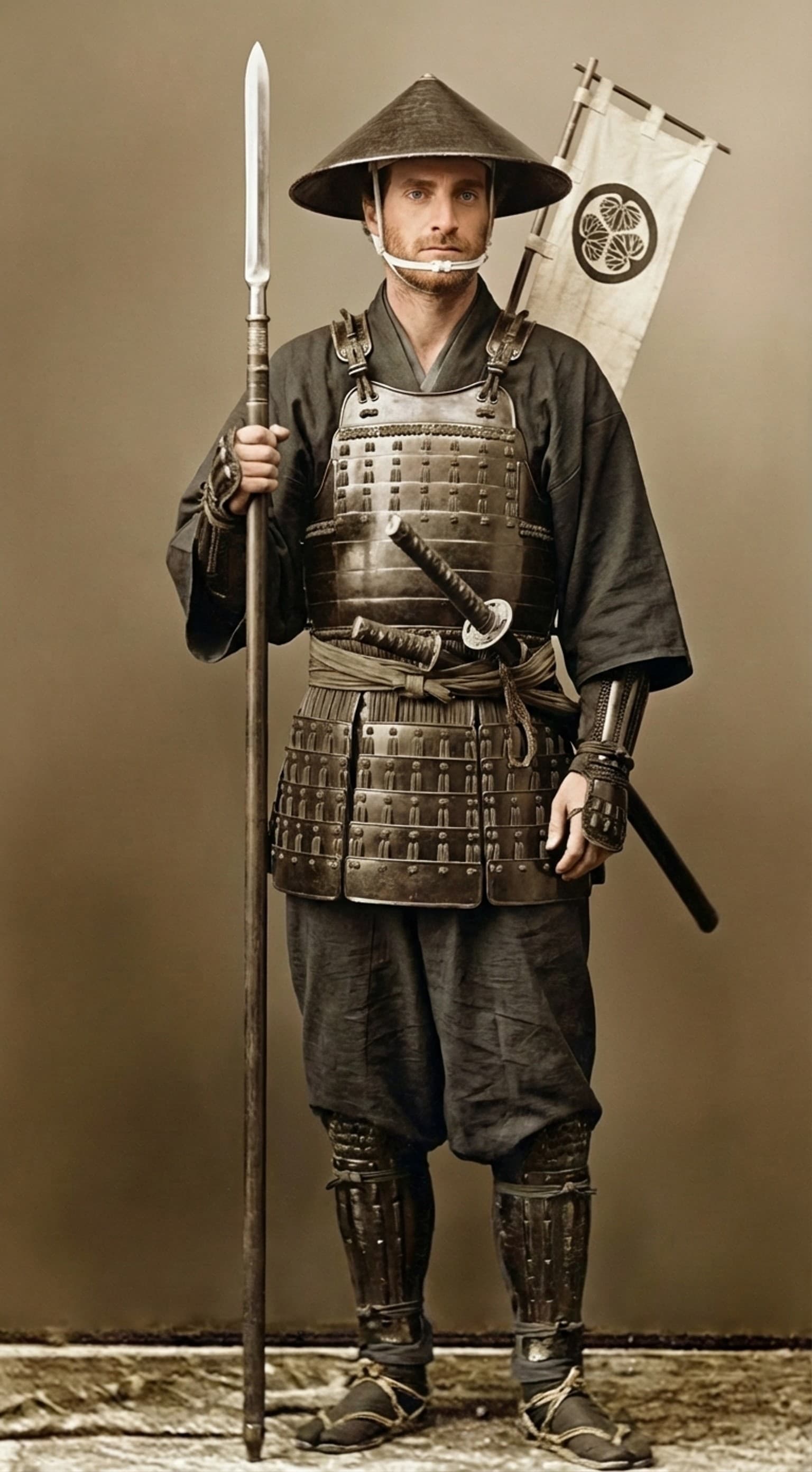
Uniform and equipment
| Uniform | Simple cotton jacket and hakama, partial armor |
|---|---|
| Dress uniform | Uniform-color jackets, larger sashimono banners |
| Headgear | Conical jingasa hat or simple kabuto |
| Equipment | Long spear (yari) or arquebus, short sword |
| Insignia and standard | Clan mon on sashimono back-banners |
Service record
| First appeared | 14th century |
|---|---|
| Peak strength | ~400,000 men |
| Recruited from | Peasant Conscripts / Professionals |
| Primary tactic | Pike Wall / Volley Fire |
| Signature engagement | Battle of Nagashino (1575) |
| Motto or battle cry | Ei! Ei! Oh! (Battle shout) |
| Obsolescence | Social Stratification (Tokugawa) |
Timeline
- 1467: Onin War Begins. The breakdown of central authority leads to the Sengoku Jidai; feudal lords begin recruiting peasants as 'Ashigaru' (light feet) to bulk up armies.
- 1543: Introduction of the Arquebus. Portuguese traders arrive at Tanegashima. The introduction of firearms elevates the Ashigaru from skirmishers to decisive shock troops.
- 1575: Battle of Nagashino. Ashigaru tactics are perfected under Oda Nobunaga, utilizing combined arms of pikes and firearms behind defensive works.
- 1588: The Sword Hunt. Hideyoshi confiscates weapons from the peasantry, effectively freezing the social class system and professionalizing the Ashigaru class.
- 1615: Siege of Osaka. The final major engagement of the era. Following the establishment of the Pax Tokugawa, the role of the Ashigaru transitions from warrior to bureaucratic police force.
Battles
Battle of Nagashino
The turning point of samurai warfare. Nobunaga's disciplined Ashigaru, protected by wooden palisades and wielding matchlocks in rotating volleys, decimated the legendary Takeda cavalry. It proved that drilled infantry could defeat the elite warrior class.
Battle of Sekigahara
The largest samurai engagement in history. Tens of thousands of Ashigaru formed the dense, grinding pike walls that defined the front lines, holding ground in the mud and fog while the fate of the Shogunate was decided by betrayal and maneuver.
Commanders
Oda Nobunaga
A ruthless innovator who revolutionized Japanese warfare. He was the first to separate the soldier from the farmer, creating a standing army of professional Ashigaru capable of complex maneuvers and disciplined volley fire that shattered traditional samurai cavalry charges.
Toyotomi Hideyoshi
The ultimate embodiment of social mobility, Hideyoshi rose from a lowly sandal-bearer to the 'Great Unifier' of Japan. He understood the grit of the common soldier better than any daimyo, transforming the Ashigaru from a rabble into a disciplined, professional fighting force.
Tactics
Yari Fusuma
The 'Wall of Spears.' Ashigaru stood shoulder-to-shoulder, rhythmically beating their pikes to intimidate foes before lowering them to create an impassable hedge of steel.
Combined Arms Volley
Alternating ranks of matchlock gunners and archers would soften the enemy, retreating behind the pike wall when cavalry approached.