
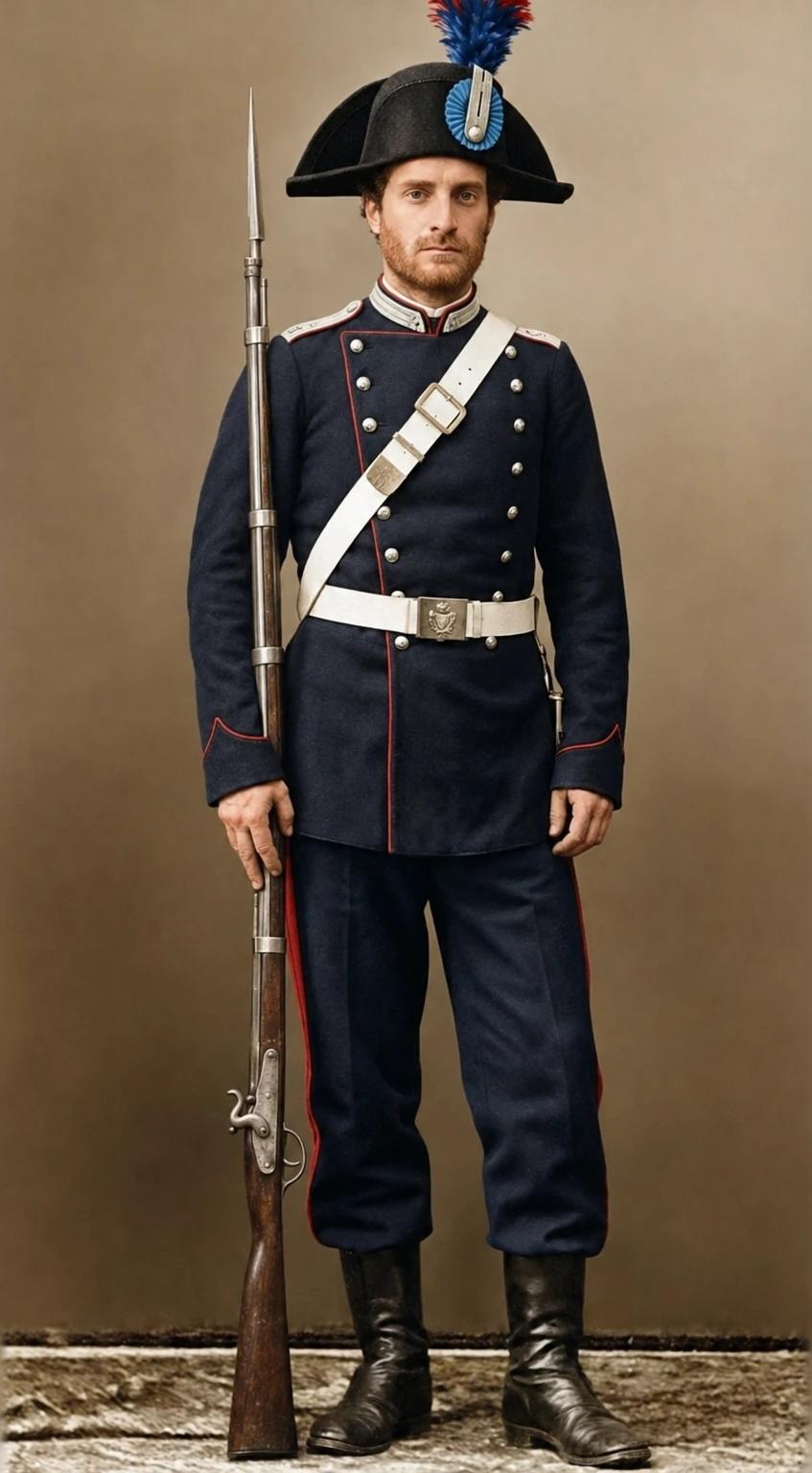
Uniform and equipment
| Uniform | Dark blue tunic with red piping, blue trousers with red stripe |
|---|---|
| Dress uniform | Dark blue coatee with white crossbelts, red-striped trousers |
| Headgear | Bicorn hat with cockade and plume, later crested helmet for some roles |
| Equipment | Carbine, pistol, sword for mounted and officer ranks |
| Insignia and standard | Silver flaming grenade with bent flame |
Service record
| First appeared | 1814 |
|---|---|
| Peak strength | 30,000+ men |
| Recruited from | Selected Veterans / Literate Recruits |
| Primary tactic | Mounted Charge / Policing |
| Signature engagement | Battle of Pastrengo (1848) |
| Motto or battle cry | Nei secoli fedele (Faithful through the centuries) |
| Obsolescence | N/A (Active) |
Timeline
- 1814: Royal Patents Issued. Victor Emmanuel I establishes the Corps of Royal Carabinieri in Turin to police the Kingdom of Sardinia.
- 1848: The Charge of Pastrengo. The Corps earns its reputation for heroism by saving King Charles Albert from capture during the First War of Independence.
- 1861: First Force of the Kingdom. With the unification of Italy, the Carabinieri are designated the 'Senior Service' (L'Arma), taking precedence over all other branches.
- 1915: The Karst Front. Carabinieri regiments deploy to the trenches of WWI, serving as both frontline shock troops and military police.
- 1943: Resistance and Deportation. Following the armistice, thousands of Carabinieri are disarmed and deported by Nazi forces; many join the partisan resistance.
Battles
Battle of Pastrengo
The Corps' defining mythos. Amidst the First War of Independence, the King's escort found themselves encircled. With sabers drawn and a cry of 'Pastrengo!', 280 horsemen charged the Austrian infantry, shattering the encirclement and turning the tide of the battle.
Battle of Culqualber
A heroic last stand. A battalion of Carabinieri held a mountain pass against overwhelming British armor and artillery for months. Fighting with grenades and bayonets until ammunition ran dry, their ferocity earned them full military honors from the conquering enemy.
Commanders
Major General Alessandro Negri di Sanfront
A cavalry commander of iron nerve. At Pastrengo, seeing King Charles Albert exposed to Austrian fire, he led three squadrons of mounted Carabinieri in a desperate, thundering charge that broke the enemy lines and saved the monarch, cementing the Corps' legend.
King Victor Emmanuel I
The architect of the Corps. Returning from exile in 1814, he envisioned a force of 'good conduct and wisdom' to restore order to a fractured Piedmont. He established the Carabinieri Reali not merely as soldiers, but as the unwavering guardians of the state and the crown.
Tactics
Carica di Pastrengo
A shock cavalry maneuver. Unlike standard cavalry, Carabinieri escorts would charge directly into infantry lines to create chaos and shield VIPs, relying on psychological impact and the heavy saber.
Capillary Control
The strategic distribution of small stations (Tenenza) in every village, creating a dense intelligence network that allowed them to suppress banditry and maintain royal authority.
Anti-Partisan Sweeps
During the unification era 'Brigandage' wars, they utilized mobile columns to hunt insurgents in the rugged terrain of Southern Italy.