
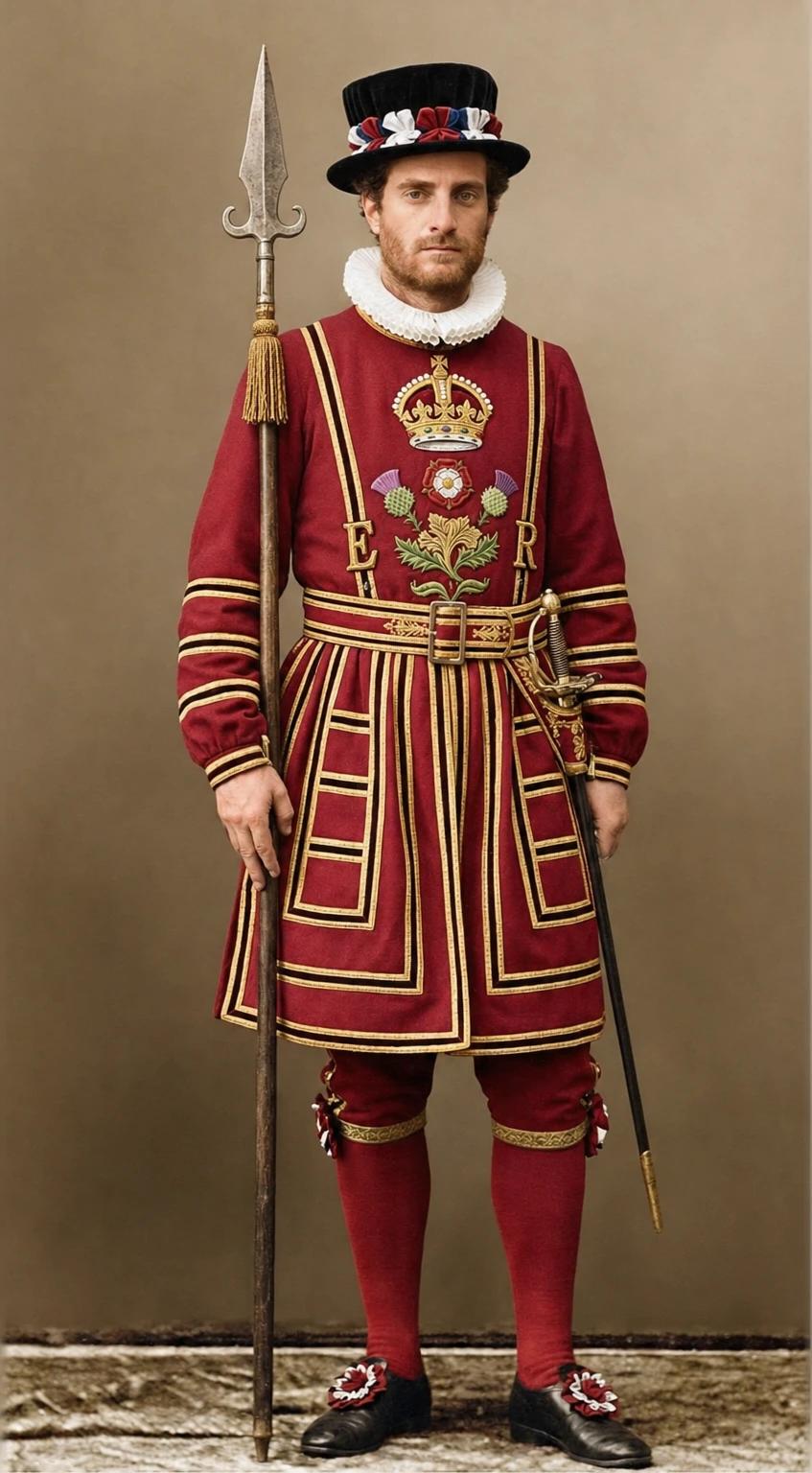
Uniform and equipment
| Uniform | Tudor scarlet coat, gold/black bars, rose badges |
|---|---|
| Dress uniform | Scarlet with extensive gold lace, rose emblems |
| Headgear | Black velvet Tudor bonnet |
| Equipment | Partisan (halberd variant), sword |
| Insignia and standard | Rose, Thistle, and Shamrock beneath Royal Crown |
Service record
| First appeared | 1485 |
|---|---|
| Peak strength | 500 men |
| Recruited from | Selected Veterans |
| Primary tactic | Bodyguard Defense |
| Signature engagement | Battle of Bosworth Field (1485) |
| Motto or battle cry | Dieu et mon Droit (God and my Right) |
| Obsolescence | Evolution to Ceremonial Role |
Timeline
- 1485: Formation at Bosworth. Henry VII creates the 'Yeomen of the Guard of (the body of) our Lord the King' immediately following his victory.
- 1509: Accession of Henry VIII. The unit is expanded and the uniforms become more lavish, reflecting the opulence of the new reign.
- 1520: Field of the Cloth of Gold. 600 Yeomen accompany Henry VIII to France, displaying English martial power and wealth to Francis I.
- 1605: The Gunpowder Plot. Yeomen search the cellars beneath Parliament, discovering Guy Fawkes and the explosives intended to kill James I.
- 1660: The Restoration. Following the English Civil War, the unit is reconstituted under Charles II, reaffirming their loyalty to the Crown.
- 1743: Last Combat Deployment. The Yeomen accompany George II to the Battle of Dettingen, their final appearance on a battlefield.
Battles
Battle of Bosworth Field
The unit's baptism of fire. As Richard III launched a desperate cavalry charge to kill Henry Tudor, the Yeomen formed a tight defensive ring, hacking down the Yorkist knights with polearms and saving the future King's life in the mud and blood of the marsh.
Battle of Stoke Field
The final, brutal confrontation of the Wars of the Roses. The Yeomen stood firm against German mercenaries and Irish kerns, protecting the King and extinguishing the last serious Yorkist threat to the Tudor dynasty.
Battle of the Spurs
Serving under Henry VIII in France, the Yeomen participated in this rout of French cavalry. While largely a cavalry engagement, the Guard's presence underscored the monarch's personal command on the continent.
Battle of Dettingen
The last time a British sovereign, George II, led troops into battle. The Yeomen were present to guard the King, marking the end of their role as a frontline combat unit before transitioning fully to ceremonial duties.
Commanders
John de Vere, 13th Earl of Oxford
A hardened Lancastrian commander and the first Captain of the Yeomen. Having survived exile and imprisonment, he forged the initial fifty guardsmen into an unbreakable shield around Henry VII, proving his tactical genius by crushing the Yorkist vanguard at Bosworth.
Sir Charles Somerset, 1st Earl of Worcester
An illegitimate son of the Duke of Somerset, Charles rose through sheer competence and loyalty. As Captain under Henry VII and Henry VIII, he transformed the Yeomen from a battlefield bodyguard into a permanent fixture of the royal court's inner sanctum.
Tactics
The Sovereign's Shield
A tight-knit infantry formation specifically designed to encircle the monarch, sacrificing mobility for 360-degree protection against assassination or cavalry charges.
Corridor Clearance
Using the length of their partisans, Yeomen could sweep narrow palace hallways, pinning potential assassins against walls or forcing them back without engaging in risky hand-to-hand grappling.
Halberd Wall
In open field engagements, the Yeomen would lock their polearms to create a bristling hedge of steel, impenetrable to enemy horses attempting to reach the King.