
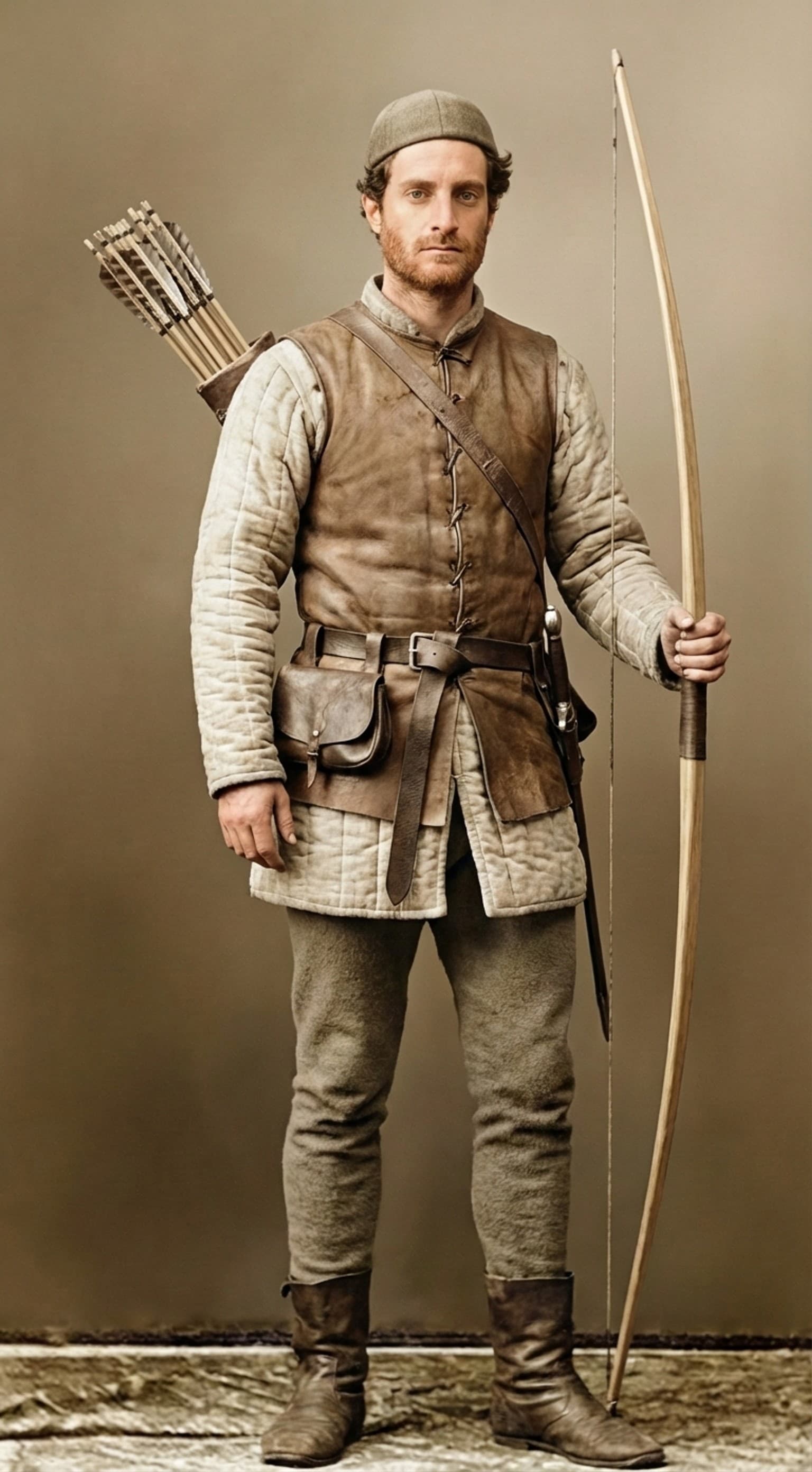
Uniform and equipment
| Uniform | Padded jack or gambeson, white cross on surcoat |
|---|---|
| Dress uniform | Livery coats of their lord |
| Headgear | Sallet, bascinet, or simple skullcap |
| Equipment | Yew longbow, arrows (bodkin), mallet, dagger/sword |
| Insignia and standard | Red Cross of St. George on surcoat |
Service record
| First appeared | 13th Century |
|---|---|
| Peak strength | 5,000+ in campaigns |
| Recruited from | Yeomanry (Free Peasants) |
| Primary tactic | Arrow Storm |
| Signature engagement | Battle of Agincourt (1415) |
| Motto or battle cry | Saint George! |
| Obsolescence | Muskets / Decline of Yeomanry |
Timeline
- 1252: Assize of Arms. King Henry III decrees that all men owning land worth 40-100 shillings must own a bow and arrows, laying the foundation for a citizen militia.
- 1298: Battle of Falkirk. Edward I demonstrates the lethal combination of massed archery and cavalry against Scottish schiltrons.
- 1363: Archery Mandate. Edward III prohibits football and other sports on Sundays, mandating archery practice to ensure a pool of skilled recruits.
- 1415: Agincourt Campaign. The legendary victory that cemented the longbowman's status as the most feared infantry in Europe.
- 1595: Retirement of the Bow. The Privy Council orders that the trained bands should be armed with muskets instead of bows, officially ending the era of the longbow.
Battles
Battle of Crécy
The longbow's terrifying continental debut. English yeomen outranged Genoese crossbowmen and decimated sixteen waves of French cavalry, proving that discipline and firepower could topple heavy armor.
Battle of Poitiers
A masterclass in defensive terrain usage. Archers targeted the horses of the French knights, creating chaos that allowed the English men-at-arms to capture King John II of France.
Battle of Agincourt
The zenith of the longbow. On a cramped, muddy field, English archers drove sharpened stakes into the ground to break the French charge, then rained armor-piercing bodkins onto the trapped nobility.
Battle of Patay
The longbow's vulnerability exposed. Caught unprepared before they could plant their defensive stakes, the archers were overrun by French heavy cavalry, marking a turning point in the Hundred Years' War.
Commanders
Henry V
The warrior-king who immortalized the longbow. Leading a dysentery-ridden army against overwhelming odds, his tactical genius and reliance on the yeoman archer at Agincourt shattered the flower of French chivalry in the mud.
Edward III
Architect of English military dominance. He recognized the strategic value of a standing archery corps, enforcing mandatory practice and unleashing the longbow's devastating potential against the French at Crécy.
Edward of Woodstock (The Black Prince)
A brutal and brilliant commander who utilized longbowmen to devastating effect at Poitiers. He perfected the defensive stand, using archers to funnel enemy cavalry into kill zones.
Tactics
The Arrow Storm
Massed volley fire at a high trajectory to create a 'cloud' of arrows, suppressing enemy movement and inflicting casualties on rear ranks.
Herce Formation
Deploying archers in V-shaped formations or on the flanks of dismounted knights to create crossfire zones (enfilade) against approaching enemies.
Direct Shot
At close range (under 50 yards), archers fired directly at targets with heavy bodkin arrows to punch through plate armor.
Stake Wall
Planting sharpened wooden stakes in front of the line to negate cavalry charges, forcing knights to dismount or halt under fire.