
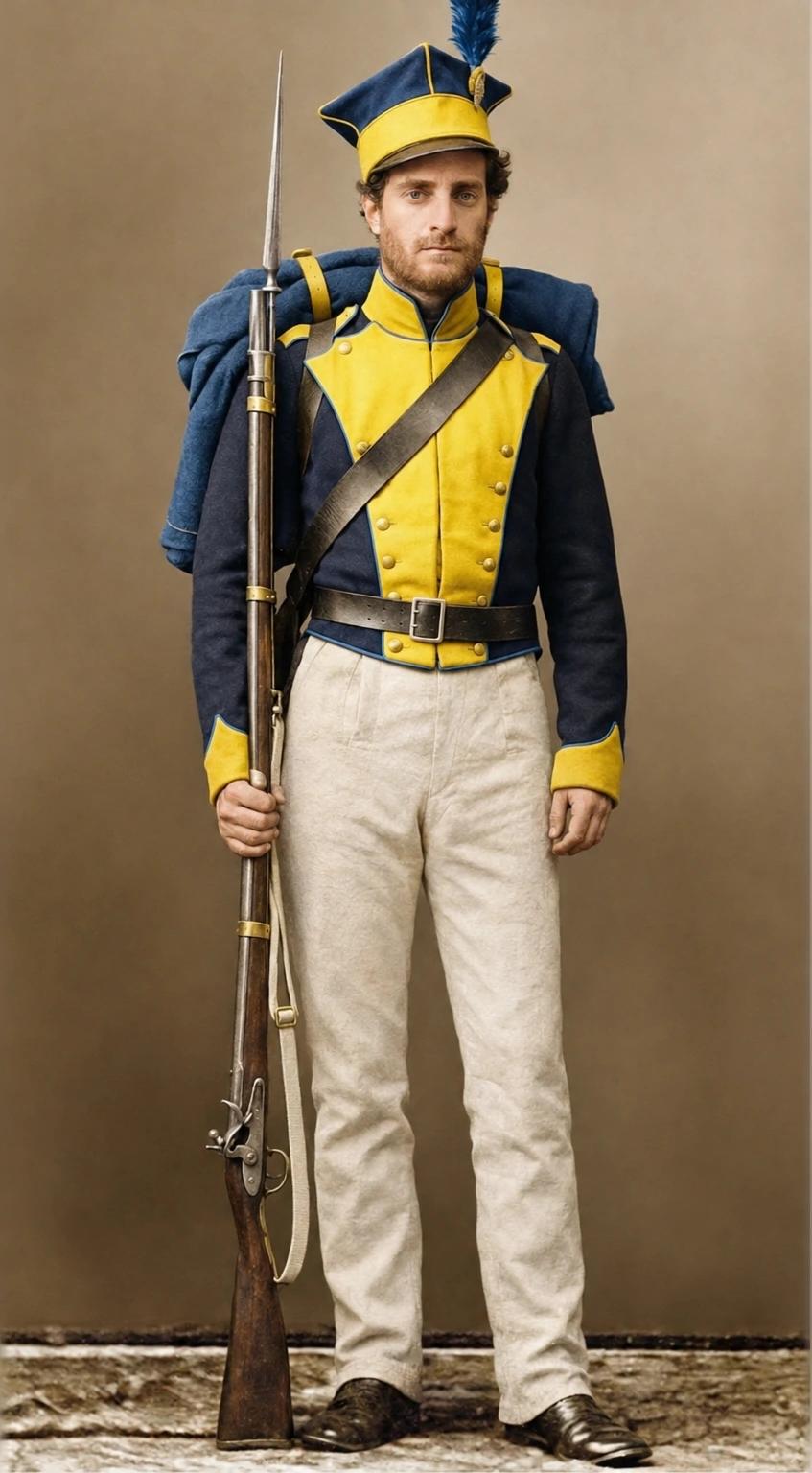
Uniform and equipment
| Uniform | Blue kurtka, yellow facings, square top shako |
|---|---|
| Dress uniform | Czapka style shako, blue and yellow |
| Headgear | Czapka (Square topped shako) |
| Equipment | Musket, bayonet |
| Insignia and standard | Brass sunburst shako plate |
Service record
| First appeared | 1808 |
|---|---|
| Peak strength | 4 Regiments |
| Recruited from | Polish Veterans |
| Primary tactic | Shock Infantry |
| Signature engagement | Siege of Saragossa (1808) |
| Motto or battle cry | Jeszcze Polska nie zginęła (Poland is not yet lost) |
| Obsolescence | Fall of Napoleon |
Timeline
- 1808: Formation. Created in Silesia from the remnants of the Polish-Italian Legion, officially entering French service.
- 1808: Deployment to Spain. The Legion is sent to the Peninsula, immediately engaging in the Siege of Saragossa.
- 1810: Defense of Fuengirola. A legendary defensive action where a skeleton force defeated a major British landing.
- 1812: Russian Campaign. Transferred to the Grande Armée for the invasion of Russia; attached to the Imperial Guard.
- 1813: German Campaign. Decimated remnants fight at Leipzig; the unit is effectively destroyed as a cohesive legion.
- 1814: Disbandment. Following Napoleon's abdication, the survivors return to Poland or are absorbed into the Russian army.
Battles
First Siege of Saragossa
The Legion underwent a baptism of fire in brutal urban combat. Fighting room-to-room against fanatical Spanish resistance, they proved their worth as shock troops, though the French forces were eventually forced to lift the siege temporarily.
Battle of Fuengirola
In a display of sheer tenacity, a small garrison of roughly 400 Poles repelled a combined British-Spanish amphibious assault of over 3,000 men. Their stubborn defense humiliated the British commander Lord Blayney, who was captured.
Battle of Berezina
Serving as the rear guard for the retreating Grande Armée, the remnants of the Legion held the line against overwhelming Russian numbers. They bought time for the Emperor to cross, sacrificing themselves in the freezing mud to save the army.
Commanders
Józef Chłopicki
A commander of iron discipline and explosive temper, Chłopicki forged the Legion into a weapon of war. Respected by Napoleon and feared by his enemies, he led his men through the hell of Saragossa with cold, tactical brilliance before resigning in 1812 due to a lack of promotion.
Józef Chłusowicz
A stalwart colonel who took command of the 1st Regiment. He led his troops through the grueling Peninsular campaigns and the freezing retreat from Moscow, maintaining cohesion when lesser units crumbled under the weight of the Russian winter.
Tactics
Shock Column
Rapid, aggressive movement in column formation designed to smash through enemy lines before they could reload.
Urban Clearance
Ruthless house-to-house fighting techniques perfected in Saragossa, utilizing grenades and bayonets in confined spaces.
Bayonet Charge
The Legion famously preferred cold steel over musketry, often closing distance under fire to engage in hand-to-hand combat.