
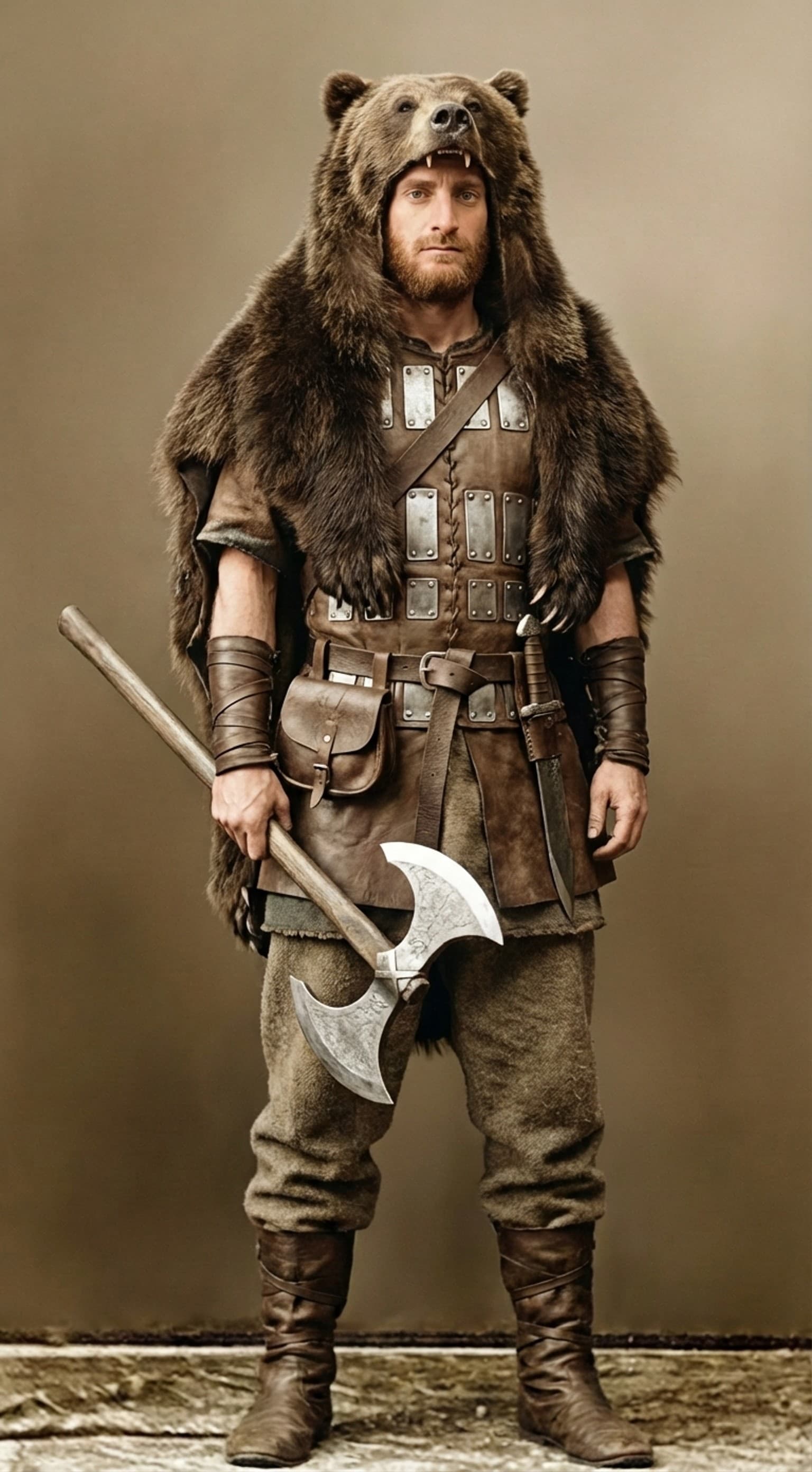
Uniform and equipment
| Uniform | Bear or wolf skins, no armor |
|---|---|
| Dress uniform | N/A |
| Headgear | Animal head pelt |
| Equipment | Axe or sword, shield (often bitten) |
| Insignia and standard | Wolf/Bear pelts worn |
Service record
| First appeared | 800 AD |
|---|---|
| Peak strength | Small bands |
| Recruited from | Religious Cultists |
| Primary tactic | Fearless Charge |
| Signature engagement | Battle of Stamford Bridge (1066) |
| Motto or battle cry | Odin! (and animal roars) |
| Obsolescence | Christianization |
Timeline
- 872: Unification of Norway. Berserkers gain prominence as the elite prow-defenders for King Harald Fairhair at Hafrsfjord.
- 981: Christianization Pressure. As Christianity spreads, the 'heathen' nature of the berserker rage begins to face social and legal stigma in Iceland.
- 1015: Ban in Norway. Jarl Eiríkr Hákonarson outlaws berserkers in Norway, marking the end of their status as royal bodyguards.
- 1066: End of the Viking Age. The defeat at Stamford Bridge symbolizes the final decline of traditional Viking raiding tactics and the berserker cult.
- 1123: Codified Prohibition. Icelandic Christian Law explicitly bans 'going berserk', punishing the act with lesser outlawry.
Battles
Battle of Hafrsfjord
The defining naval clash for Norway's unification. Berserkers were stationed at the prows of the longships, the most dangerous position, clearing enemy decks with frenzied assaults that shattered opposing shield walls.
Battle of Stiklestad
King Olaf II's attempt to retake Norway. His army included fierce shock troops, but the berserkers reportedly charged prematurely in their rage, disrupting the formation and contributing to the King's encirclement and death.
Battle of Stamford Bridge
The twilight of the Viking Age. While the Norse army was caught unarmored, a single berserker held the bridge crossing, demonstrating the terrifying individual lethality of the cult before the English army overwhelmed the invaders.
Commanders
Egill Skallagrímsson
A warrior-poet of immense strength and volatile temper. Known for his cranial thickness and primal rages, Egill embodied the complex duality of the berserker: a sophisticated skald capable of unspeakable violence in the heat of battle.
Harald Fairhair
The first King of Norway who institutionalized berserkers as royal shock troops. He kept a retinue of these 'wolf-coats' on his flagship, utilizing their terrifying reputation to unify the fractured petty kingdoms of the North.
The Lone Warrior of Stamford Bridge
An anonymous giant of a man who held the narrow bridge against the entire English army. Wielding a massive Dane axe, he reportedly slew 40 Saxons single-handedly, buying time for his kin to form lines, before being killed from below.
Tactics
Berserkergang
A self-induced trance state characterized by shivering, teeth-chattering, and howling, culminating in a blind, pain-numbing fury.
Shield-Biting
A psychological display where warriors gnawed on their shield rims to demonstrate total loss of humanity and intimidate foes before the charge.
The Boar Snout
A wedge formation (Svinfylking) where berserkers formed the tip, using their weight and ferocity to shatter the enemy shield wall on impact.