
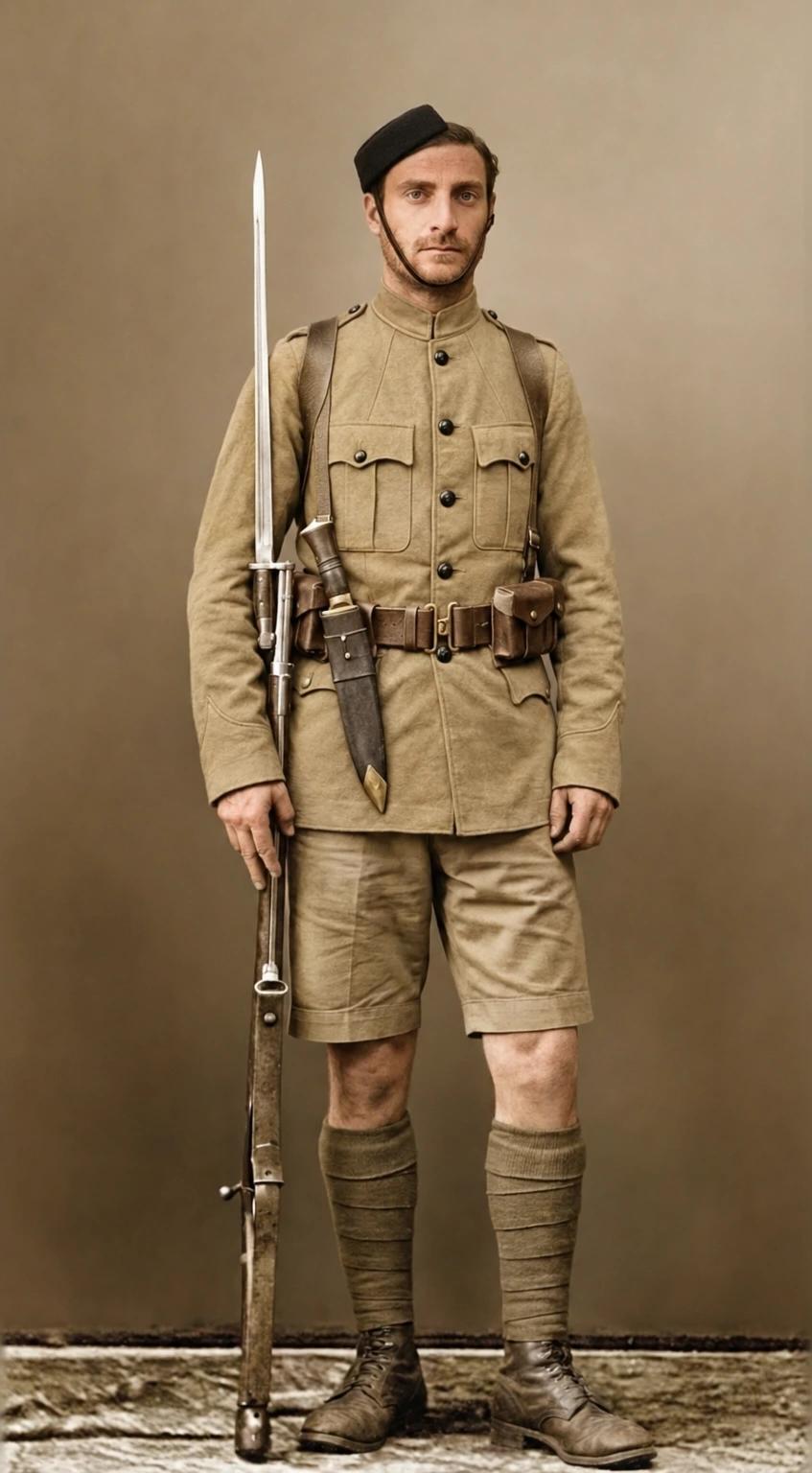
Uniform and equipment
| Uniform | Khaki drill tunic and shorts, puttees |
|---|---|
| Dress uniform | Rifle Green |
| Headgear | Black Kilmarnock cap |
| Equipment | Kukri, Rifle |
| Insignia and standard | Crossed kukris |
Service record
| First appeared | 1890s |
|---|---|
| Peak strength | Battalions |
| Recruited from | Nepalese Hill Tribes |
| Primary tactic | Stealth / Close Combat |
| Signature engagement | Tirah Campaign (1897) |
| Motto or battle cry | Jai Mahakali, Ayo Gorkhali! (Victory to Goddess Mahakali, here come the Gurkhas!) |
| Obsolescence | N/A (Still Active) |
Timeline
- 1815: Formation of the Nusseree Battalion. Following the Anglo-Nepalese War, the British East India Company begins recruiting their former enemies, forming the first Gurkha units.
- 1857: Siege of Delhi. The Sirmoor Battalion (later 2nd Gurkhas) defends Hindu Rao's House for months, suffering heavy casualties but earning the right to carry a Queen's Truncheon.
- 1878: Second Anglo-Afghan War. Gurkha units are deployed extensively as scouts and shock troops in the rugged terrain of Afghanistan.
- 1897: Tirah Campaign. The high-water mark of frontier warfare. Gurkha scouts prove indispensable in navigating the tribal territories of the Afridis.
- 1903: Kitchener Reforms. The Indian Army is reorganized, and the Gurkha regiments are permanently numbered (1st through 10th), solidifying their identity.
Battles
Battle of Peiwar Kotal
A masterclass in mountain warfare. Gurkha scouts identified a hidden goat path, allowing British forces to execute a silent night march and flank the Afghan stronghold, turning a potential stalemate into a decisive rout.
Defense of Chitral
A grueling 48-day siege where a small detachment of Sikhs and Gurkhas held out against thousands of besiegers. The Gurkhas' ability to sortie at night and silence enemy miners saved the fort from being breached.
Battle of Dargai Heights
The defining moment for the Gurkhas in the Victorian era. Facing Afridi tribesmen on sheer cliffs, the scouts led a frontal assault into a 'kill zone' swept by enemy fire, securing the heights through sheer grit and the terrifying threat of the kukri.
Commanders
Field Marshal Frederick Roberts
Known as 'Bobs', he held the Gurkhas in the highest esteem, utilizing their scouting abilities extensively during the Second Anglo-Afghan War. He cemented the regiment's reputation as the premier hill-fighting force of the Empire.
Colonel John Frederick McCausland
Commanded the 1st Battalion, 2nd Gurkhas during the Tirah Campaign. His leadership was instrumental during the assault on the Dargai Heights, where he directed his scouts to scale precipitous cliffs to flank entrenched tribal positions.
Tactics
High-Altitude Piquet
Scouts would race to seize the highest peaks overlooking a marching column. By holding the high ground, they prevented tribal snipers from firing down on the main body of troops.
The Kukri Rush
When ammunition ran low or stealth was broken, the unit would cease firing and charge en masse with drawn blades. The psychological impact often broke enemy morale before contact was made.
Silent Sentry Removal
Operating at night, scouts would infiltrate enemy camps. Using the inward curve of the kukri, they could neutralize guards instantly and silently, opening gaps for the main assault.