
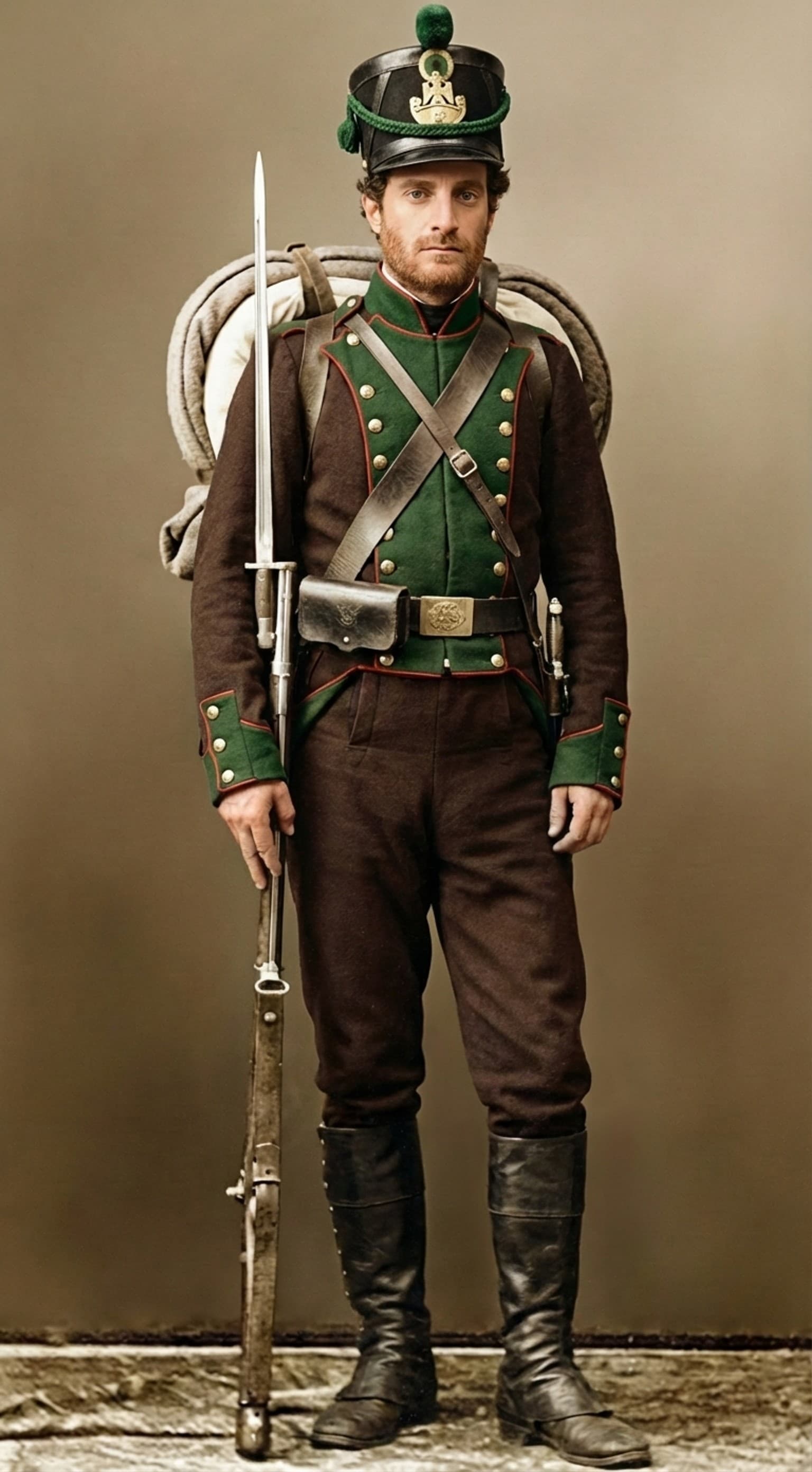
Uniform and equipment
| Uniform | Dark brown or green jacket, black facings |
|---|---|
| Dress uniform | Dark jacket with silver lace, epaulettes |
| Headgear | Barretina or shako with light plume |
| Equipment | Rifle, bayonet, sabre-briquet |
| Insignia and standard | Brass bugle horn with regimental number |
Service record
| First appeared | 1808 |
|---|---|
| Peak strength | ~15,000 men |
| Recruited from | Agile Conscripts |
| Primary tactic | Sharpshooting |
| Signature engagement | Battle of Bussaco (1810) |
| Motto or battle cry | Que nunca por vencidos se conheçam (That they may never be known as defeated) |
| Obsolescence | Universal Rifles |
Timeline
- 1808: Formation. Following the French occupation, the Portuguese army is reorganized; the first six battalions of Caçadores are created by royal decree.
- 1809: Beresford's Reforms. William Beresford arrives to retrain the army, instituting British drill manuals and harsh discipline to professionalize the light infantry.
- 1810: Defense of Bussaco. The Caçadores earn international renown by repelling French assaults on the ridges of Bussaco.
- 1811: Expansion. Due to their battlefield success, the number of Caçadores battalions is expanded to twelve to support the growing Allied offensive.
- 1813: Crossing the Pyrenees. The unit participates in the invasion of France, fighting through the rugged mountain passes where their skirmishing skills are paramount.
- 1814: End of Campaign. After the Battle of Toulouse and Napoleon's abdication, the veteran battalions return to Portugal as national heroes.
Battles
Battle of Bussaco
The proving ground for the reformed Portuguese army. Caçadores battalions held the ridges against Masséna's veteran French columns, delivering withering volleys that halted the assault and proved they were equal to any soldier in Europe.
Battle of Fuentes de Oñoro
Engaged in brutal house-to-house fighting, the Caçadores demonstrated their tenacity in close quarters, holding key positions in the village against overwhelming French numbers in a bloody, confused melee.
Battle of Salamanca
Operating as part of the Allied offensive, Caçadores units screened the rapid maneuvers that caught the French off guard, harassing the enemy flanks and contributing to the destruction of Marmont's army.
Battle of Toulouse
In the final major engagement of the Peninsular War, the Caçadores fought on French soil, storming fortified heights and cementing their legacy as the premier light infantry of the Iberian campaign.
Commanders
William Carr Beresford
A strict British disciplinarian appointed Marshal of the Portuguese Army. He ruthlessly drilled the disorganized Portuguese levies, transforming the Caçadores into an elite fighting force that Wellington dubbed the 'Fighting Cocks' of the army.
Arthur Wellesley (Duke of Wellington)
While supreme commander of the Allied forces, Wellington integrated the Caçadores directly into British divisions. He placed immense trust in their marksmanship and discipline, often relying on them to screen the advance of his heavy infantry.
Tactics
Skirmish Screening
Deployed in loose order ahead of the main battle line to harass enemy columns, pick off officers, and disrupt formations before the main engagement.
Terrain Utilization
Masters of the rugged Iberian landscape, they utilized rocks, scrub, and ridges for cover, firing from concealed positions unlike the rigid line infantry.
Targeted Sharpshooting
Elite companies equipped with rifles specifically targeted French officers and NCOs to degrade the enemy's command and control structure.