
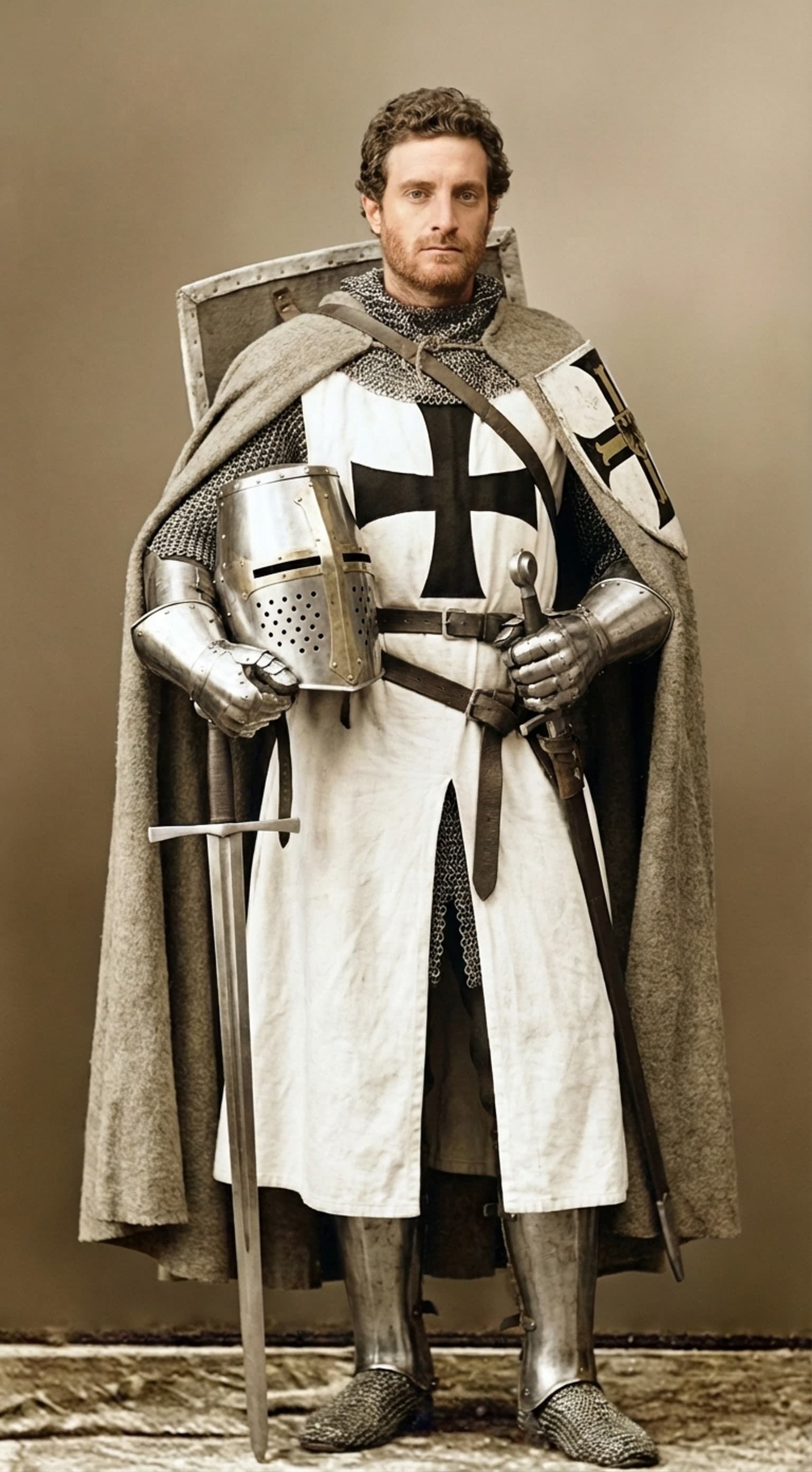
Uniform and equipment
| Uniform | White surcoat with black cross over mail and later plate |
|---|---|
| Dress uniform | Full white cloaks with large black cross, decorated belts |
| Headgear | Bascinet or great helm, often painted white or with crosses |
| Equipment | Lance, sword, mace, heater shield with black cross |
| Insignia and standard | Black cross on white surcoat/shield |
Service record
| First appeared | 1190s |
|---|---|
| Peak strength | 1,000–1,500 knights plus many retainers |
| Recruited from | German Nobility |
| Primary tactic | Heavy Cavalry Wedge |
| Signature engagement | Battle of Lake Peipus (1242) |
| Motto or battle cry | Helfen, Wehren, Heilen (Help, Defend, Heal) |
| Obsolescence | Battle of Grunwald / Secularization |
Timeline
- 1190: Foundation in Acre. Established originally as a field hospital for German crusaders during the Siege of Acre in the Holy Land.
- 1198: Militarization. Pope Innocent III grants the brethren status as a military order, modeling them after the Templars and Hospitallers.
- 1226: Golden Bull of Rimini. Emperor Frederick II grants the Order sovereignty over Prussia, sanctioning the Northern Crusades.
- 1230: Prussian Crusade Begins. The Order crosses the Vistula river, beginning a brutal, decades-long campaign to conquer and Christianize the pagan Prussians.
- 1309: Move to Marienburg. Grand Master Siegfried von Feuchtwangen moves the Order's headquarters from Venice to Marienburg, solidifying the monastic state.
- 1386: Christianization of Lithuania. Jogaila of Lithuania converts to Catholicism, removing the Order's primary religious justification for war, though conflict continues.
- 1410: Disaster at Grunwald. The Order suffers a catastrophic defeat against the Polish-Lithuanian union, losing its Grand Master and military elite.
- 1466: Second Peace of Thorn. The Order cedes West Prussia to Poland and the Grand Master becomes a vassal of the Polish King.
- 1525: Secularization. Grand Master Albert of Brandenburg converts to Lutheranism and secularizes the Prussian territories, ending the monastic state.
Battles
Battle of the Ice
On the frozen surface of Lake Peipus, the Order's heavy cavalry charged Alexander Nevsky's Novgorod militia. Bogged down in close quarters and outmaneuvered on the ice, the Knights were routed, halting their eastward expansion into Orthodox Russia.
Battle of Grunwald (Tannenberg)
One of the largest battles of the Middle Ages. The Order faced the combined might of Poland and Lithuania. Despite initial success, the Knights were encircled and annihilated, breaking their military dominance in the Baltic forever.
Siege of Marienburg
Following the catastrophe at Grunwald, Heinrich von Plauen organized a fanatical defense of the Order's capital. Their successful resistance against the Polish-Lithuanian siege saved the Teutonic State from total dissolution.
Commanders
Hermann von Salza
The Grand Master who transformed a small field hospital into a continental power. A master diplomat and strategist, he navigated the politics of Pope and Emperor to secure the Golden Bull of Rimini, laying the foundation for the Order's State in Prussia.
Winrich von Kniprode
The longest-serving Grand Master, presiding over the Order's Golden Age. He modernized the army, instituted rotational training for knights, and waged relentless crusades against Lithuania while turning Marienburg into a cultural capital.
Ulrich von Jungingen
A brave but impetuous leader whose aggression precipitated the disastrous war with Poland-Lithuania. He died leading a desperate final charge at the Battle of Grunwald, refusing to flee as his army collapsed around him.
Tactics
The Boar's Snout (Cuneus)
A heavy cavalry wedge formation. The best-armored knights formed the tip and sides to break the enemy line, while squires and sergeants filled the center to exploit the breach.
Brick Gothic Fortification
The strategic construction of massive red-brick castles (Ordensburgen) within a day's ride of each other to secure conquered territory and serve as logistical hubs.
Schützen Support
The deployment of mounted crossbowmen and light cavalry (often native auxiliaries) to harass enemy flanks and screen the heavy cavalry's deployment.
Reisen (Raiding)
Seasonal, relentless raids into pagan territory designed to degrade enemy resources and morale, often treating war as a continuous liturgical duty.