
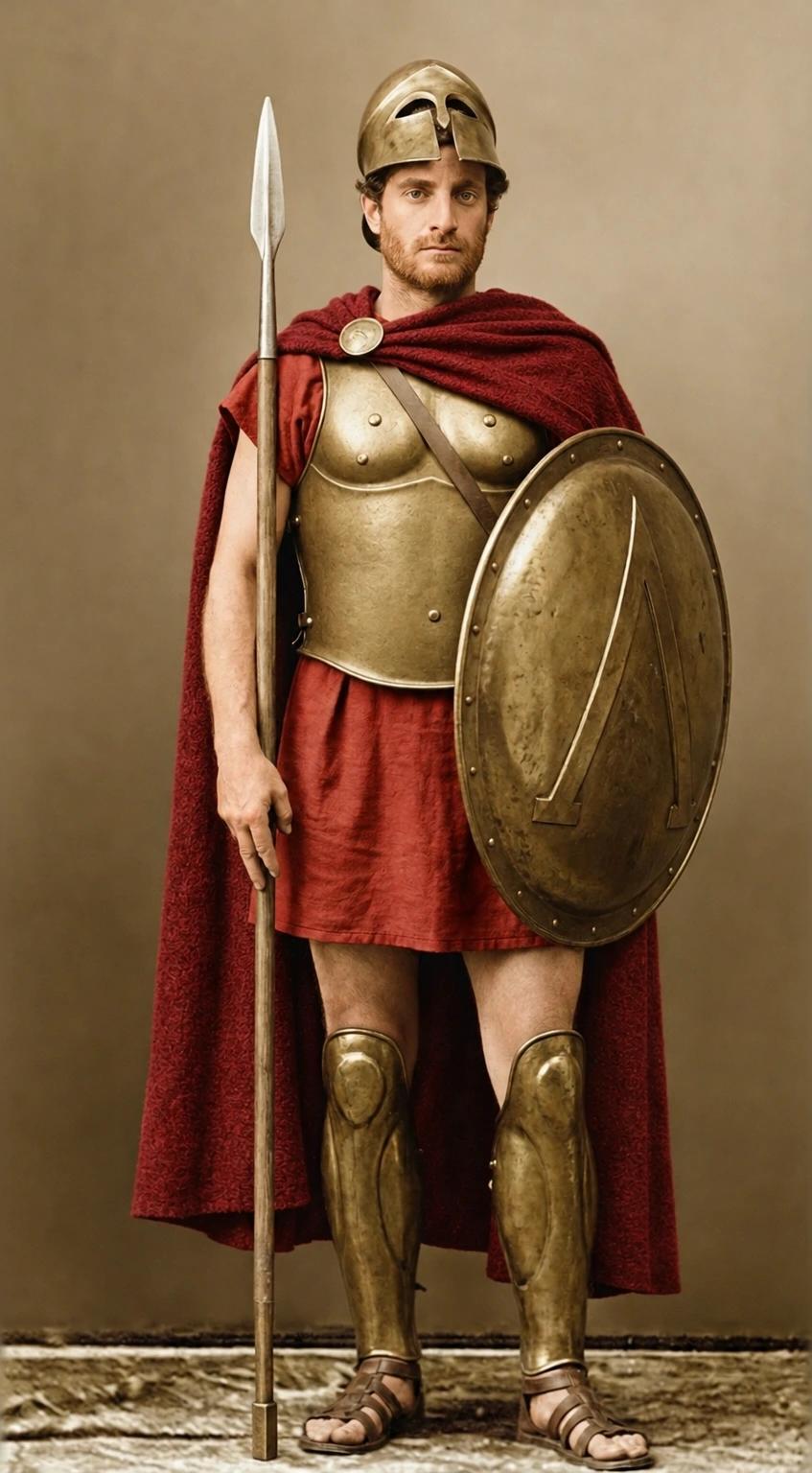
Uniform and equipment
| Uniform | Crimson tunic, bronze cuirass or bell cuirass, bronze greaves |
|---|---|
| Dress uniform | Highly polished bronze armor, richly painted shields with lambda |
| Headgear | Bronze Corinthian helmet (crest optional) |
| Equipment | Doru spear, hoplon shield, xiphos short sword |
| Insignia and standard | Lambda (Λ) red on shield |
Service record
| First appeared | c. 800 BC |
|---|---|
| Peak strength | ~8,000 citizen-soldiers |
| Recruited from | Spartiate Citizens (Homoioi) |
| Primary tactic | Phalanx Push (Othismos) |
| Signature engagement | Battle of Thermopylae (480 BC) |
| Motto or battle cry | Molon Labe (Come and take them - attributed) |
| Obsolescence | Manpower Decline / Flexible Tactics |
Timeline
- 700 BC: Lycurgan Reforms. Semi-mythical establishment of the Great Rhetra, creating the militaristic society, the Agoge education system, and the professional citizen-soldier class.
- 546 BC: Battle of the Champions. Sparta defeats Argos, establishing dominance over the Peloponnese.
- 480 BC: Defense of Thermopylae. King Leonidas and the 300 die defending the pass, cementing the Spartan reputation for fearlessness.
- 431 BC: Peloponnesian War Begins. Start of the protracted conflict with the Delian League led by Athens.
- 404 BC: Fall of Athens. Sparta emerges as the hegemon of Greece after Lysander's victory.
- 371 BC: Disaster at Leuctra. Theban victory destroys Spartan manpower reserves; the decline of Sparta as a major power begins.
- 195 BC: War against Nabis. Roman intervention forces Sparta to surrender, effectively ending its independence as a military state.
Battles
Battle of Thermopylae
A tactical defeat but a strategic and moral triumph. A small vanguard held the narrow pass against Xerxes' massive army for three days, inflicting disproportionate casualties before being flanked and fighting to the last man.
Battle of Plataea
The final land battle of the second Persian invasion. Spartan hoplites withstood a withering arrow storm before unleashing a devastating charge that crushed the Persian infantry and killed their commander, Mardonius.
Battle of Mantinea
The largest hoplite battle of the Peloponnesian War. Despite a collapsing left flank, the Spartan veterans on the right crushed their opposites and wheeled inward, displaying superior drill discipline to dismantle the Argive coalition.
Battle of Leuctra
The catastrophe that broke Spartan power. Theban general Epaminondas used an oblique order to smash the Spartan right wing, killing King Cleombrotus and shattering the myth of Spartan invincibility.
Commanders
Leonidas I
The embodiment of Spartan agoge discipline. He led 300 Spartiates and a coalition of Greeks to the Hot Gates, choosing annihilation over retreat to delay the Persian juggernaut. His sacrifice defined the Spartan ethos for eternity.
Lysander
A ruthless and innovative strategist who broke the Athenian naval stranglehold. He engineered the final victory in the Peloponnesian War, tearing down the Long Walls of Athens and establishing Spartan hegemony.
Pausanias
Regent of Sparta who commanded the combined Greek forces at Plataea. Despite later controversies, his tactical leadership shattered Mardonius's Persian army, effectively ending the invasion of Greece.
Tactics
The Phalanx
A dense block of armored spearmen, usually 8 ranks deep. It functioned as a singular armored organism, relying on absolute cohesion rather than individual prowess.
Othismos (The Shove)
The critical moment of battle where the front ranks locked shields and physically pushed against the enemy line, driving spears forward while the rear ranks added weight to break the opponent's formation.
Lacedaemonian Drill
Unlike other Greeks, Spartans drilled to music (aulos). This allowed them to perform complex maneuvers, such as wheeling or counter-marching, in silence and perfect order amidst the chaos of battle.