
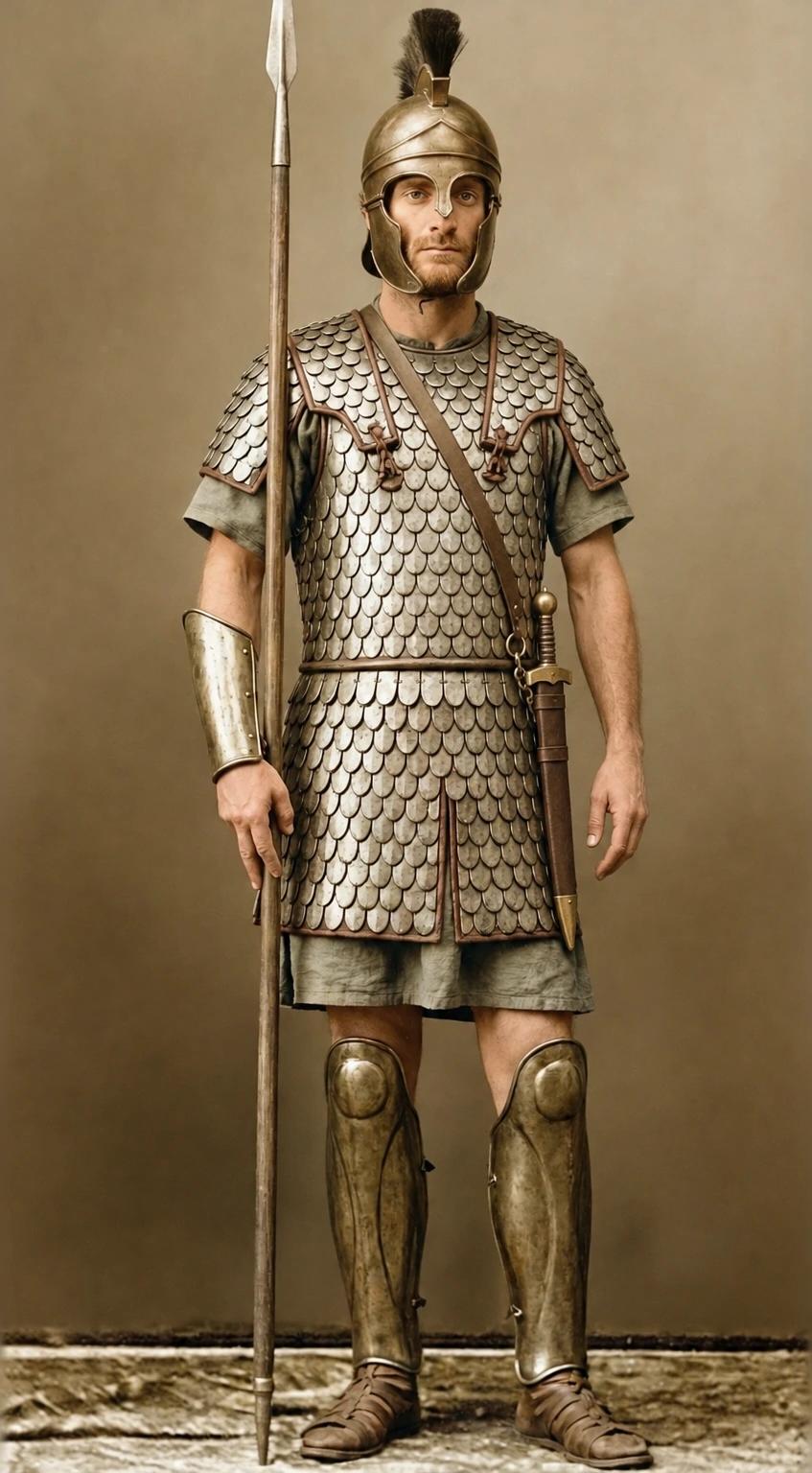
Uniform and equipment
| Uniform | Scale or lamellar armor for rider and horse, long tunic |
|---|---|
| Dress uniform | Gilded scales, colored plumes, ornate horse barding |
| Headgear | Conical or dome helmet with face guard |
| Equipment | Long kontos lance, sword, sometimes bow |
| Insignia and standard | Inverted anchor dynastic symbol |
Service record
| First appeared | 3rd century BC |
|---|---|
| Peak strength | ~5,000 riders |
| Recruited from | Military Settlers |
| Primary tactic | Shock Charge |
| Signature engagement | Battle of Magnesia (190 BC) |
| Motto or battle cry | Nicator (Victor) |
| Obsolescence | Roman Legion Tactics |
Timeline
- 63: Roman Annexation. Pompey the Great annexes Syria; the remnants of the Seleucid heavy cavalry traditions are absorbed or disbanded.
- 166: Daphne Parade. Antiochus IV displays 1,500 fully armored cataphracts, showcasing the unit as the pinnacle of royal power.
- 190: Disaster at Magnesia. The loss to Rome signals the decline of Seleucid hegemony, though the cataphracts remain a feared elite unit.
- 200: Triumph at Panium. The cataphracts prove their supremacy over traditional Hellenistic cavalry in the Fifth Syrian War.
- 209: Eastern Anabasis. Antiochus III campaigns in Bactria and Parthia, adopting heavier armor styles from the steppe nomads.
- 312: Foundation of the Empire. Seleucus I Nicator secures access to Media and the superior horse breeding grounds of the East.
Battles
Battle of Beth Zechariah
Deployed alongside war elephants, the heavy cavalry proved impenetrable to the Maccabean infantry. The combination of armored beasts and iron-clad riders forced the Jewish rebels to retreat to Jerusalem.
Battle of Magnesia
A tragic display of individual valor amidst tactical failure. While the cataphracts successfully routed the Roman left legion, they pursued too far. The exposed Seleucid phalanx collapsed, turning a potential victory into a catastrophic empire-breaking defeat.
Battle of Panium
The defining moment for Seleucid heavy horse. Antiochus III's cataphracts shattered the Ptolemaic right flank, encircling the enemy infantry. The sheer weight of the armored charge proved decisive in securing Coele-Syria for the empire.
Commanders
Antiochus IV Epiphanes
Known for the grand Review at Daphne, he displayed the sheer opulence and terror of the Seleucid war machine. Under his rule, the cataphract corps was standardized and heavily armored, serving as the iron fist in his campaigns against Egypt and the Maccabees.
Antiochus III the Great
A restless conqueror who restored the Seleucid Empire's glory. He integrated Eastern heavy cavalry traditions into the Hellenistic army, wielding his cataphracts as a sledgehammer at Panium to crush the Ptolemaic forces, though his aggression ultimately faltered against Rome.
Tactics
The Kontos Charge
A frontal assault where the rider grips the lance with both hands, using the horse's momentum to deliver a shield-shattering blow.
Column Formation
Deploying in deep columns rather than wide lines to maximize the physical weight of the impact on a specific point of the enemy line.
Combined Arms Hammer
Acting as the mobile hammer to the phalanx's anvil, swinging wide to crush the enemy flanks while infantry held the center.