
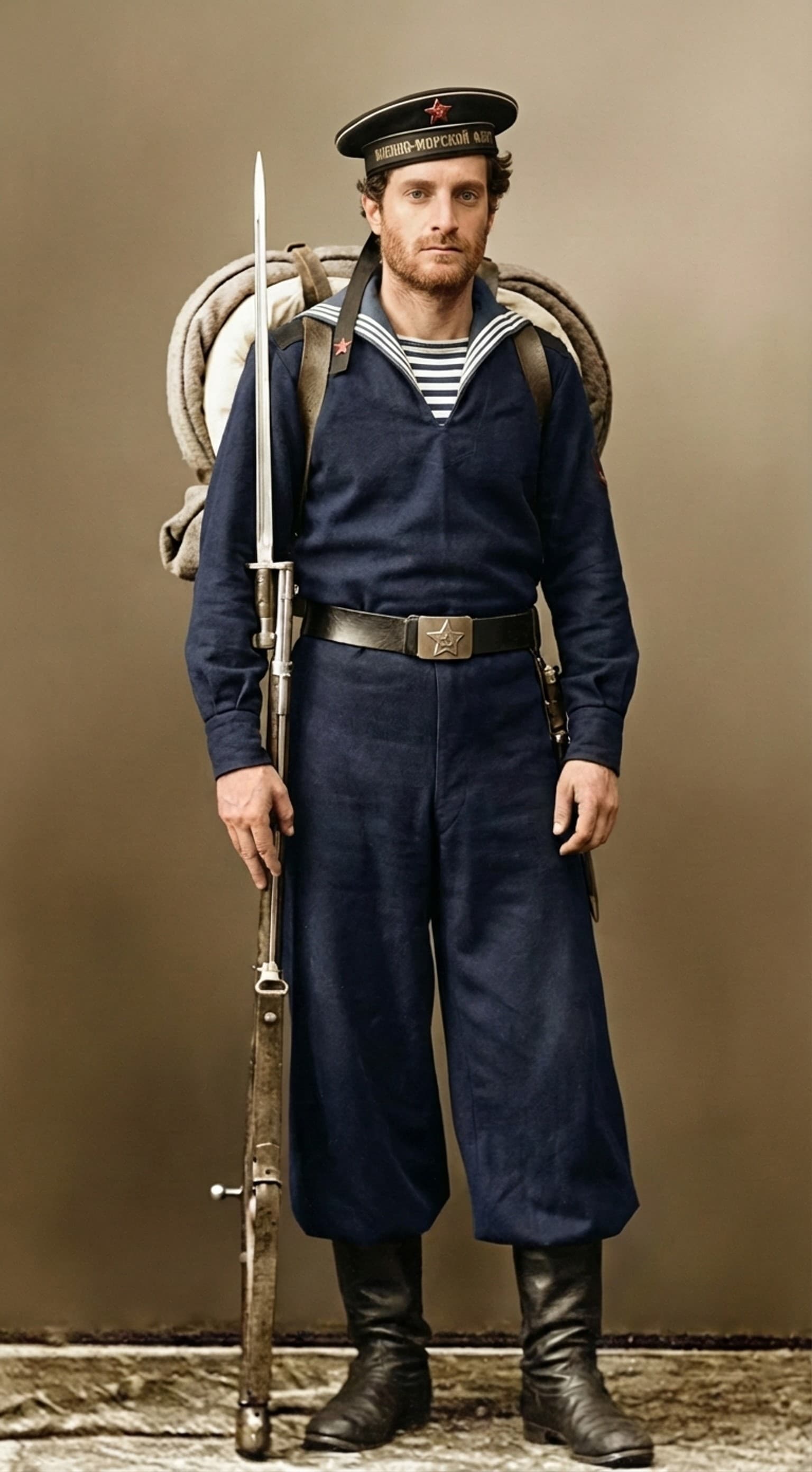
Uniform and equipment
| Uniform | Black naval blouse with white-and-blue striped shirt (telnyashka), black trousers |
|---|---|
| Dress uniform | Black tunic with gold buttons, white belt, medals |
| Headgear | Black sailor cap (beskozyrka) with ribbon, steel helmet in combat |
| Equipment | Rifle or PPSh SMG, bayonet, grenades |
| Insignia and standard | Gold anchor sleeve patch; telnyashka |
Service record
| First appeared | 1918 |
|---|---|
| Peak strength | ~350,000 men |
| Recruited from | Navy Sailors / Conscripts |
| Primary tactic | Amphibious Landing / Shock |
| Signature engagement | Defense of Sevastopol (1941-42) |
| Motto or battle cry | Polundra! (Look out!) |
| Obsolescence | N/A (Still Active) |
Timeline
- 1705: Formation. Peter the Great establishes the first Regiment of Naval Soldiers, laying the historical foundation for Russian marine forces.
- 1940: Reorganization. Recognizing the looming threat of war, the Soviet Navy begins forming specialized Naval Infantry brigades.
- 1941: Mass Mobilization. Following the German invasion, hundreds of thousands of sailors are transferred to land fronts to halt the Blitzkrieg at Odessa, Leningrad, and Sevastopol.
- 1943: Amphibious Offensives. Shift from desperate defense to offense; successful landings at Novorossiysk and Kerch mark the turning of the tide in the Black Sea.
- 1945: Manchurian Operation. Pacific Fleet marines execute rapid amphibious assaults against Japanese forces in Korea and the Kuril Islands.
- 1989: Cold War Peak. The force reaches its zenith as a mechanized arm of the Soviet Navy before the dissolution of the USSR.
Battles
Defense of Sevastopol
For 250 days, Naval Infantry anchored the defense of the fortress city against overwhelming Axis forces. Though the city eventually fell, their ferocious resistance tied up the German 11th Army, delaying the advance on Stalingrad and cementing their reputation as the 'Black Death'.
Battle of Stalingrad
Stripped from ships and deployed as shock infantry, sailors of the Volga Flotilla and Pacific Fleet fought in the ruins. Their refusal to retreat, famously fighting in burning grain elevators and sewers, was instrumental in breaking the Wehrmacht's morale.
Malaya Zemlya Landing
Under Kunikov, a small force seized a rocky beachhead against heavy fire. They held the ground for 225 days against artillery and air raids, eventually facilitating the liberation of Novorossiysk and the Taman Peninsula.
Commanders
Viktor Leonov
A legendary scout and two-time Hero of the Soviet Union. Operating in the Northern and Pacific Fleets, Leonov mastered the art of raids behind enemy lines, capturing German headquarters and Japanese garrisons often outnumbered, relying on stealth and sheer audacity.
Cesar Kunikov
A charismatic and fearless commander who led the legendary landing at Malaya Zemlya. Originally an engineer, his tactical brilliance turned a diversionary raid into a decisive beachhead. He died of wounds sustained in battle, becoming a posthumous Hero of the Soviet Union.
Tactics
Psychological Shock
Marines often discarded helmets for sailor caps and attacked silently or with a distinct 'Polundra!' war cry, wearing black uniforms to terrify enemy infantry.
Tactical Amphibious Desant
Rapid deployment of light infantry from small craft directly onto hostile beaches to seize ports or disrupt enemy rear guards.
Urban Assault Groups
Organized into small, heavily armed storm groups equipped with SMGs, flamethrowers, and explosives for house-to-house clearing.