
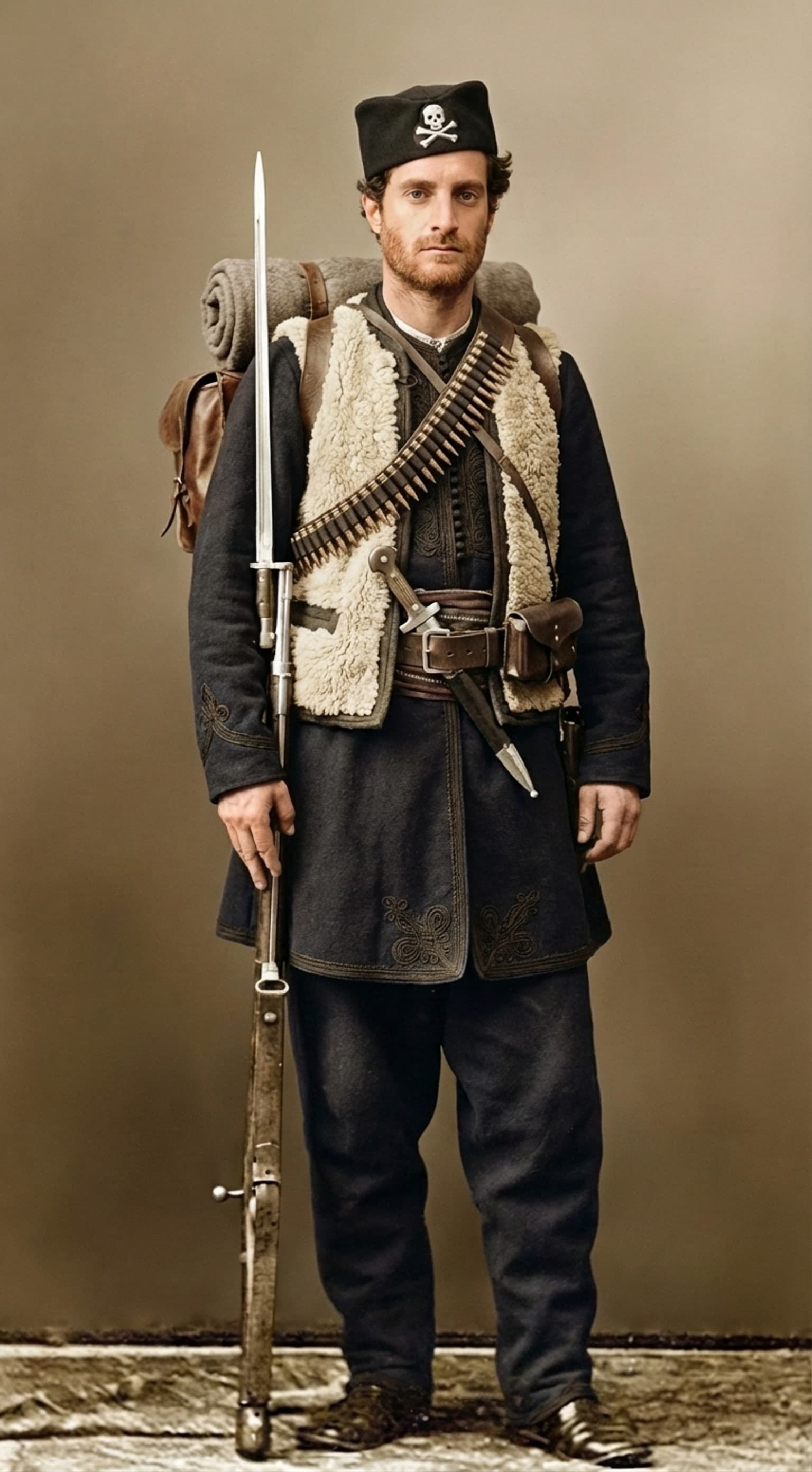
Uniform and equipment
| Uniform | Peasant clothes, fur hat, bandoliers |
|---|---|
| Dress uniform | Black uniform with skull badge |
| Headgear | Šajkača or fur hat |
| Equipment | Rifle, dagger (kama), bombs |
| Insignia and standard | Skull and crossbones on flags and hats |
Service record
| First appeared | 1903 |
|---|---|
| Peak strength | Thousands |
| Recruited from | Volunteers |
| Primary tactic | Guerilla Raid |
| Signature engagement | Balkan Wars |
| Motto or battle cry | Sloboda ili Smrt (Freedom or Death) |
| Obsolescence | Role Shifted in WWII |
Timeline
- 1903: Formation of the Central Committee. Following the May Coup, the Serbian Chetnik Organization is founded in Belgrade to coordinate guerrilla activities in Ottoman-held Macedonia.
- 1904: Crossing the Drina. The first organized bands (četas) cross the border into Ottoman territory, marking the beginning of the armed struggle.
- 1908: Young Turk Revolution. Operations are temporarily suspended as the new Ottoman government promises reforms; Chetniks briefly lay down arms before hostilities resume.
- 1912: First Balkan War. Chetnik detachments are integrated into the regular Serbian Army structure as vanguard and sabotage units.
- 1914: Defense of Belgrade. At the outbreak of WWI, Chetnik units under Tankosić play a critical role in the urban defense of the capital against Austro-Hungarian forces.
- 1916: Dissolution of the Volunteer Detachment. After the devastation at Kajmakčalan and the death of Vojvoda Vuk, the remaining irregular units were disbanded or absorbed into the regular army.
Battles
Battle of Čelopek
A defining early engagement where a small band of Chetniks, surrounded by a massive Ottoman force, fought ferociously until dawn. Their survival and successful breakout cemented the mythos of the Chetnik's invincibility in the mountains.
Battle of Kumanovo
Serving as the vanguard for the First Serbian Army, Chetnik detachments engaged Ottoman forces in the fog before the main battle lines formed. Their disruption of the enemy flanks was crucial to the decisive Serbian victory of the First Balkan War.
Battle of Kajmakčalan
In the clouds of the Nidže mountains, the Volunteer Detachment stormed heavily fortified Bulgarian positions. The victory opened the gate to Serbia but cost the unit massive casualties, including the death of Vojvoda Vuk, effectively ending the classic Chetnik era.
Commanders
Vojin Popović (Vojvoda Vuk)
The most respected field commander of the Chetnik movement. Known as 'The Wolf', he led the Volunteer Detachment through the Balkan Wars and WWI. A strict disciplinarian who led from the front, he was killed storming the peaks of Kajmakčalan.
Vojislav Tankosić
A volatile and fearless major known for his brutality towards enemies and fierce loyalty to Serbia. A master of explosives and conspiracy, he orchestrated the guerrilla networks in Macedonia and played a pivotal role in the Black Hand. He died defending the retreat from Serbia in WWI.
Jovan Stojković (Vojvoda Babunski)
A former teacher turned warlord, Babunski became a legend for defending the Serbian population in Macedonia against Bulgarian Exarchists and Ottomans. His unit was renowned for its discipline and his personal charisma inspired folk songs.
Tactics
Nocturnal Infiltration
Units moved almost exclusively at night to bypass Ottoman checkpoints, striking villages or outposts before vanishing into the forests by dawn.
Bomb Shock
Initiating ambushes with a volley of hand grenades (bombs) to create chaos and smoke before charging with daggers and revolvers.
The Living Wall
A defensive tactic where Chetniks would hold mountain passes against superior numbers by utilizing pre-prepared rock cover and overlapping fields of fire.