
Uniform and equipment
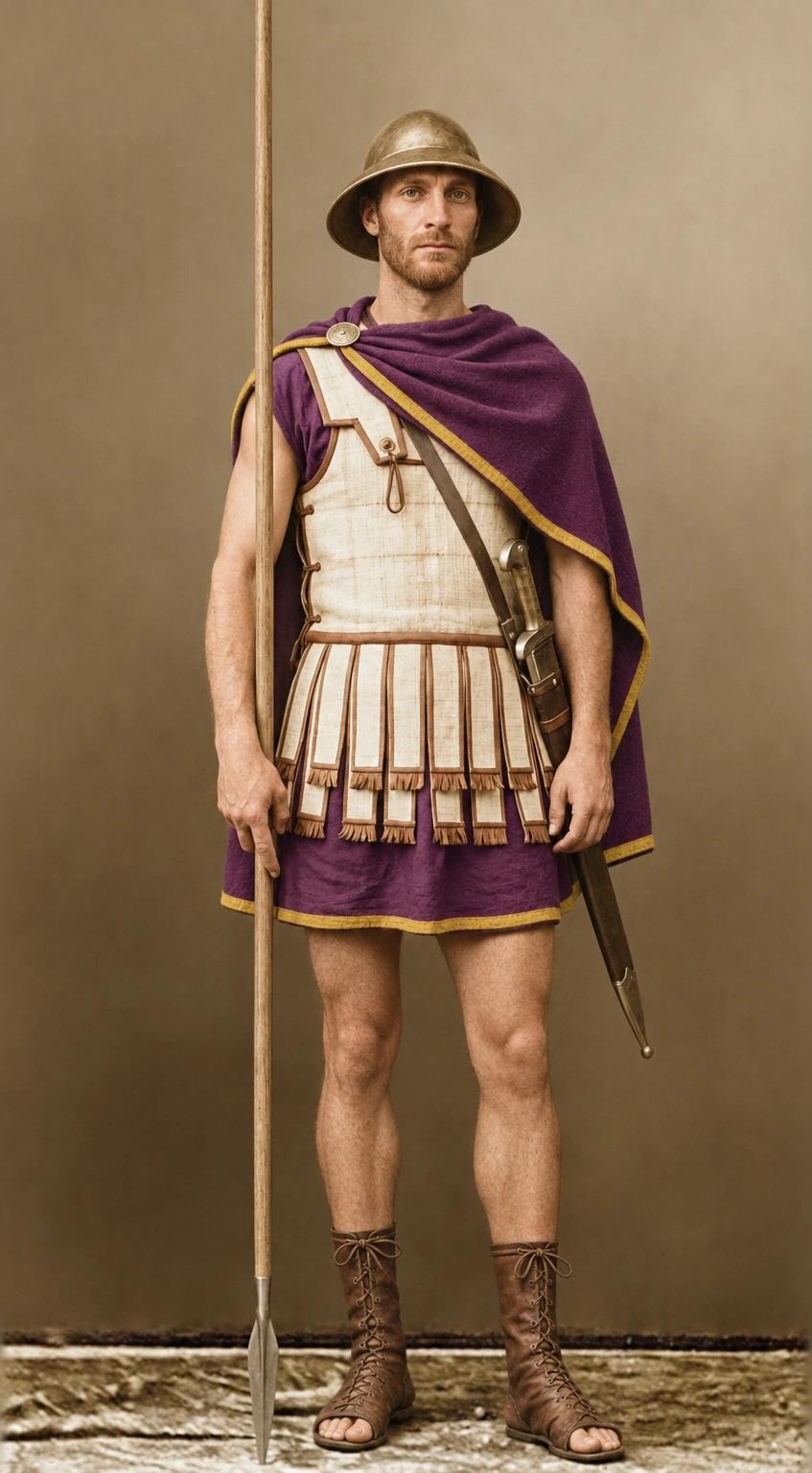
| Uniform | Short tunic and cuirass over trousers, ornate cloaks |
|---|---|
| Dress uniform | Bright cloaks in royal colors, muscle cuirasses with embossed motifs |
| Headgear | Boeotian cavalry helmet with crest and plume for officers |
| Equipment | Long xyston lance, sword or kopis, small cavalry shield for some |
| Insignia and standard | Vergina Sun (16- or 8-ray star) on standards/cloth |
Service record
| First appeared | 340s BC |
|---|---|
| Peak strength | 1,800–2,000 men |
| Recruited from | Macedonian Landed Nobility |
| Primary tactic | Wedge Formation Charge |
| Signature engagement | Battle of Gaugamela (331 BC) |
| Motto or battle cry | Alalai! (Battle cry) |
| Obsolescence | Fragmentation of Diadochi Kingdoms |
Timeline
- 323: Fragmentation. Upon Alexander's death in Babylon, the unit fractures as rival generals (Diadochi) claim squadrons for their own private armies.
- 330: Reorganization. Following the execution of Philotas, Alexander splits the command of the Companions to prevent any single individual from gaining too much power.
- 334: Invasion of Asia. The unit crosses the Hellespont, serving as the spearhead for the conquest of the Persian Empire.
- 338: The Hammer Strike. The Companions destroy the flower of Greek resistance at Chaeronea, establishing Macedonian hegemony.
- 359: Reformation under Philip II. King Philip II reorganizes the Macedonian nobility into a disciplined shock cavalry corps, introducing the wedge formation.
Battles
Battle of Chaeronea
The debut of the Companions as a decisive strategic asset. Led by an 18-year-old Alexander, they annihilated the Sacred Band of Thebes, proving the supremacy of the Macedonian 'Hammer and Anvil' tactic against Greek hoplites.
Battle of Gaugamela
The unit's magnum opus. Alexander identified a gap in the stretched Persian line and led the Companions in a terrifying wedge charge straight at Darius III, shattering the enemy's nerve and collapsing the Achaemenid Empire.
Battle of the Hydaspes
Facing King Porus's war elephants, the Companions displayed exceptional discipline. Unable to charge the beasts directly, they executed complex flanking maneuvers to dismantle the Indian cavalry, securing Alexander's final great victory.
Commanders
Alexander III of Macedon (The Great)
The warrior-king who personally led the Royal Squadron (Agema) into the heat of battle. His reckless bravery and tactical genius transformed the Companions into the ancient world's premier shock force, shattering empires from Greece to India.
Philotas
Son of Parmenion and commander of the Companion Cavalry during the early Persian campaigns. A skilled but arrogant leader, he orchestrated the cavalry's movements until his execution for conspiracy, marking a shift in the unit's command structure.
Cleitus the Black
Commander of the Royal Squadron who saved Alexander's life at the Granicus by severing a Persian arm mid-strike. A traditionalist veteran of Philip II's army, his tragic death at Alexander's drunken hand symbolized the growing rift within the ranks.
Tactics
The Flying Wedge (Embolon)
A triangular formation led by the commander at the apex. It allowed the unit to pierce enemy lines at a specific point and turn rapidly, acting like a blade cutting through fabric.
Hammer and Anvil
The phalanx (anvil) pinned the enemy infantry in place, while the Companions (hammer) circled wide to deliver a crushing blow to the rear or flank.
Face-Targeting Charge
Riders were trained to aim their lances at the faces of enemy cavalrymen, a psychological tactic that forced opponents to flinch or break formation before impact.