
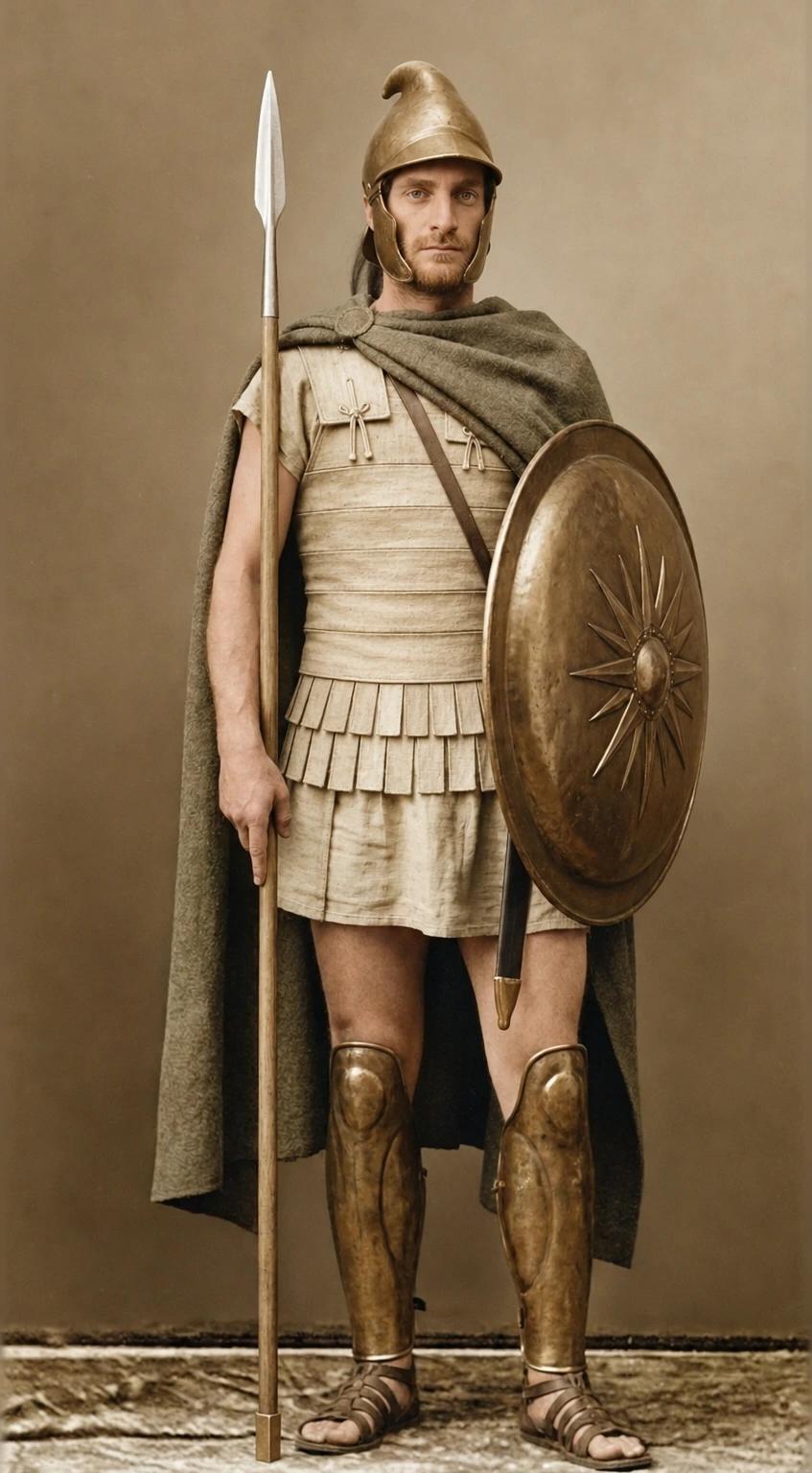
Uniform and equipment
| Uniform | Short tunic, linothorax armor, smaller shield than phalangites |
|---|---|
| Dress uniform | White tunics edged in purple, bronze muscle cuirass, ornate cloaks |
| Headgear | Phrygian or Boeotian helmet, often crested for officers |
| Equipment | Shorter spear than sarissa, round shield, sword or kopis |
| Insignia and standard | Macedonian eagle or Vergina Sun on shield |
Service record
| First appeared | 360s BC |
|---|---|
| Peak strength | 3,000 men |
| Recruited from | Selected Peasantry / Gentry |
| Primary tactic | Flexible Flank Protection / Assault |
| Signature engagement | Battle of Gaugamela (331 BC) |
| Motto or battle cry | Alalalalai! (Macedonian War Cry) |
| Obsolescence | Evolution into Silver Shields (Argyraspides) |
Timeline
- 316: Betrayal and Disbandment. The Silver Shields betray their commander Eumenes to Antigonus. Feared for their treachery, they are sent to die in fragmented border wars.
- 323: Death of Alexander. With the King's death in Babylon, the unit becomes a powerful political pawn in the Wars of the Diadochi.
- 327: Evolution to Argyraspides. Veterans of the Hypaspists are granted silver-plated shields, beginning their transition into the legendary 'Silver Shields'.
- 334: Invasion of Persia. The unit crosses the Hellespont, serving as Alexander's premier shock infantry for the conquest of Asia.
- 338: Battle of Chaeronea. The Hypaspists execute a feigned retreat, breaking the Greek line and proving their discipline superior to the southern hoplites.
- 359: Philip II's Reforms. Philip II reorganizes the Macedonian army, likely formalizing the Hypaspists as an elite corps of foot guards selected for size and strength.
Battles
Siege of Tyre
In a brutal display of versatility, the Hypaspists spearheaded the final assault. Abandoning formation for close-quarters savagery, they stormed the breach in the walls, slaughtering the defenders and securing the island city.
Battle of Gaugamela
The Hypaspists held the critical right flank of the infantry line. While the phalanx pinned the center, Nicanor's men fought a desperate, gritty melee to prevent Persian encirclement, allowing Alexander to deliver the killing blow.
Battle of the Hydaspes
Facing King Porus's war elephants, the Hypaspists displayed immense courage. They utilized their mobility to slash at the beasts' trunks and hamstrings, turning the terrifying charge into a chaotic rout amidst the mud and blood.
Commanders
Seleucus I Nicator
Following Nicanor, Seleucus took command of the Royal Hypaspists. A man of immense ambition and physical strength, he led the elite guard through the grueling Indian campaign before eventually founding the Seleucid Empire.
Nicanor, son of Parmenion
The stalwart commander of the Hypaspists during Alexander's major campaigns. He led the unit with iron discipline, serving as the vital hinge between the heavy phalanx and the explosive Companion cavalry until his death from illness in 330 BC.
Tactics
The Hinge
Positioned between the slow, unwieldy phalanx and the fast cavalry, they flexed to maintain the line's integrity, preventing gaps from opening during rapid advances.
Commando Assault
Used for night raids, forced marches, and seizing high ground. Unlike the phalanx, they could operate in rough terrain and silence sentries before the main army arrived.
Wedge Formation
When attacking fortifications or broken lines, they formed a dense wedge to shatter enemy cohesion through sheer impact and sword-work.