
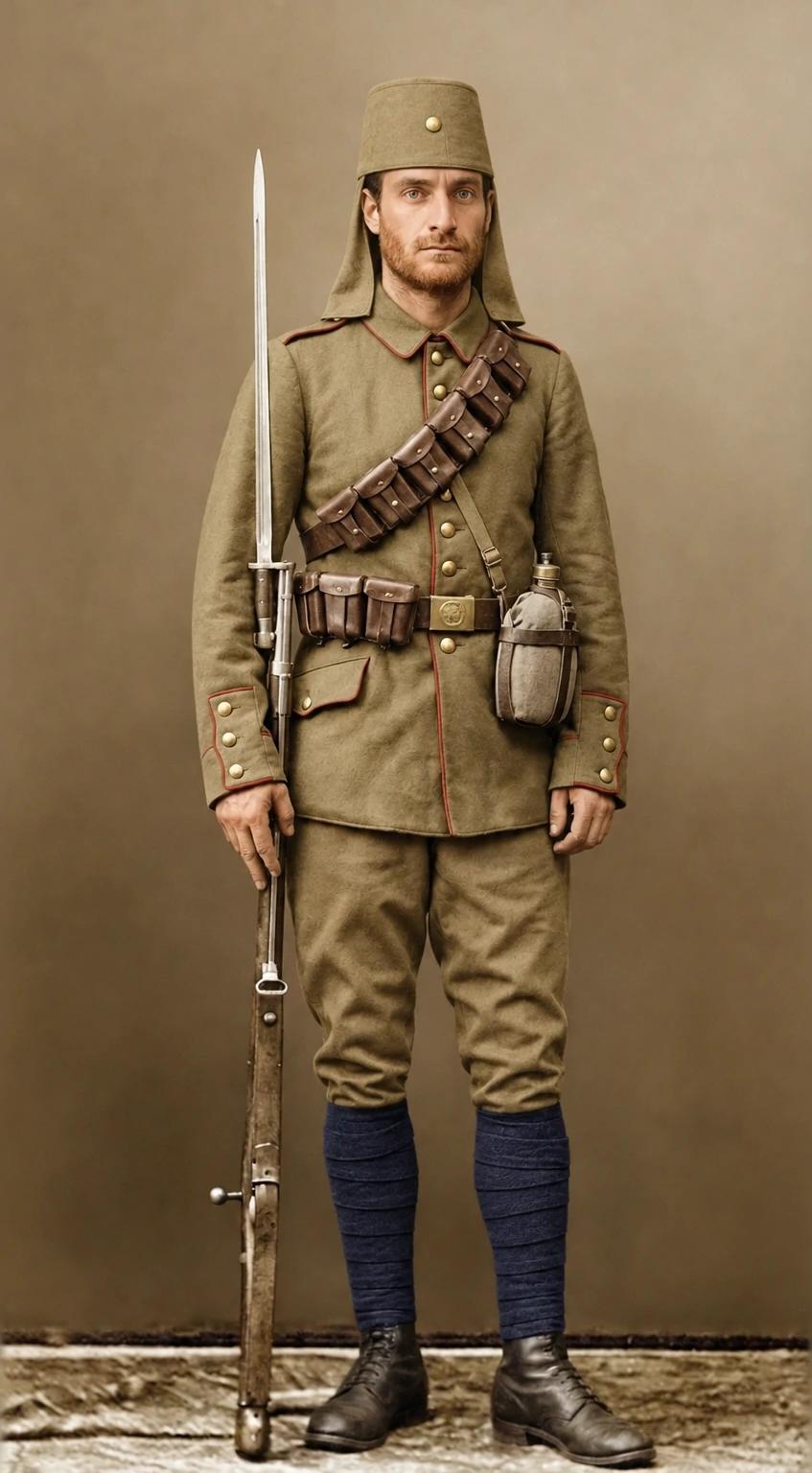
Uniform and equipment
| Uniform | Khaki uniform |
|---|---|
| Dress uniform | Khaki with Tarbush |
| Headgear | Tarbush (Fez style) with neck flap |
| Equipment | Mauser 1871, bayonet |
| Insignia and standard | Reichskriegsflagge (imperial war flag) |
Service record
| First appeared | 1891 |
|---|---|
| Peak strength | 14,000 men |
| Recruited from | African Volunteers |
| Primary tactic | Bush Warfare / Guerilla |
| Signature engagement | Battle of Tanga (1914) |
| Motto or battle cry | Heia Safari! (Marching Song) |
| Obsolescence | End of WWI |
Timeline
- 1891: Formation. The Wissmann Troop is officially reorganized into the Imperial Schutztruppe for German East Africa.
- 1914: Outbreak of WWI. Lettow-Vorbeck ignores orders to remain neutral, mobilizing the Askaris to draw Allied forces away from the Western Front.
- 1914: Defense of Tanga. The unit achieves legendary status by repelling a massive British amphibious invasion.
- 1916: The Great Retreat. Facing overwhelming numbers, the Schutztruppe abandons the colony's north, beginning a mobile guerilla campaign.
- 1917: Crossing the Ruvuma. Cut off from Germany, the unit crosses into Portuguese Mozambique to capture weapons and food.
- 1918: Surrender at Abercorn. Undefeated in the field, the Schutztruppe formally lays down arms in Northern Rhodesia on November 25, two weeks after the Armistice.
Battles
Battle of Tanga
The 'Battle of the Bees'. An amphibious assault by 8,000 British Indian troops was shattered by a significantly smaller force of Askaris. Amidst swarms of angry wild bees and machine gun fire, the Askaris broke the British lines, capturing vital supplies and proving their elite status.
Battle of Jassin
A gritty siege of a British outpost. While a tactical victory that secured the border, the expenditure of 200,000 rounds of ammunition forced Lettow-Vorbeck to abandon static warfare forever in favor of guerilla tactics, realizing he could not sustain a war of attrition.
Battle of Mahiwa
One of the fiercest battles on African soil. The Schutztruppe inflicted over 2,700 casualties on a superior British force. However, the Askaris burned through their remaining smokeless powder cartridges, forcing a strategic retreat into Mozambique to scavenge for supplies.
Commanders
Paul von Lettow-Vorbeck
The 'Lion of Africa'. A master of asymmetric warfare who commanded the Schutztruppe with iron discipline and mutual respect. He led his small force of Askaris on a four-year undefeated guerilla campaign against 300,000 Allied troops, only surrendering days after the Armistice in Europe.
Tom von Prince
A fierce captain known as 'Bwana Sakarani' (The Wild Master). Born in Mauritius to a British father and German mother, he was a key commander of the Askari companies. He led the desperate street fighting at Tanga, where he was killed in action leading his men against British regulars.
Tactics
Buschkrieg (Bush Warfare)
Utilization of dense vegetation for concealment, allowing Askaris to ambush superior columns at close range before melting back into the jungle.
Porter Logistics
Reliance on thousands of loyal carriers rather than vehicles, granting the unit unmatched mobility over rough terrain where British trucks failed.
Aggressive Defense
Rapid counter-attacks with bayonets immediately following enemy contact to disrupt formations before they could bring superior firepower to bear.