
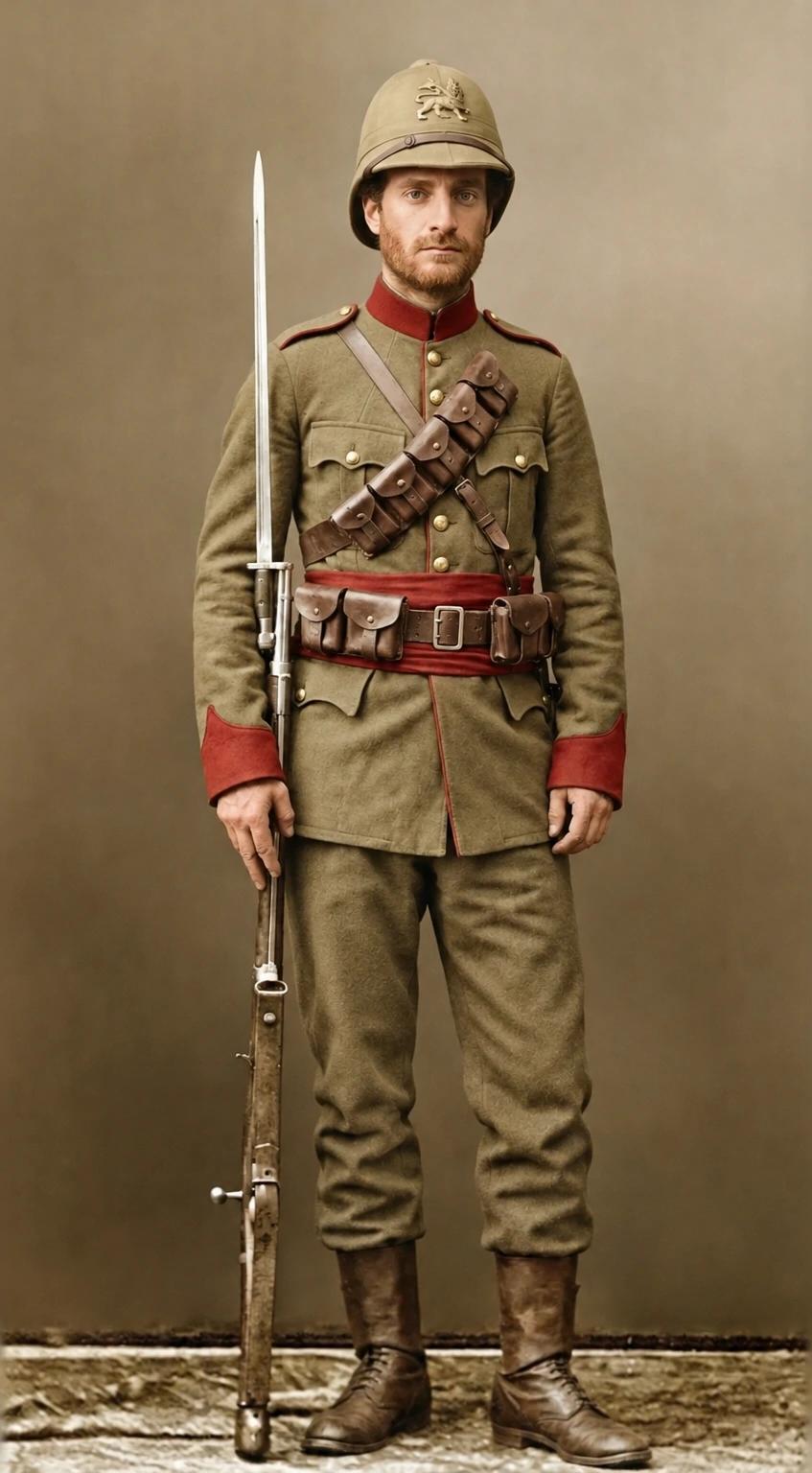
Uniform and equipment
| Uniform | Khaki tunics with colored sashes and puttees; officers with Sam Brown belts |
|---|---|
| Dress uniform | Dark blue or green tunics with red sashes and embroidered lion-of-Judah badges |
| Headgear | Kepi or peaked cap with lion badge, sometimes cloaks with lion motifs |
| Equipment | Rifles, bayonets, officers with sabres |
| Insignia and standard | Lion of Judah badge |
Service record
| First appeared | 1917 |
|---|---|
| Peak strength | 10,000 men |
| Recruited from | Loyal Tribesmen / Modern Conscripts |
| Primary tactic | Mixed Skirmish / Shock |
| Signature engagement | Battle of Maychew (1936) |
| Motto or battle cry | Moa Anbessa (Conquering Lion) |
| Obsolescence | Italian Invasion (1935) / 1974 Coup |
Timeline
- 1896: Victory at Adwa. The Imperial Guard helps secure Ethiopia's independence against Italy.
- 1917: Formation of Kebur Zabagna. Ras Tafari (later Haile Selassie) establishes the Guard as a distinct, modernized unit separate from the regular army.
- 1930: Imperial Coronation. The Guard is fully formalized with modern uniforms and Belgian training officers.
- 1935: Italian Invasion. The Guard mobilizes as the elite core of the resistance against Mussolini's forces.
- 1951: Deployment to Korea. Elements of the Guard form the Kagnew Battalions, serving with distinction alongside US forces.
- 1960: Failed Coup Attempt. A faction of the Guard attempts to overthrow the Emperor, leading to a fracture in the unit's loyalty.
- 1974: Dissolution. Following the Marxist Derg revolution and the deposition of the Emperor, the Imperial Guard is disbanded.
Battles
Battle of Adwa
The defining moment of African resistance. The Guard formed the strategic reserve that shattered the Italian center, securing Ethiopia's sovereignty and humiliating a European colonial power.
Battle of Maychew
The Guard's heroic last stand against Fascist Italy. Despite superior discipline, they were overwhelmed by aerial bombardment and mustard gas, marking the temporary end of conventional resistance.
Battle of Pork Chop Hill
Deployed as the Kagnew Battalion, Guard elements fought under the UN flag. They became legendary for never surrendering a position and never leaving a man behind, dead or alive.
Commanders
Menelik II
The architect of modern Ethiopia and a brilliant strategist. He mobilized the Imperial Guard and provincial levies to crush colonial invaders, personally commanding forces with a blend of traditional ferocity and astute diplomatic foresight.
Haile Selassie I
The Lion of Judah. He transformed the Guard (Kebur Zabagna) into a modern, elite force trained by European advisors. Even in exile and during the liberation, he remained the spiritual and tactical figurehead of the resistance.
Ras Mulugeta Yigezu
Minister of War who led the Imperial forces during the Second Italo-Ethiopian War. A traditional warrior of the old school, he commanded the Guard elements at the tragic Battle of Amba Aradam.
Tactics
Afarsata (Encirclement)
A traditional maneuver where the Guard would anchor the center while wings enveloped the enemy flanks to crush them.
Shock Charge
After softening the enemy with rifle fire, the Guard would close distance rapidly for vicious hand-to-hand combat with swords and bayonets.
Highland Ambush
Utilizing the rugged terrain of the Ethiopian plateau to launch surprise attacks from high ground, negating enemy artillery advantages.