
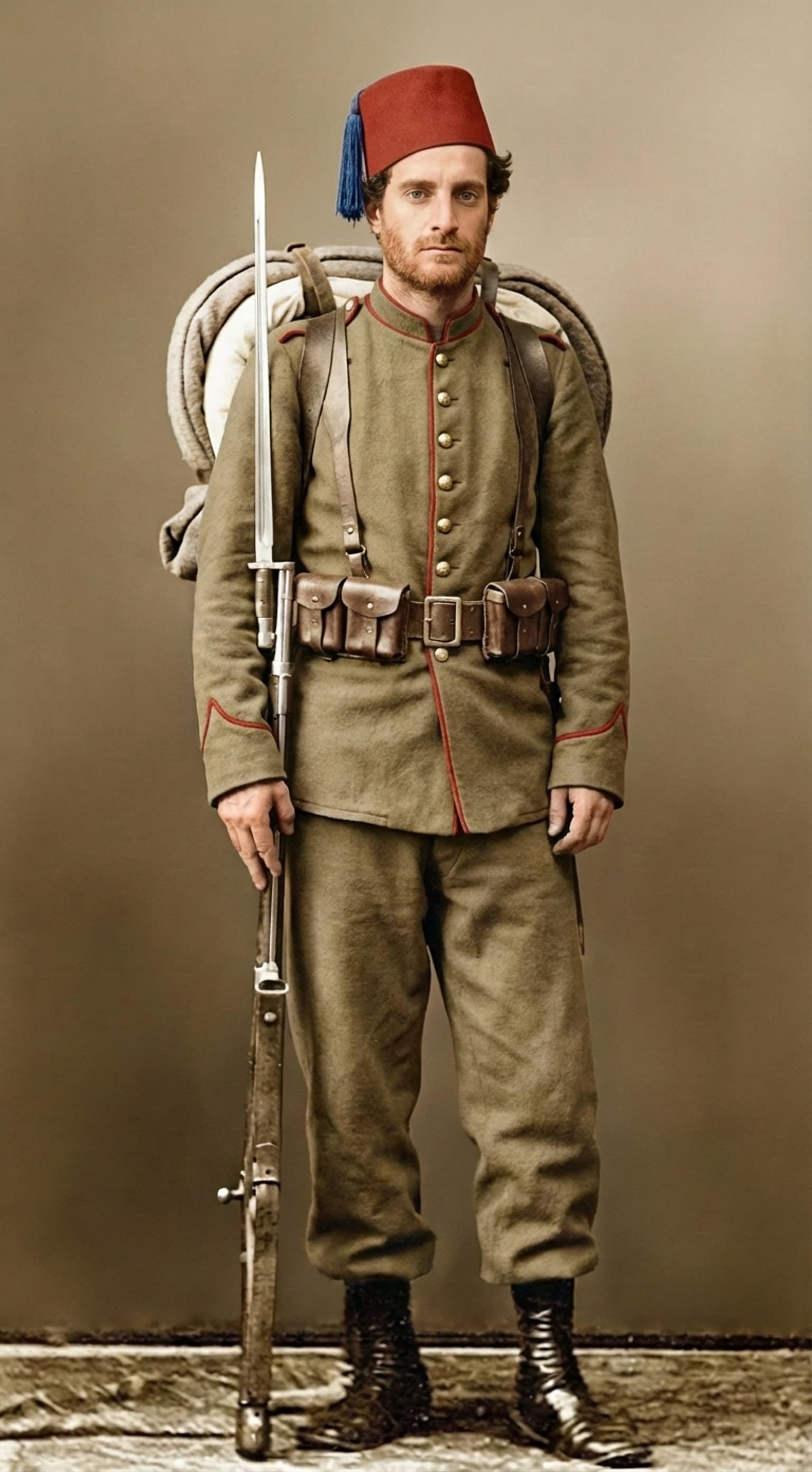
Uniform and equipment
| Uniform | Dark blue jacket, light blue trousers, leather equipment |
|---|---|
| Dress uniform | Dark blue jacket with yellow braiding, red fez |
| Headgear | Red fez with yellow tassel |
| Equipment | Rifle, bayonet, ammunition pouches |
| Insignia and standard | Gold fouled anchor (Troupes de marine badge) |
Service record
| First appeared | 1857 |
|---|---|
| Peak strength | ~200,000 men |
| Recruited from | Colonial Volunteers / Conscripts |
| Primary tactic | Shock Infantry |
| Signature engagement | Battle of the Yser (1914) |
| Motto or battle cry | Dem ba Jeex (Wolof: Until the End) |
| Obsolescence | Decolonization |
Timeline
- 1857: Formation. Governor Louis Faidherbe signs the decree creating the first permanent battalion of Tirailleurs Sénégalais in Saint-Louis, Senegal.
- 1898: Fashoda Incident. A detachment of Tirailleurs under Jean-Baptiste Marchand treks across Africa to the Nile, triggering a diplomatic crisis with Britain.
- 1914: Deployment to Europe. For the first time, large numbers of West African troops are shipped to metropolitan France to fight on the Western Front.
- 1917: The Black Force Crisis. Following the slaughter at Chemin des Dames, recruitment methods in West Africa are reformed to sustain the war effort.
- 1940: Battle of France. Tirailleurs fight desperate rearguard actions; thousands are executed by German forces upon capture due to Nazi racial ideology.
- 1944: Operation Dragoon. Reconstituted units participate in the liberation of Southern France, playing a critical role in the capture of Toulon and Marseille.
- 1944: Thiaroye Massacre. French forces fire on repatriated Tirailleurs demanding unpaid wages in Senegal, a tragic betrayal of their wartime service.
- 1960: Dissolution. With the independence of African colonies, the regiments are disbanded or integrated into the new national armies.
Battles
Battle of the Yser
Thrown into the 'Race to the Sea,' the Tirailleurs held the line against overwhelming German numbers. Their stubborn defense in the freezing mud of Flanders cemented their reputation as elite infantry, though at a terrible cost.
Recapture of Fort Douaumont
Spearheading the assault to retake the symbolic heart of Verdun, the Tirailleurs charged through heavy fog and artillery fire. Their success in reclaiming the fort was a major morale boost for France.
Second Battle of the Aisne
Part of the disastrous Nivelle Offensive. Deployed as shock troops in freezing conditions, many suffered frostbite before the attack began. They were decimated by machine-gun fire, leading to a crisis of morale.
Defense of Chasselay
A heroic last stand against the German advance. After running out of ammunition, the survivors were massacred by the SS Division Totenkopf in a racially motivated war crime.
Commanders
General Louis Faidherbe
The architect of French West Africa who formally established the Tirailleurs Sénégalais in 1857. He transformed local auxiliary units into a disciplined, regular corps that became the backbone of French colonial power.
General Charles Mangin
A controversial yet brilliant strategist who advocated for 'La Force Noire.' He viewed the Tirailleurs as elite shock troops capable of breaking the stalemate of trench warfare through sheer ferocity and resilience.
Captain Charles N'Tchoréré
A naturalized French officer of Gabonese origin. During the 1940 Battle of France, he commanded his men to the last round. When captured and ordered to fall in with enlisted men, he asserted his rank and was executed by the SS.
Tactics
Choc (Shock Assault)
Utilizing their reputation for fearlessness, units were often massed to deliver a decisive, high-impact blow to break enemy lines.
Nettoyage de Tranchée
Trench clearing operations where the 'Coupe-Coupe' machete was used to devastating effect in close-quarters combat.
Infiltration
Adapting colonial bush warfare skills to the Western Front, small groups would infiltrate enemy positions for reconnaissance and raids.