
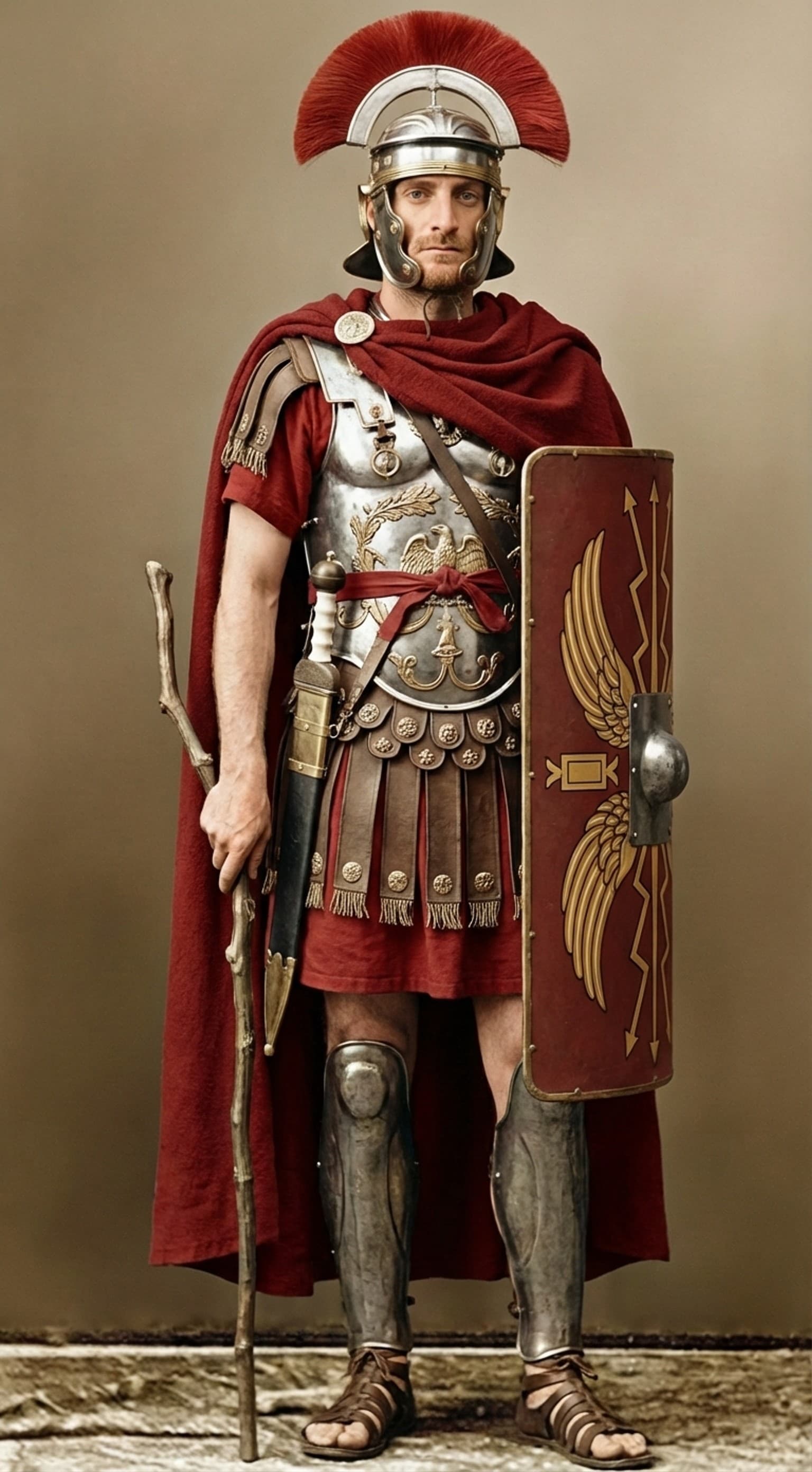
Uniform and equipment
| Uniform | Mail or scale armor over tunic, transverse-crested helmet, vine staff |
|---|---|
| Dress uniform | Engraved muscled cuirass, crimson cloak, transverse crest with colored plumes |
| Headgear | Distinctive transverse-crested helmet, often with dyed horsehair |
| Equipment | Gladius, pugio, vine staff (symbolic), sometimes greaves |
| Insignia and standard | Transverse horsehair crest on helmet |
Service record
| First appeared | 1st century BC |
|---|---|
| Peak strength | 4,000–5,000 men across legions |
| Recruited from | Promoted from Ranks / Equestrian Order |
| Primary tactic | Front-line Leadership |
| Signature engagement | Siege of Jerusalem (70 AD) |
| Motto or battle cry | Signa Inferre! (Advance the standard) |
| Obsolescence | Fall of Western Empire |
Timeline
- 9: Battle of the Teutoburg Forest. Three legions are wiped out. Many centurions die defending their eagles or are executed by Germanic tribes, a traumatic blow to the corps.
- 43: Invasion of Britannia. Centurions lead the push into the unknown, establishing forts and roads at the edge of the known world.
- 58: Gallic Wars Begin. A decade of campaigning under Caesar that forged the most effective centurionate in history, prioritizing merit over birth.
- 107: Marian Reforms. The professionalization of the legions transforms the centurion from a temporary appointee to a permanent, professional officer class.
- 193: Year of the Five Emperors. The political power of the army peaks; the Praetorian Guard (led by their tribunes and centurions) auctions off the Empire.
- 312: Battle of the Milvian Bridge. Constantine's victory leads to major structural changes, eventually phasing out the classical principate-style centurion in favor of new ranks.
Battles
Siege of Alesia
The ultimate test of the centurionate's discipline. Encircled and outnumbered, centurions managed the dual-front defense of the circumvallation walls, physically plugging gaps in the line against Vercingetorix's desperate sorties.
Battle of Pharsalus
A clash of veterans where centurions determined the fate of the Republic. Caesar's centurions, including Crastinus, led the charge against Pompey's superior numbers, using experience and ferocity to shatter the enemy morale.
Battle of Watling Street
Facing Boudica's massive horde, Roman discipline triumphed. Centurions held the legionaries in a tight wedge formation, waiting until the last second to unleash pila volleys before carving through the disorganized Britons.
Siege of Jerusalem
Brutal urban warfare. Centurions led assault parties through the breach, navigating narrow streets and burning structures. Their leadership was critical in maintaining cohesion amidst the chaos of the Temple Mount assault.
Commanders
Spurius Ligustinus
The archetype of the career soldier. Rising from the ranks to Primus Pilus, he served for 22 years in 6 campaigns. Famous for a speech to the Senate where he displayed his battle scars and medals, embodying the Republic's stoic virtue and the professional backbone of the legions.
Gaius Crastinus
A Primus Pilus of the 10th Legion under Caesar. At Pharsalus, he famously told Caesar, 'You will thank me today, dead or alive,' before leading the forlorn hope charge. He died breaking the enemy line, struck in the face by a gladius, earning eternal fame for his suicidal bravery.
Marcus Cassius Scaeva
A centurion of superhuman endurance. At the Battle of Dyrrhachium, he single-handedly held a fort against Pompeian forces. Despite his shield being pierced by 120 arrows and suffering wounds to the eye, shoulder, and thigh, he refused to yield, rallying his men to hold the line.
Tactics
The Wedge (Cuneus)
Centurions would order and lead a triangular formation to punch through enemy lines, relying on shock and the officer's presence at the tip of the spear.
Line Rotation
Centurions orchestrated the complex maneuver of cycling tired front-line troops to the rear and bringing fresh men forward during active combat.
Disciplined Silence
Unlike barbarian hordes, centurions enforced silence before the clash, ensuring orders via trumpet or standard were clearly heard.