
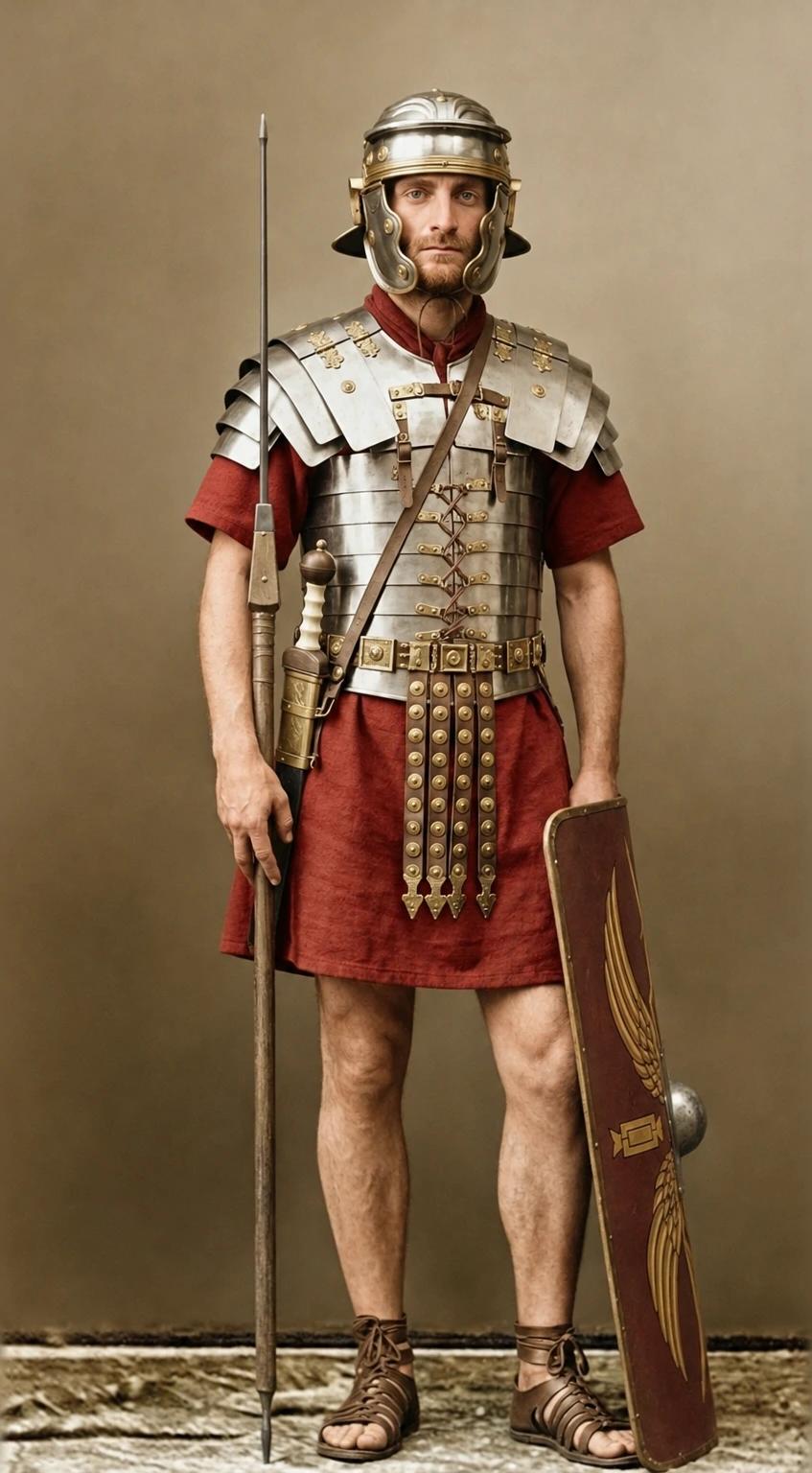
Uniform and equipment
| Uniform | Red tunic, lorica segmentata (plate armor), caligae sandals |
|---|---|
| Dress uniform | Polished armor, phalerae (medals) on harness, transverse crests for parade |
| Headgear | Imperial Gallic helmet with cheek guards and brow ridge |
| Equipment | Gladius, scutum (rectangular shield), pilum (javelin), pugio |
| Insignia and standard | Aquila eagle; thunderbolts on shields |
Service record
| First appeared | 30 BC |
|---|---|
| Peak strength | ~450,000 men (all legions) |
| Recruited from | Roman Citizens / Volunteers |
| Primary tactic | Testudo / Pilum Volley & Charge |
| Signature engagement | Battle of Watling Street (61 AD) |
| Motto or battle cry | Roma Victrix! (Rome Victorious!) |
| Obsolescence | Economic Collapse / Barbarian Invasions |
Timeline
- 107 BC: Marian Reforms. Gaius Marius opens recruitment to the landless poor, standardizing equipment and creating the professional standing army.
- 58 BC: Gallic Wars Begin. Julius Caesar begins a campaign that hardens the legions into the most effective fighting force in the Mediterranean.
- 43: Invasion of Britannia. Emperor Claudius sends four legions to conquer Britain, establishing a permanent heavy military presence on the island.
- 69: Year of the Four Emperors. Civil war where legions declare their own generals as Emperor, proving the army is the true power broker of Rome.
- 117: Peak Empire. Under Trajan, the legions push the empire's borders to their greatest extent, from Scotland to the Persian Gulf.
- 193: Severan Reforms. Septimius Severus increases soldier pay and allows them to marry, beginning the shift toward a settled, frontier-based garrison force.
Battles
Siege of Alesia
The ultimate test of legionary engineering. Caesar's troops constructed two massive lines of fortifications—one to keep Vercingetorix in, one to keep relief forces out. They defeated attacks from both sides through sheer endurance and rapid redeployment.
Battle of the Teutoburg Forest
Three legions were ambushed in dense terrain where their formation fighting was useless. Over days of rain and mud, they were picked apart by Arminius's tribes. The loss halted Roman expansion into Germania forever and traumatized the Imperial psyche.
Battle of Watling Street
Outnumbered perhaps 20 to 1, Paulinus's legions chose a narrow defile to negate Boudica's numbers. A disciplined pilum volley followed by a wedge formation charge shattered the Briton horde, slaughtering nearly 80,000 rebels in a brutal display of professional butchery.
Commanders
Gaius Marius
The reformer who transformed the legions from a citizen militia into a professional fighting force. He introduced the eagle standard and the practice of soldiers carrying their own kit ('Marius' Mules'), forging a class of men loyal to their general above the state.
Julius Caesar
A brilliant strategist who turned his legions into a devoted instrument of conquest. Through the Gallic Wars, he honed the legionary into a versatile engineer-soldier capable of building bridges, walls, and fleets as proficiently as they slaughtered barbarians.
Gnaeus Julius Agricola
The architect of Roman Britain's conquest. He pushed the legions to the edge of the known world in Caledonia, demonstrating the legion's ability to project power into the most hostile and remote terrains.
Tactics
Pilum Volley & Charge
At 15 yards, the front line hurls heavy javelins to pierce shields and disrupt the enemy line, immediately followed by a sword charge into the confusion.
Testudo (Tortoise)
Soldiers lock shields overhead and on the flanks to create an impenetrable shell against missile fire, used primarily during sieges to approach walls.
Triplex Acies Rotation
A checkerboard formation allowing exhausted front-line troops to filter back through gaps while fresh troops step forward, maintaining constant pressure.
Castra Construction
The tactical doctrine of building a fortified camp with ditch and palisade every single night, ensuring the legion could never be caught unprepared.