
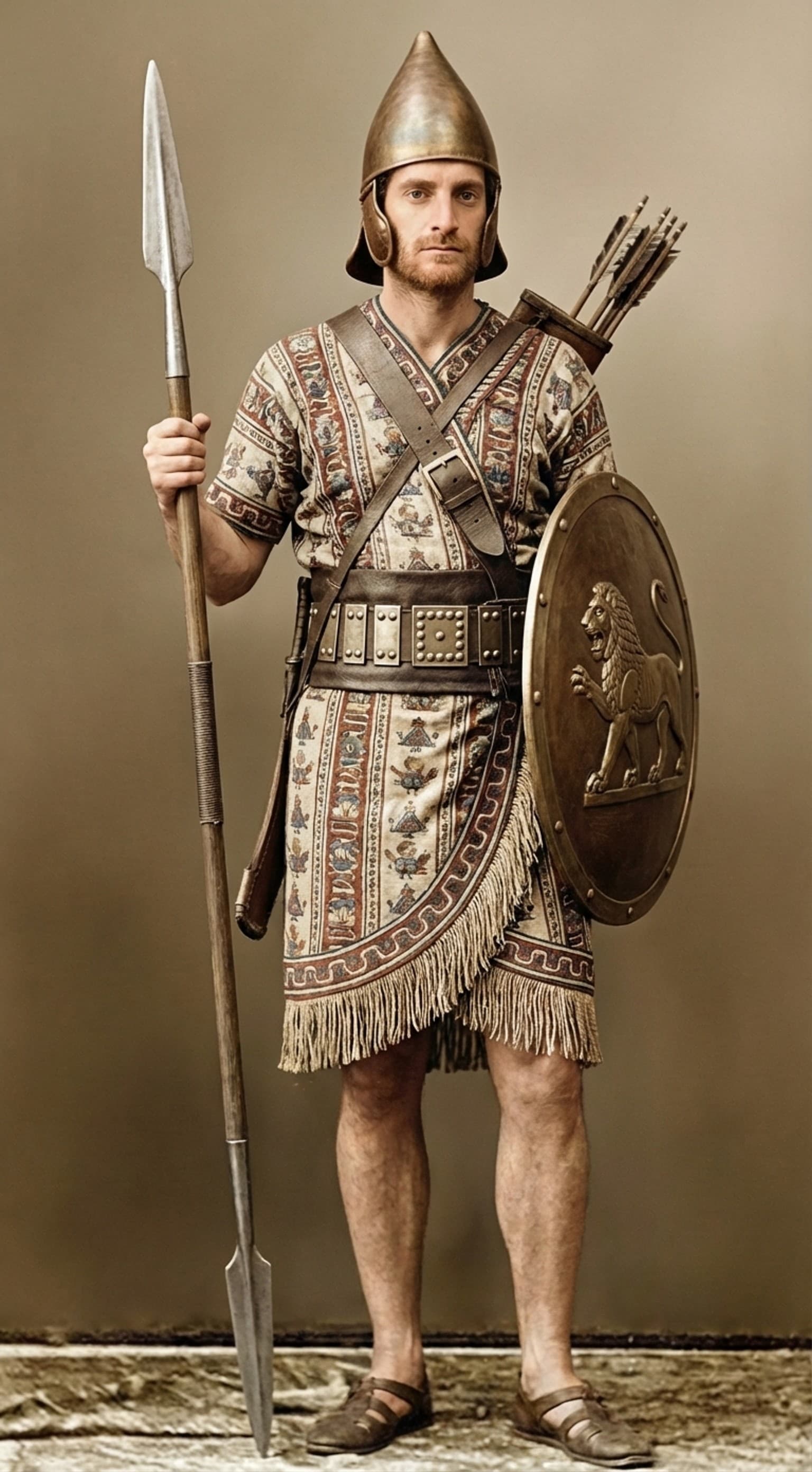
Uniform and equipment
| Uniform | Knee-length dyed wool tunic, bronze scale corselet, colorful fringed cloak |
|---|---|
| Dress uniform | Richly dyed purple or crimson cloaks over polished scale armor, wide decorated belts |
| Headgear | High conical bronze helmet with cheek pieces |
| Equipment | Long spear, large rectangular shield, iron sword or dagger |
| Insignia and standard | Winged disc of Ashur on shields/standards |
Service record
| First appeared | c. 800 BC |
|---|---|
| Peak strength | 3,000–5,000 men |
| Recruited from | Professional Standing Army (Qurubuti) |
| Primary tactic | Combined Arms Siege Assault |
| Signature engagement | Siege of Lachish (701 BC) |
| Motto or battle cry | Ashur is King! |
| Obsolescence | Fall of Nineveh / Median Conquest |
Timeline
- 612: Destruction of the Corps. The annihilation of the Royal Guard during the sack of Nineveh, extinguishing the unit forever.
- 671: Invasion of Egypt. Under Esarhaddon, the Guard adapts to desert warfare, marching into the Delta and capturing Memphis.
- 701: The Levantine Campaign. Sennacherib deploys the Guard to crush the rebellion in the West, culminating in the Siege of Lachish.
- 720: Battle of Qarqar (Sargon II). The Guard proves its worth in open field combat, crushing a coalition of Syrian and Israelite forces.
- 745: Reforms of Tiglath-Pileser III. Establishment of the Royal Guard as the core of a permanent, professional standing army.
Battles
Fall of Nineveh
The final stand. The Royal Guard fought street by street against a tidal wave of Medes and Babylonians. They died to the last man in the burning ruins of the palace they were sworn to protect, marking the end of the empire.
Battle of Halule
A bloodbath against a coalition of Babylonians, Elamites, and Aramaeans. Sennacherib's Guard held the center against overwhelming numbers. Though the enemy was halted, the Guard suffered horrific casualties, halting Assyrian expansion for years.
Siege of Lachish
The Guard's defining hour. Amidst a storm of arrows and burning oil, they marched up a massive earthen ramp, shielding the battering rams. Their discipline broke the Judean defenses, leading to the city's total destruction and the exile of its people.
Commanders
Sennacherib
A ruthless architect of empire who turned the Royal Guard into a siege-breaking sledgehammer. Known for his 'Palace Without Rival' and the brutal suppression of Judean and Babylonian revolts, he personally led his iron-clad elite into the thickest fighting.
Ashurbanipal
The scholar-warrior who hunted lions with the same intensity he hunted Elamites. Under his command, the Guard reached the zenith of its logistical reach, projecting Assyrian terror from the Nile to the Zagros Mountains.
Tiglath-Pileser III
The great reformer who forged the 'Kisir Sharruti' (standing army). He professionalized the Royal Guard, transforming them from a ceremonial retinue into the ancient world's first true heavy infantry corps, standardized and drilled to perfection.
Tactics
Combined Arms Siege
The Guard provided a mobile wall of wicker shields to protect archers and sappers, allowing battering rams to breach fortifications while suppressing defenders with heavy fire.
The Iron Phalanx
In open battle, heavy spearmen formed a dense, impenetrable wall, locking shields to absorb chariot charges before grinding the enemy down with sheer weight and discipline.
Terror Shock
Psychological warfare where the Guard would execute brutal, calculated displays of violence on the battlefield to break enemy morale before the main engagement began.