
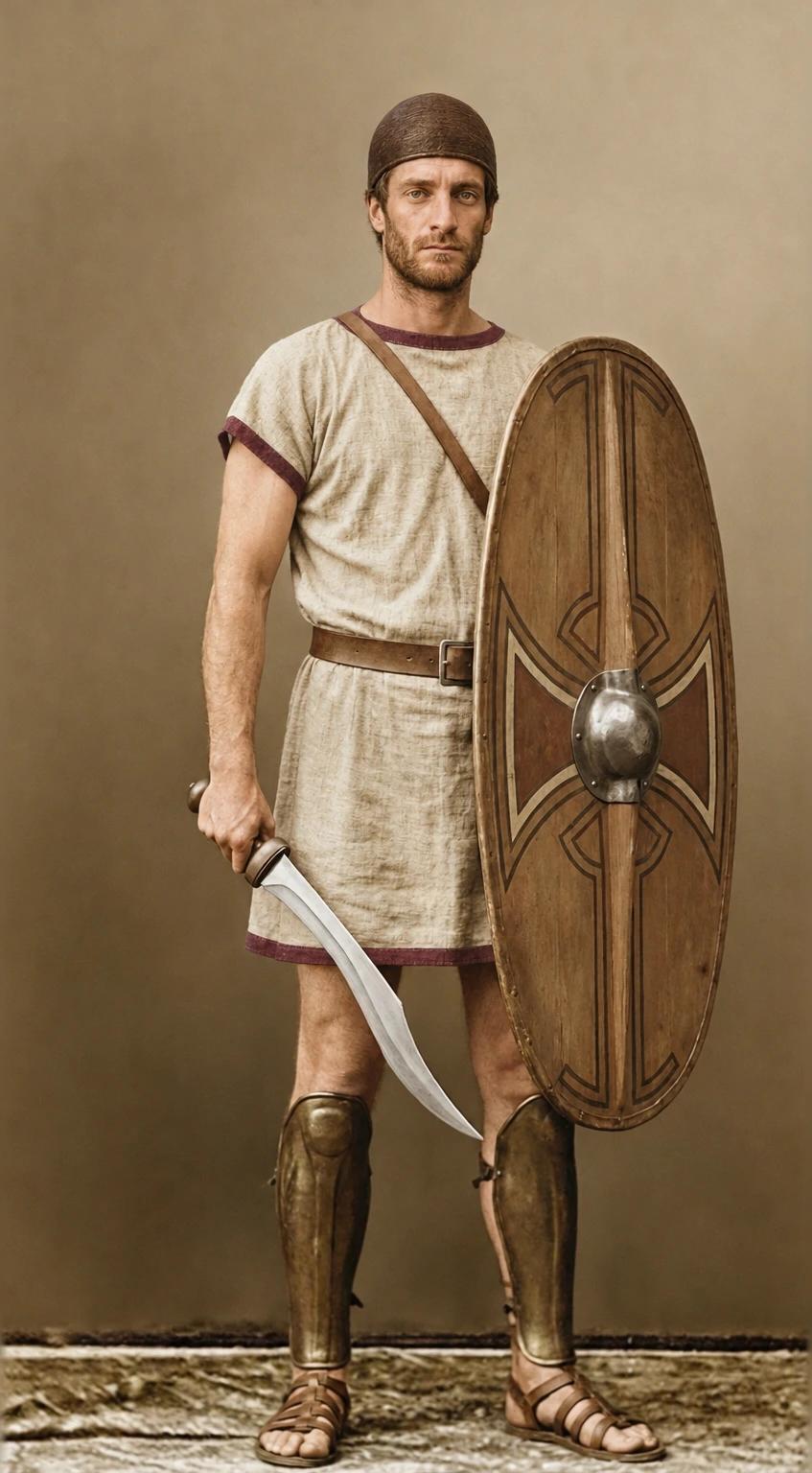
Uniform and equipment
| Uniform | White tunic with crimson trim, sinew belt |
|---|---|
| Dress uniform | N/A |
| Headgear | Sinew cap or bronze helmet with crest |
| Equipment | Falcata (curved sword), large oval shield (scutum), soliferrum (javelin) |
| Insignia and standard | Flat oval scutum with heavy boss |
Service record
| First appeared | 3rd Century BC |
|---|---|
| Peak strength | Thousands in Carthaginian/Roman service |
| Recruited from | Tribal Warriors |
| Primary tactic | Sword and Javelin Ambush |
| Signature engagement | Battle of Cannae (216 BC) |
| Motto or battle cry | Devotio (The Vow) |
| Obsolescence | Roman Conquest |
Timeline
- 237 BC: Barcid Conquest. Hamilcar Barca lands in Spain, beginning the systematic integration of Iberian tribes into the Carthaginian military machine.
- 219 BC: Siege of Saguntum. Iberian troops spearhead the assault on Saguntum, triggering the Second Punic War.
- 218 BC: Crossing the Alps. Thousands of Scutarii brave the freezing heights with Hannibal, suffering heavy attrition but entering Italy as hardened veterans.
- 216 BC: Zenith at Cannae. The unit achieves legendary status by holding the line against the full weight of the Roman Republic.
- 206 BC: Roman Hegemony. Following the defeat at Ilipa, Iberian loyalty fractures; many tribes turn to guerrilla warfare against the new Roman occupiers.
- 195 BC: Cato's Pacification. Cato the Elder campaigns ruthlessly to disarm the tribes, leading to mass suicides of warriors who refused to live without their falcatas.
Battles
Battle of the Trebia
Fresh from crossing the Alps, Iberian infantry waded through freezing waters to engage Roman heavy infantry. Their ability to fight effectively in broken terrain and endure harsh conditions proved decisive in Hannibal's first major victory on Italian soil.
Battle of Cannae
The Scutarii held the center against superior Roman numbers. Instructed to slowly retreat rather than break, they formed a convex crescent that inverted under pressure, drawing the legions into a kill box. Their discipline in the face of annihilation enabled the greatest encirclement in history.
Battle of Ilipa
Facing Scipio Africanus, the Iberian allies were outmaneuvered. Scipio refused to engage the fierce Scutarii in the center, instead crushing the flanks. It marked the collapse of Carthaginian power in Iberia, transitioning the tribes from mercenaries to rebels against Rome.
Commanders
Indibilis
King of the Ilergetes who embodied the fierce independence of the Iberian tribes. Initially a Carthaginian ally, he waged a relentless guerrilla war against Rome. A master of terrain and ambush, he led his Scutarii in a desperate, decades-long struggle to keep Hispania free from foreign yokes.
Hannibal Barca
Though Carthaginian, Hannibal forged the Iberian Scutarii into a legendary fighting force. He recognized their unique blend of mobility and staying power, famously placing them at the center of his line at Cannae to absorb the Roman legions' weight, a tactical gamble that immortalized their courage.
Tactics
The Elastic Defense
Used famously at Cannae, the Scutarii formed a line that slowly gave ground under pressure without breaking formation, absorbing enemy momentum and allowing flanks to envelop the foe.
Soliferrum Volley
Before contact, the unit unleashed a synchronized volley of heavy iron javelins to shatter enemy shields, rendering opponents vulnerable to the follow-up sword charge.
Concursare
A fluid style of fighting involving rapid charges followed by feigned retreats to disorder enemy lines, exploiting the Scutarii's lighter equipment compared to heavy legionaries.