
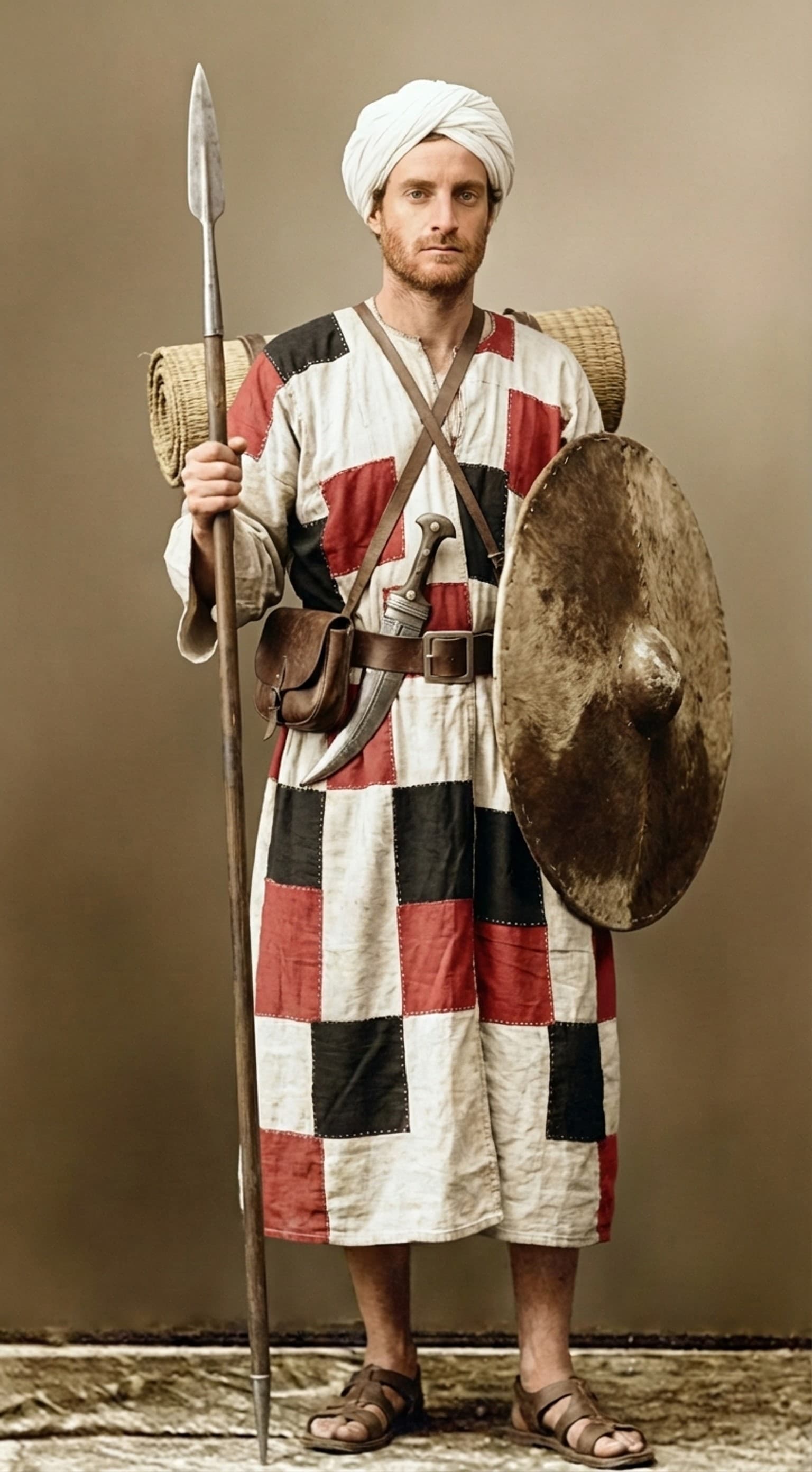
Uniform and equipment
| Uniform | Patched jibba (tunic) |
|---|---|
| Dress uniform | N/A |
| Headgear | Turban or skullcap |
| Equipment | Spear, sword, shield, captured rifles |
| Insignia and standard | Black/green Shahada flags |
Service record
| First appeared | 1881 |
|---|---|
| Peak strength | 50,000+ |
| Recruited from | Religious Followers |
| Primary tactic | Mass Human Wave |
| Signature engagement | Battle of Omdurman (1898) |
| Motto or battle cry | Fi Sabil Allah! (In the path of God) |
| Obsolescence | Maxim Guns |
Timeline
- 1881: Declaration of the Mahdiyya. Muhammad Ahmad proclaims himself the Mahdi at Abba Island, initiating the holy war against the Turks.
- 1883: Destruction of Hicks Pasha's Army. The victory at Shaykan secures massive stocks of modern weapons and legitimizes the rebellion.
- 1885: Fall of Khartoum. The Mahdist forces capture the capital; General Gordon is killed. The Mahdi dies shortly after; the Khalifa takes power.
- 1889: Battle of Toski. A failed invasion of Egypt is halted by Anglo-Egyptian forces, marking the limit of Mahdist expansion.
- 1896: Dongola Expedition. The British begin the systematic reconquest of the Sudan, pushing down the Nile.
- 1898: Battle of Omdurman. The main Mahdist army is destroyed by Kitchener; the Khalifa flees into the interior.
- 1899: Battle of Umm Diwaykarat. The final stand of the Khalifa, who is killed in battle, ending the Mahdist state.
Battles
Battle of Shaykan
A masterclass in ambush. The Ansar annihilated an 11,000-strong Egyptian expeditionary force led by William Hicks. Hidden in the dense scrub, the Dervishes overwhelmed the thirst-maddened column, seizing thousands of rifles and proving they could destroy modern armies.
Battle of Abu Klea
A ferocious engagement where Mahdist forces ambushed the British Desert Column. Despite heavy casualties and ultimate defeat, the Ansar successfully penetrated the British square, engaging in desperate hand-to-hand combat and shaking the confidence of the Imperial forces.
Siege of Khartoum
The culmination of the Mahdist uprising. After a grueling siege, Ansar warriors stormed the starving city just days before British relief arrived. General Gordon was killed on the palace steps, and the fall of the city marked the establishment of the Mahdist state.
Battle of Omdurman
The twilight of the Ansar. 50,000 warriors charged bravely across open ground against Kitchener's Anglo-Egyptian army. Mowed down by Maxim guns and artillery before they could reach striking distance, their heroism was shattered by industrial warfare.
Commanders
Muhammad Ahmad (The Mahdi)
The charismatic spiritual leader who ignited the revolt against Turco-Egyptian rule. Claiming to be the Guided One, he united disparate tribes into a fanatical army through religious fervor, leading them to stunning victories before his sudden death shortly after taking Khartoum.
Abdallahi ibn Muhammad (The Khalifa)
The Mahdi's successor and ruthless administrator who transformed a tribal uprising into a structured military state. He commanded the Ansar with an iron fist, maintaining the jihad for over a decade until the catastrophic clash with British firepower at Omdurman.
Osman Digna
A master of guerrilla warfare and the Mahdi's ablest general in the Red Sea Hills. Famous for his tactical brilliance, his Beja warriors achieved the legendary feat of breaking a British infantry square at the Battle of Tamai.
Tactics
Shock Charge
A massed, high-speed frontal assault designed to overwhelm the enemy with sheer numbers and ferocity before they could reload.
Desert Ambush
Using the terrain to conceal thousands of warriors until the enemy was at point-blank range, negating long-range firepower.
Breaking the Square
Targeting the corners or gaps of British infantry squares, rushing in to force chaotic melee combat where swords and spears excelled.