
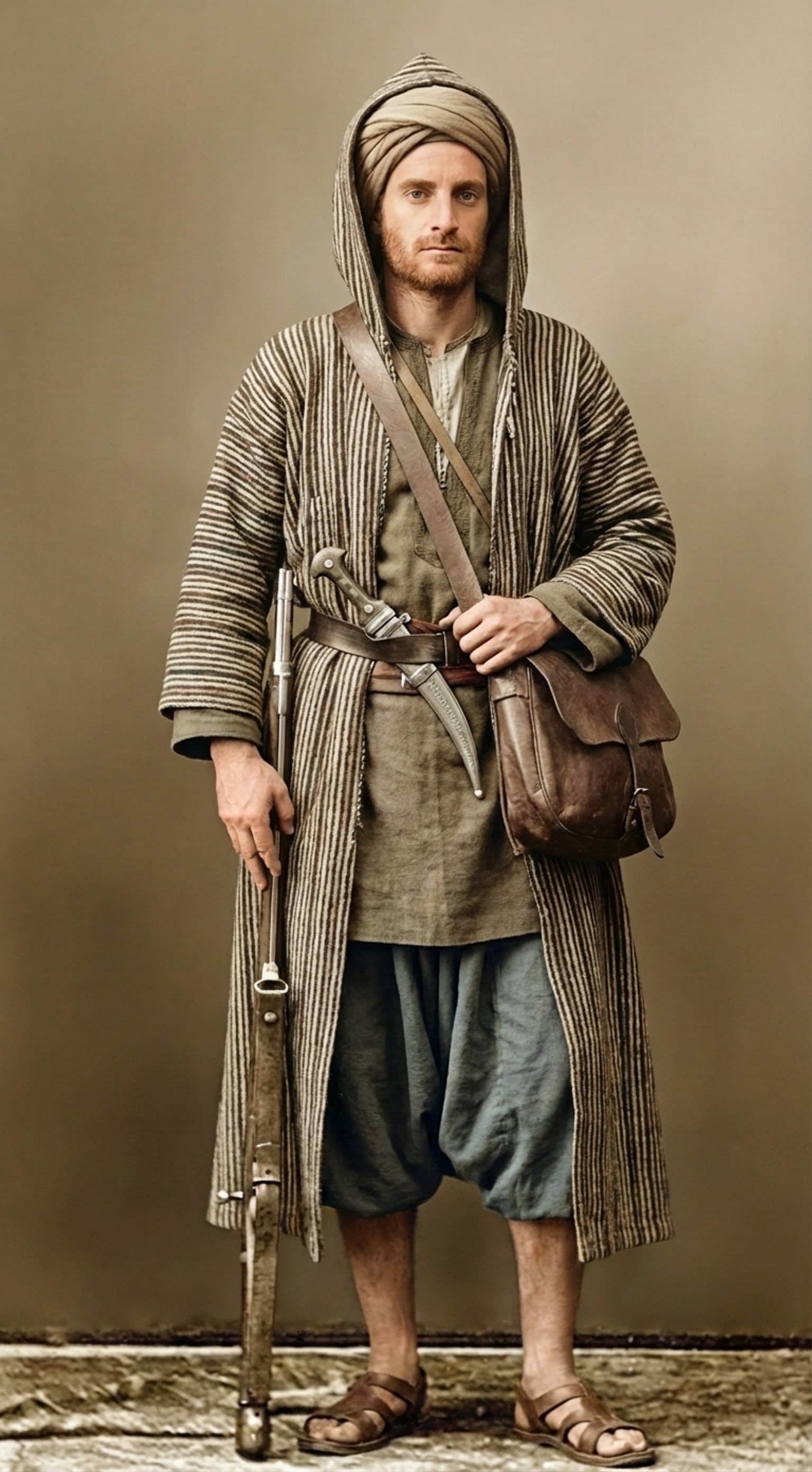
Uniform and equipment
| Uniform | Striped djellaba cloak, loose trousers, puttees |
|---|---|
| Dress uniform | Finely woven djellaba, sashes and silver-decorated belts |
| Headgear | Tarboush fez or turban |
| Equipment | Rifle, curved jambiya dagger, sometimes carbine |
| Insignia and standard | Striped wool djellaba |
Service record
| First appeared | 1908 |
|---|---|
| Peak strength | ~15,000 men |
| Recruited from | Berber Tribesmen |
| Primary tactic | Mountain Irregular Warfare |
| Signature engagement | Battle of Monte Cassino (1944) |
| Motto or battle cry | Zidou l'Goumier (Forward Goumier) |
| Obsolescence | Moroccan Independence |
Timeline
- 1908: Formation. General Lyautey creates the first Goum units as irregular police forces to assist in the pacification of Morocco.
- 1943: Tunisian Campaign. Goumiers see their first major action against the Wehrmacht, proving their worth in the jagged terrain of northern Tunisia.
- 1944: Operation Diadem. The Goumiers achieve their most famous victory by breaching the Gustav Line in Italy via the Aurunci Mountains.
- 1944: Operation Dragoon. The unit lands in Provence, participating in the liberation of southern France.
- 1945: Invasion of Germany. Goumiers cross the Rhine and advance into the Black Forest and Austria, ending the war deep in enemy territory.
- 1949: Indochina War. Deployed to Southeast Asia to fight the Viet Minh in jungle terrain similar to their mountain homes.
- 1956: Disbandment. Following Moroccan independence, the Goums are transferred from the French Army to the newly formed Royal Moroccan Army.
Battles
Liberation of Marseille
Transferred from the mountains to urban warfare, Moroccan Tabors fought house-to-house against entrenched German defenders. Their ferocity in close-quarters combat was pivotal in liberating the strategic port city.
Battle of the Vosges
Fighting in freezing rain and snow, the Goumiers pushed through dense forests and rugged terrain to break German defenses in Alsace, proving their resilience in conditions far removed from their native Atlas mountains.
Battle of the Garigliano (Monte Cassino)
The Goumiers scaled the 'impassable' Petrella Peak without artillery support, flanking the German positions. Their silent night infiltration shattered the Gustav Line, forcing a German retreat and opening the road to Rome.
Commanders
Marshal Alphonse Juin
Commander of the French Expeditionary Corps. Though a general of the army, his strategic reliance on the Goumiers' mountain warfare capabilities in Italy cemented their legendary status in military history.
General Augustin Guillaume
A fierce commander who spoke the Berber dialects and lived among his troops. Guillaume transformed the irregular Goums into a disciplined shock force capable of breaking the German Gustav Line where regular infantry failed.
Tactics
Mountain Infiltration
Traversing terrain deemed 'impassable' by conventional European armies to bypass fortified positions and strike the enemy's rear.
Night Raids
Using silence and knives (Koummya) to eliminate sentries and sow panic in enemy lines under the cover of darkness.
Mule-Borne Logistics
Reliance on mules rather than trucks allowed them to operate autonomously in high-altitude zones without established supply roads.
Swarming Assault
A loose, aggressive infantry charge that closed distance rapidly, utilizing the psychological impact of their fierce reputation.