
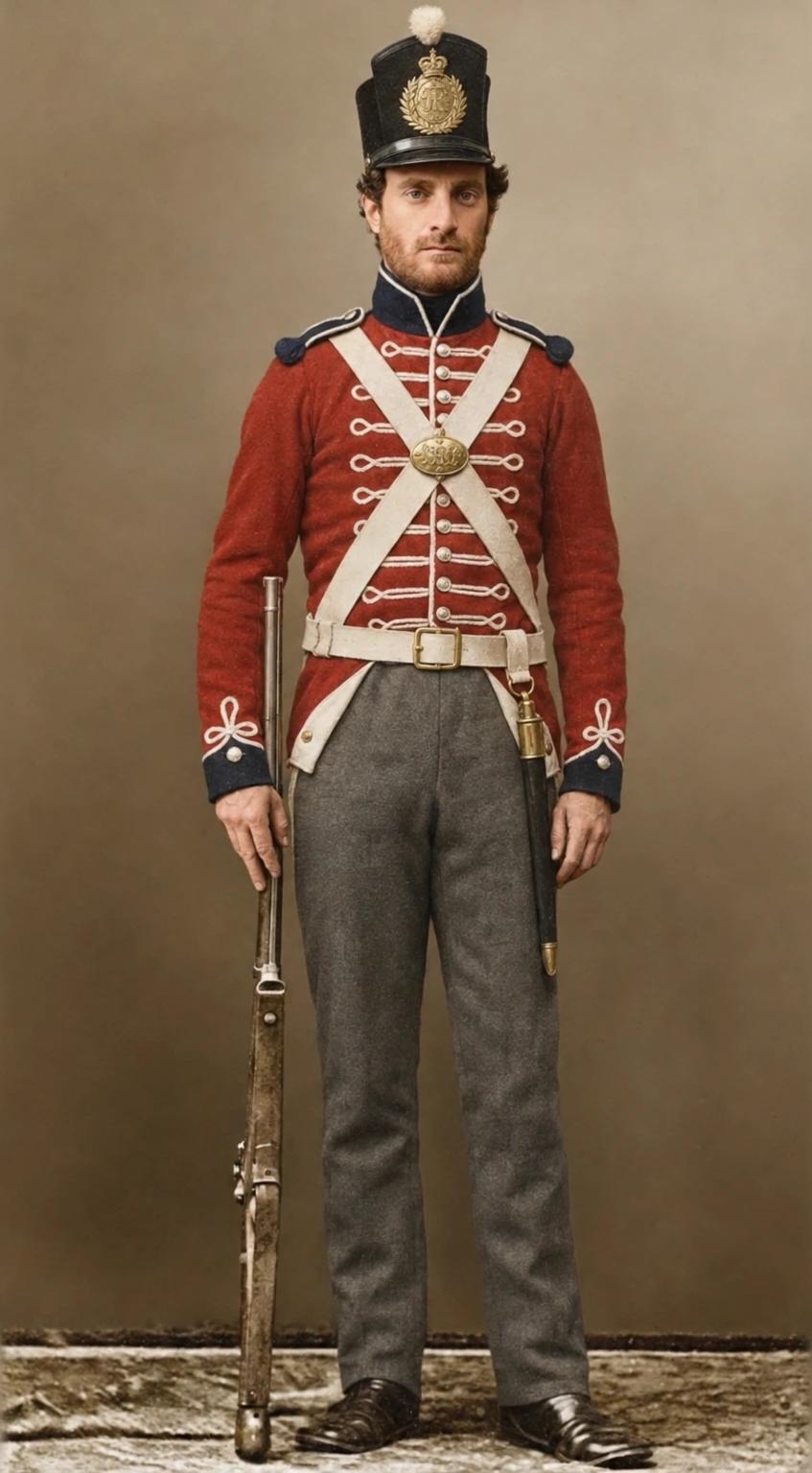
Uniform and equipment
| Uniform | Red (Line) or Green (Light) coats |
|---|---|
| Dress uniform | British style with German distinctions |
| Headgear | Shako or stovepipe |
| Equipment | Baker rifle (Light) or Musket |
| Insignia and standard | White Horse of Hanover |
Service record
| First appeared | 1803 |
|---|---|
| Peak strength | 28,000 men |
| Recruited from | Hanoverian Exiles |
| Primary tactic | Disciplined Firepower |
| Signature engagement | Defense of La Haye Sainte (1815) |
| Motto or battle cry | King and Fatherland! |
| Obsolescence | Disbanded 1816 |
Timeline
- 1803: Convention of Artlenburg. The Electorate of Hanover surrenders to France; the army is dissolved, and soldiers flee to Britain to form the King's German Regiment.
- 1805: Expansion to Legion. The unit is expanded and officially renamed the King's German Legion, incorporating infantry, cavalry, and artillery.
- 1808: Peninsular Deployment. The KGL arrives in Portugal to join Wellington's army, beginning a long campaign against Napoleon's marshals.
- 1812: Glory at Garcia Hernandez. KGL Dragoons achieve immortality by breaking French infantry squares, a rare tactical anomaly.
- 1815: The Waterloo Campaign. The Legion plays a pivotal role in the Hundred Days campaign, specifically the defense of La Haye Sainte.
- 1816: Disbandment. With Napoleon defeated and Hanover liberated, the Legion is dissolved, its members returning home to form the core of the new Hanoverian army.
Battles
Battle of Talavera
One of the Legion's first major tests in the Peninsula. The KGL infantry stood firm alongside the Guards, enduring withering artillery fire and repelling French columns. It proved to the British establishment that these exiled Hanoverians were equal to the finest Redcoats.
Battle of Garcia Hernandez
A feat almost unique in history. The KGL Heavy Dragoons, seizing a momentary gap, charged and successfully broke two formed French infantry squares. This brutal display of shock cavalry prowess shattered the myth of the infantry square's invulnerability and cemented the Legion's elite status.
Defense of La Haye Sainte (Waterloo)
The KGL 2nd Light Battalion held this critical farmhouse in the center of the Allied line. Outnumbered and starved of ammo, they repelled wave after wave of French infantry. Their eventual forced retreat, only after every round was spent, broke the momentum of Napoleon's assault.
Commanders
Major Georg Baring
The stoic commander of the 2nd Light Battalion. At Waterloo, he led the legendary defense of La Haye Sainte. Despite running out of ammunition and facing overwhelming French numbers, Baring held the farmhouse for hours, fighting with bayonets and rifle butts to buy Wellington precious time.
Christian von Ompteda
A tragic and dutiful officer commanding the KGL 2nd Brigade. Known for his strict honor, he was ordered into a suicidal charge at Waterloo by the Prince of Orange. He obeyed, leading his men into a maelstrom of French cavalry, and fell while rallying the remnants of his shattered battalion.
General Charles Alten
A master of light infantry tactics who commanded the famous Light Division in the Peninsular War. Respected for his cool head under fire, Alten transformed the KGL into one of the most professional and lethal fighting forces in Europe, bridging British discipline with German precision.
Tactics
Skirmish Order
KGL Light Battalions operated in loose pairs, utilizing cover and the accuracy of the Baker rifle to harass enemy lines and pick off officers before the main engagement.
Shock Cavalry Charge
Demonstrated at Garcia Hernandez, heavy dragoons would charge immediately after an enemy volley, using the weight of horses and straight swords to smash through disorganized infantry.
Disciplined Platoon Fire
The Line Battalions utilized the standard British two-rank line, delivering rolling volleys of musket fire with a mechanical precision that withered French columns.