
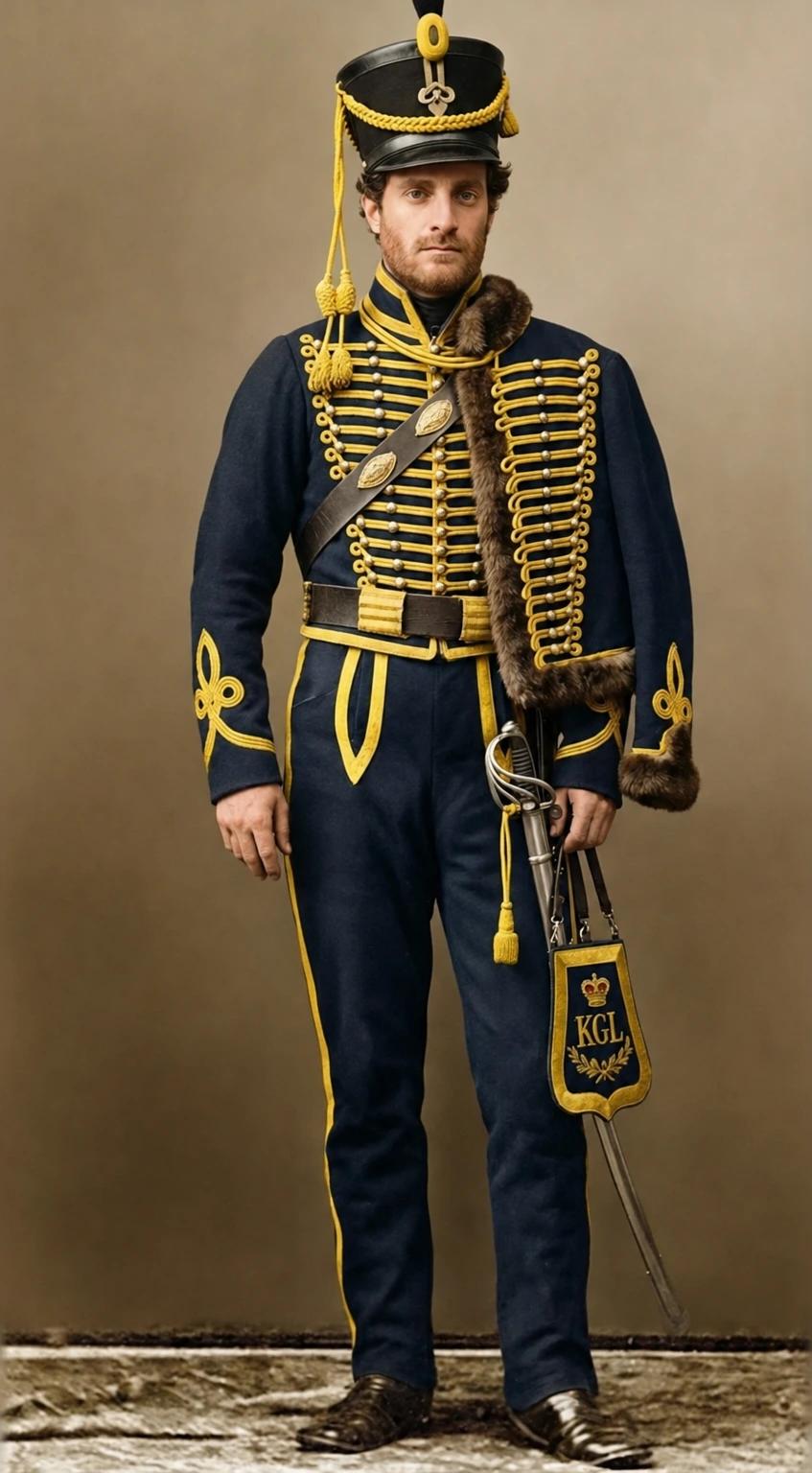
Uniform and equipment
| Uniform | Dark blue dolman with white or yellow braiding, scarlet pelisse |
|---|---|
| Dress uniform | Highly braided hussar jacket with pelisse slung over shoulder |
| Headgear | Mirliton cap, later shako with cords and plume |
| Equipment | Curved sabre, pistols, carbine |
| Insignia and standard | White Horse of Hanover with motto Nec Aspera Terrent |
Service record
| First appeared | 1803 |
|---|---|
| Peak strength | ~2,000 men |
| Recruited from | Hanoverian Exiles |
| Primary tactic | Light Cavalry Charge / Picket |
| Signature engagement | Battle of Salamanca (1812) |
| Motto or battle cry | Honi soit qui mal y pense (Shame on him who thinks evil of it) |
| Obsolescence | Disbandment after 1815 |
Timeline
- 1803: Formation. Following the Convention of Artlenburg, the Hanoverian army is dissolved. Exiled soldiers flee to England to form the King's German Legion.
- 1805: First Deployment. The Hussars participate in an abortive expedition to Hanover, attempting to reclaim their homeland from Napoleon.
- 1809: Arrival in Peninsula. The 1st Hussars land in Portugal, joining Wellington's army and immediately proving superior in outpost duties.
- 1812: Glory at Salamanca. The Hussars achieve legendary status by breaking French infantry squares, earning the admiration of the entire British army.
- 1815: Waterloo Campaign. The unit fights its final major engagement, suffering heavy losses but contributing to the final defeat of Napoleon.
- 1816: Disbandment. With Napoleon defeated, the KGL is dissolved, and its veterans return to Hanover to form the core of the new Royal Hanoverian Army.
Battles
Battle of El Bodón
A desperate rearguard action where KGL Hussars repeatedly charged superior French cavalry to buy time for Wellington's infantry to withdraw. Their disciplined aggression against overwhelming odds prevented a catastrophic collapse of the Allied line.
Battle of Salamanca
The unit's defining moment. Observing the French infantry disordered by shrapnel, the KGL Hussars charged and shattered a formed infantry square—a nearly impossible feat for cavalry. They decimated the French 3rd Division, capturing thousands.
Battle of Waterloo
Stationed on the vital right flank, the KGL Hussars engaged in brutal, close-quarters skirmishes for hours. Despite heavy casualties, they checked the advance of French cuirassiers, protecting the crumbling Allied center until the Prussians arrived.
Commanders
Major-General Victor von Alten
A seasoned Hanoverian aristocrat who commanded the KGL cavalry brigade with iron discipline. Unlike many reckless British counterparts, von Alten prioritized horse preservation and tactical cohesion, ensuring his hussars were always combat-ready in the harsh Peninsular terrain.
Lieutenant-Colonel Friedrich von Arentschildt
The fearless commander of the 1st Hussars who achieved the impossible at Salamanca. Leading his exiles with cold fury, he capitalized on a momentary French lapse to break a defensive square, cementing the KGL's reputation as the finest light cavalry in Wellington's army.
Tactics
Vedette and Picket Duty
Masters of the 'outpost,' KGL Hussars formed a protective screen around the army. Their vigilance was so absolute that Wellington famously stated he always slept soundly when the Germans were on picket.
The Opportunistic Charge
Unlike heavy cavalry, they avoided frontal assaults on prepared lines. Instead, they stalked the enemy, waiting for disorder or exhaustion before launching rapid, devastating flank attacks to roll up the line.
Skirmishing Retreat
When outnumbered, they utilized a 'leapfrog' retreat tactic, firing carbines from the saddle to harass pursuers while maintaining a cohesive front to prevent a rout.