
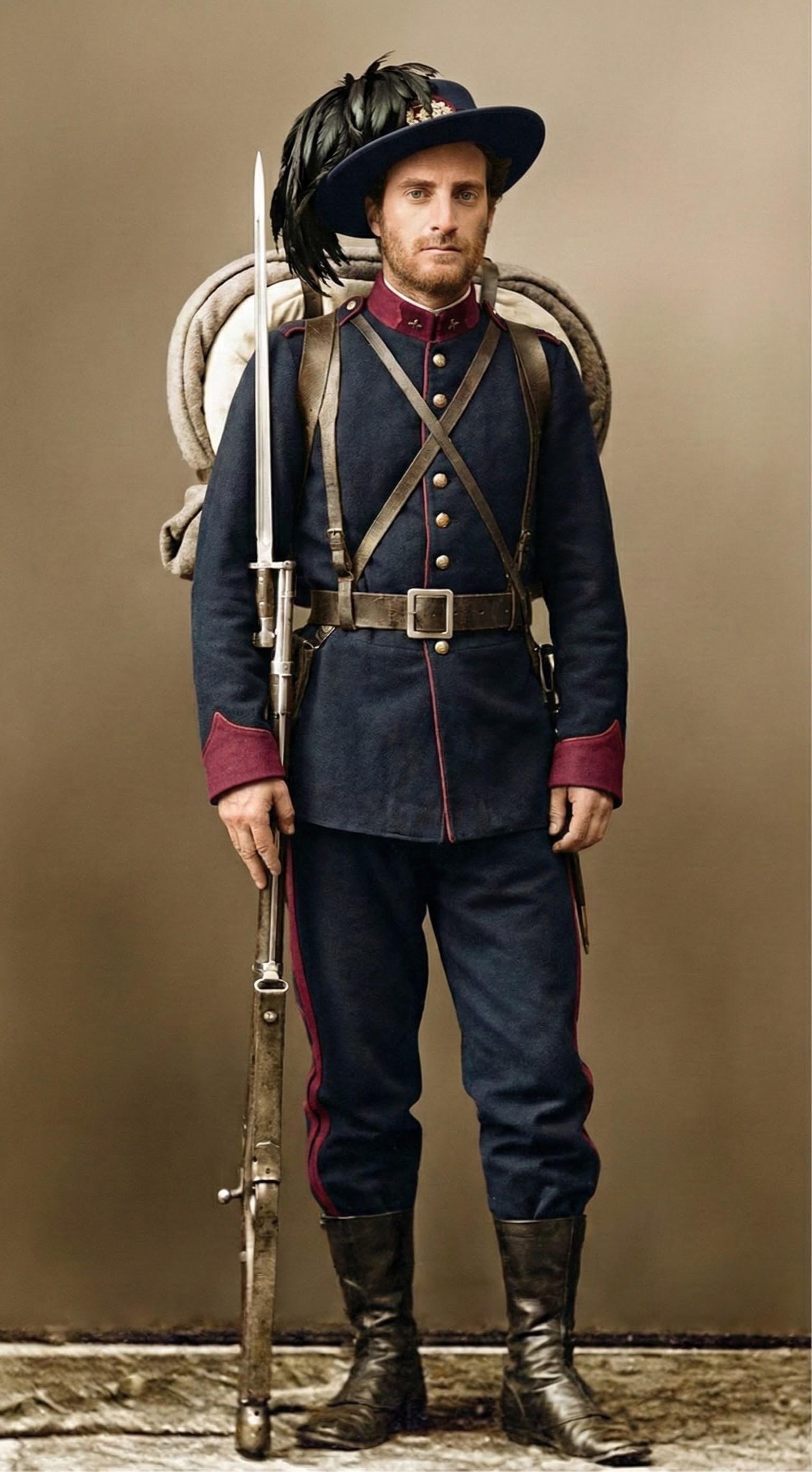
Uniform and equipment
| Uniform | Dark blue tunic, crimson facings, light blue trousers |
|---|---|
| Dress uniform | Blue with gold frogging, crimson sash |
| Headgear | Wide-brimmed hat with cock feather plume cascade |
| Equipment | Rifle, plume holder, fanfare trumpet |
| Insignia and standard | Piumetto black capercaillie feathers; grenade/bugle/rifles badge |
Service record
| First appeared | 1836 |
|---|---|
| Peak strength | 10,000 men |
| Recruited from | Fit Volunteers / High Endurance |
| Primary tactic | Rapid March / Marksmanship |
| Signature engagement | Capture of Rome (1870) |
| Motto or battle cry | Ictu impetuque primus (First in striking and assaulting) |
| Obsolescence | Motorization (Adapted) |
Timeline
- 1836: Foundation. King Charles Albert of Sardinia accepts Alessandro La Marmora's proposal for a corps of light infantry marksmen.
- 1848: First War of Independence. The unit sees its first major combat against the Austrian Empire at the Battle of Goito.
- 1855: Crimean Expedition. Deployment to the Crimea; the unit gains prestige but loses its founder to cholera.
- 1870: Breach of Porta Pia. Bersaglieri lead the assault that ends the temporal power of the Pope and unifies Italy.
- 1899: Cyclist Battalions. Formal introduction of bicycle-mounted units, enhancing their role as a rapid reaction force.
- 1915: World War I. Conversion to trench and alpine warfare; special 'Arditi' shock units are formed from Bersaglieri ranks.
- 1943: Armistice and Civil War. Following the armistice, Bersaglieri units are split, some fighting for the Allies (CIL) and others for the RSI.
Battles
Battle of Goito
The baptism of fire. La Marmora led his black-plumed troops in a storming charge across the Mincio bridge. La Marmora was shot in the jaw, but the Bersaglieri routed the Austrian defenders, proving the efficacy of their rapid assault doctrine.
Battle of the Cernaia
Fighting alongside the French and British, the Bersaglieri held the Tractir Bridge against overwhelming Russian numbers. Their discipline and precision fire earned them international acclaim and a place among Europe's elite.
Capture of Rome (Porta Pia)
The culmination of Italian unification. The 12th Bersaglieri Battalion stormed the breach in the Aurelian Walls at Porta Pia under heavy Papal Zouave fire, seizing the Eternal City for the Kingdom of Italy.
Second Battle of El Alamein
A tragic, heroic stand. The Bersaglieri fought with desperate ferocity against British armor. Rommel famously remarked, 'The German soldier has impressed the world, but the Italian Bersagliere has impressed the German soldier.'
Commanders
Alessandro La Marmora
The visionary founder who revolutionized Italian infantry. Obsessed with physical fitness and marksmanship, he died of cholera in the Crimea, leading the very men he trained to run into battle.
Luciano Manara
A charismatic patriot and martyr of the Risorgimento. He led the Lombard Bersaglieri during the desperate defense of the Roman Republic against the French, falling heroically at Villa Spada.
Tactics
Passo di Corsa
A signature high-step running march at 180 steps per minute. This allowed the unit to deploy faster than line infantry and charge with overwhelming momentum.
Independent Marksmanship
Unlike line infantry who fired in volleys, Bersaglieri were trained to fire at will with precision, targeting officers and artillery crews.
Cyclist Mobility
Using folding bikes to cover 60-100km a day, dismounting only to engage the enemy, effectively acting as the poor man's mechanized infantry.