
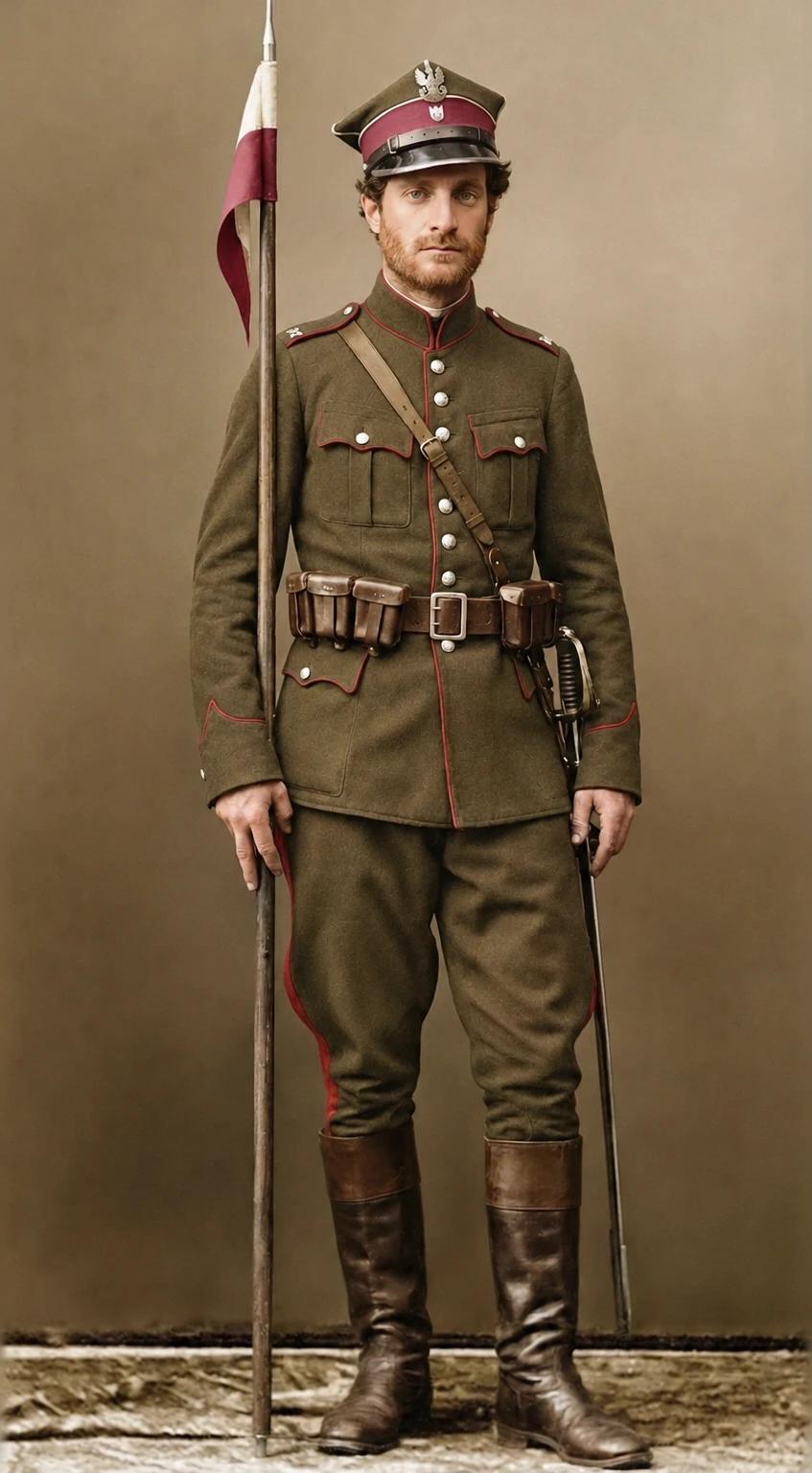
Uniform and equipment
| Uniform | Field-gray kurtka with colored collar patches, riding breeches |
|---|---|
| Dress uniform | Long double-breasted kurtka with colored facings, ornamental belts |
| Headgear | Four-pointed rogatywka cap with national cockade |
| Equipment | Lance (for parade), sabre, carbine |
| Insignia and standard | Polish Eagle (Orzeł) on rogatywka |
Service record
| First appeared | 1918 |
|---|---|
| Peak strength | 40,000 men in cavalry brigades |
| Recruited from | Volunteers / Conscripts |
| Primary tactic | Mobile Infantry / Last Charges |
| Signature engagement | Battle of Komarów (1920) |
| Motto or battle cry | Honor i Ojczyzna (Honor and Fatherland) |
| Obsolescence | German Blitzkrieg (Tanks) |
Timeline
- 1918: Resurrection. Following WWI, Polish cavalry regiments are formed from the remnants of Austrian, German, and Russian units, unifying under the white eagle.
- 1920: The Miracle at the Vistula. Uhlans play a critical role in the Polish-Soviet War, executing deep raids and the decisive charge at Komarów.
- 1921: Reorganization. Peacetime transition. The cavalry becomes the elite guardian of the 'Kresy' (Eastern Borderlands), maintaining a high state of readiness against Soviet threats.
- 1934: Modernization. Introduction of the Szabla wz. 34 and gradual integration of anti-tank weaponry, acknowledging the changing face of war while retaining the horse for mobility.
- 1939: The September Campaign. Poland is invaded. The Uhlans fight bravely as mobile infantry brigades, covering the retreat and delivering stinging counterattacks before the state collapses.
Battles
Battle of Komarów
The largest cavalry battle since 1813. Polish Uhlans outmaneuvered and shattered the feared Soviet 1st Horse Army. It was a chaotic, swirling melee of saber and lance that saved Europe from the Red Army and cemented the Uhlan legend.
Battle of Mokra
On the first day of WWII, the Volhynian Cavalry Brigade stood firm against German Panzers. Fighting dismounted with anti-tank rifles and artillery train support, they destroyed over 100 German vehicles, proving cavalry was not obsolete, merely evolved.
Charge at Krojanty
A desperate tactical counterattack to cover retreating infantry. Uhlans charged German infantry, dispersing them, until armored cars arrived. The subsequent slaughter birthed the German propaganda myth of Poles charging tanks with lances.
Commanders
Władysław Anders
A commander of iron will who led the 15th Poznań Uhlans with distinction. During the 1939 campaign, he fought despite grievous wounds. He later resurrected the Polish spirit, leading the II Corps from the Soviet Gulags to the victory at Monte Cassino.
Juliusz Rómmel
The architect of the last great cavalry victory in history. As commander of the 1st Cavalry Division, he shattered Budyonny's Konarmiya at Komarów, proving that discipline and the saber could still break the Bolshevik tide.
Bolesław Wieniawa-Długoszowski
The embodiment of the Uhlan spirit—poet, doctor, and reckless cavalier. Piłsudski's favorite aide, he represented the romantic, dashing soul of the Polish cavalry before the grim reality of mechanized warfare took hold.
Tactics
Mobile Infantry (Dragoons)
By the late 1930s, the primary doctrine was to use the horse for rapid operational movement, then dismount to fight on foot with carbines and machine guns, utilizing cover.
The Shock Charge
Standard in 1920, but rare in 1939. Used only against disorganized infantry or to break out of encirclement. A psychological weapon of terror involving sabers and thunderous noise.
Delaying Action
Uhlans utilized the difficult terrain of Poland's forests and marshes to ambush mechanized columns, force them to deploy, and then retreat before decisive engagement.