
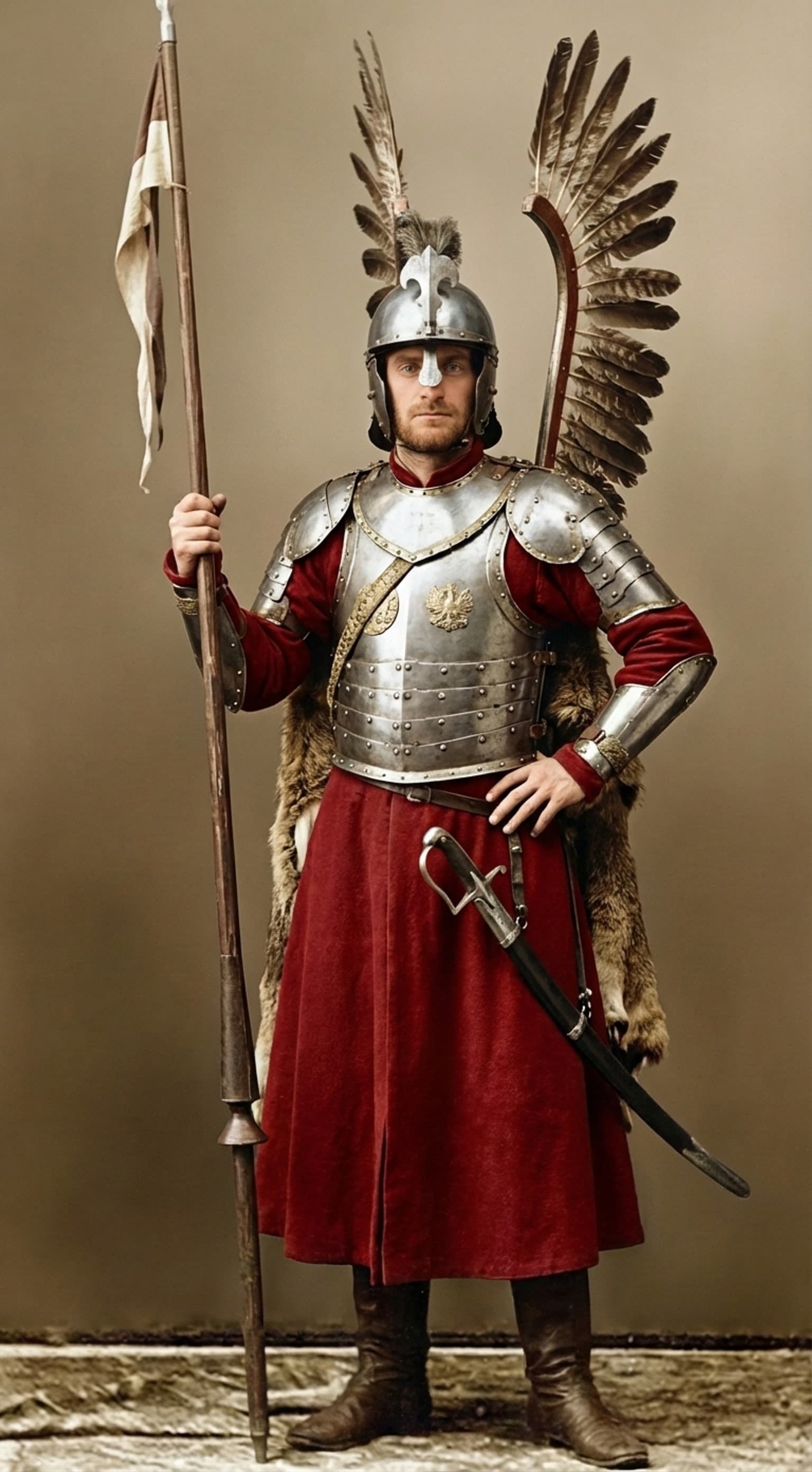
Uniform and equipment
| Uniform | Red/blue dolman, leopard or tiger pelts, wings attached to backplate |
|---|---|
| Dress uniform | Jeweled dolman, ermine pelts |
| Headgear | Fur kolpak with jeweled aigrette |
| Equipment | Lance, szabla sabre, warhammer, pistols |
| Insignia and standard | Feathered wings on saddle/armor; bicolor pennants |
Service record
| First appeared | 1500s (peaked 1700s) |
|---|---|
| Peak strength | 2,000 men |
| Recruited from | Szlachta (Nobility) |
| Primary tactic | Heavy Lance Charge |
| Signature engagement | Battle of Vienna (1683) |
| Motto or battle cry | Jezus Maria! (Jesus, Mary!) |
| Obsolescence | Improved Firearms / Swedish Tactics |
Timeline
- 1503: Formation. The Polish Sejm hires the first Serbian and Hungarian mercenaries, initially serving as light cavalry.
- 1576: Batory Reforms. King Stefan Batory standardizes the unit, mandating heavy armor and the long lance, transforming them into the primary shock force.
- 1605: Legend of Kircholm. The Hussars achieve legendary status by destroying a vastly superior Swedish army with minimal losses.
- 1683: Savior of Vienna. The Hussars execute the largest cavalry charge in history, marking the peak of their fame.
- 1702: Decline at Kliszów. Hussars fail against Swedish muskets and chevaux de frise obstacles, signaling the end of the heavy cavalry era.
- 1776: Disbandment. The Sejm officially dissolves the Hussar formations, absorbing them into the National Cavalry brigades.
Battles
Battle of Kircholm
A masterclass in shock tactics. 2,600 Hussars annihilated 11,000 Swedes in 20 minutes. The Hussars used feigned retreats to break the Swedish pike formations before shattering them with a decisive charge.
Battle of Klushino
The zenith of Hussar dominance. Facing 35,000 Russians and mercenaries, 5,000 Poles charged repeatedly, breaking through wooden barricades and pike walls. The victory opened the gates of Moscow to the Polish crown.
Battle of Vienna
The salvation of Europe. Sobieski led 18,000 horsemen, including 3,000 Winged Hussars, down the Kahlenberg hills. The sheer momentum and psychological terror of the winged riders shattered the Ottoman lines instantly.
Battle of Hodów
The 'Polish Thermopylae'. 400 Hussars and Panzer cavalry, dismounted and out of ammunition, held off 40,000 Tatars using captured arrows loaded into their own weapons, proving their resilience beyond the charge.
Commanders
Stanisław Żółkiewski
A legendary Field Hetman who achieved the impossible at Klushino, defeating a Russo-Swedish force five times his size. He marched the Hussars all the way to Moscow, capturing the city and the Tsar.
Stefan Batory
Prince of Transylvania and King of Poland who transformed the Hussars from light cavalry into the heavy, plate-armored shock force that dominated Europe. His reforms standardized their equipment and tactics, creating the 'Angels of Death'.
John III Sobieski
The 'Lion of Lechistan' who led the largest cavalry charge in history. A brilliant strategist and King of Poland, he personally spearheaded the Hussar assault at Vienna, breaking the Ottoman siege and saving Christendom from invasion.
Tactics
The Knee-to-Knee Charge
Riders began at a walk, transitioned to a trot, and only galloped in the final meters. They rode so tightly that their knees touched, creating a solid wall of steel and horseflesh that maximized impact force.
Lance Breaker
Utilizing the extreme length of the hollow Kopia (up to 5.5m), Hussars could strike pikemen before the pikes could reach the horse, shattering the enemy infantry wall.
Feigned Retreat
Adopting Tatar tactics, Hussars would simulate a panic to draw enemy infantry out of defensive positions, then wheel around to slaughter the disorganized formation.