
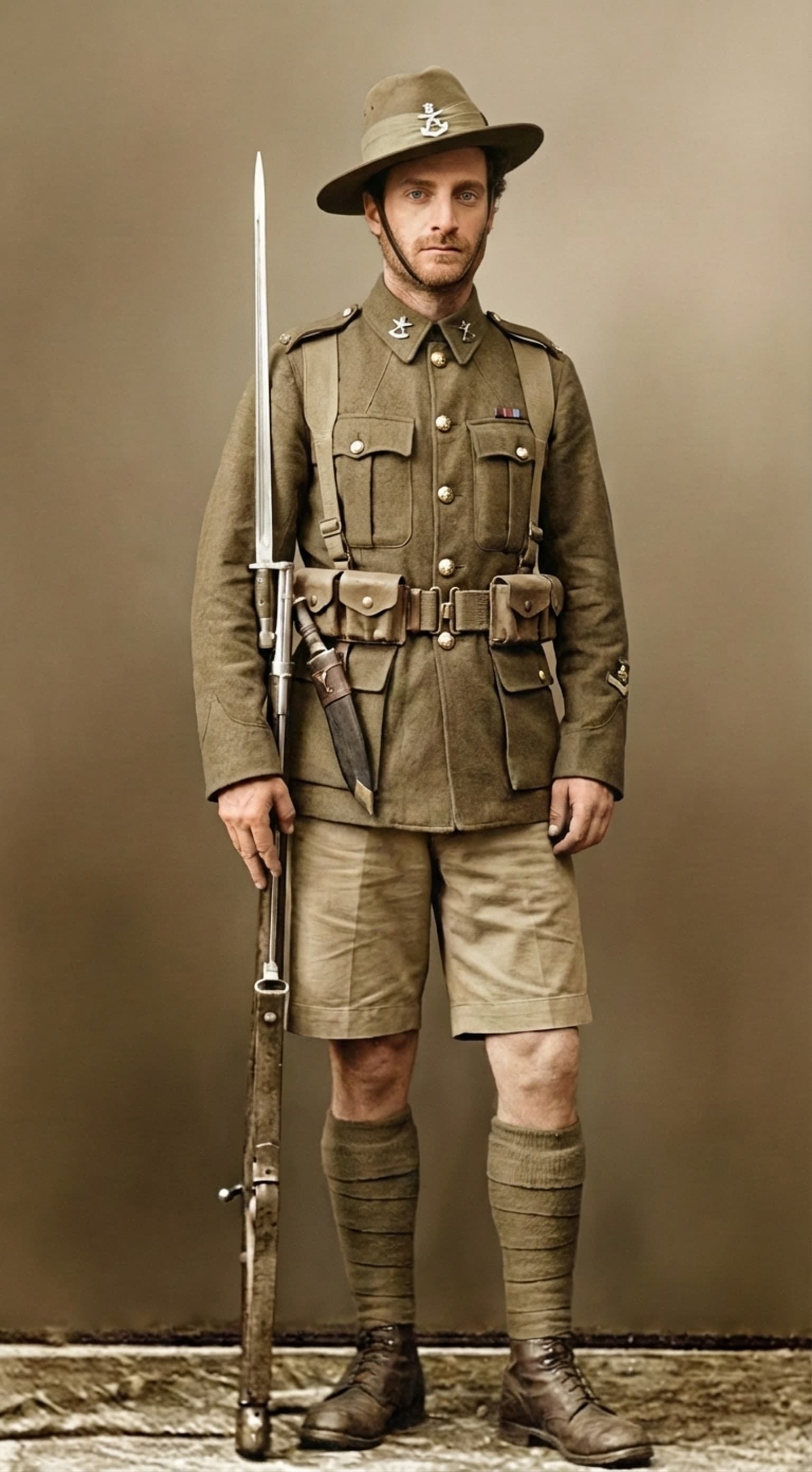
Uniform and equipment
| Uniform | Khaki tunic, puttees, dark green facings |
|---|---|
| Dress uniform | Khaki or rifle-green dress with polished buttons |
| Headgear | Slouch hat with upturned brim |
| Equipment | Rifle, bayonet, kukri knife |
| Insignia and standard | Crossed kukris (blades up, outwards) |
Service record
| First appeared | 1815 |
|---|---|
| Peak strength | ~20,000 men |
| Recruited from | Nepalese Hill Tribes |
| Primary tactic | Close Quarter Skirmish |
| Signature engagement | Battle of Kandahar (1880) |
| Motto or battle cry | Ayo Gorkhali! (Here come the Gurkhas!) |
| Obsolescence | N/A (Still Active) |
Timeline
- 1815: Formation of the Sirmoor Battalion. Following the Treaty of Sugauli, the first corps of Gurkhas enters British service, marking the beginning of a 200-year alliance.
- 1857: Siege of Delhi. The Sirmoor Battalion holds Hindu Rao's House against overwhelming odds during the Indian Mutiny, earning the title 'Rifles' and the Queen's Truncheon.
- 1915: Battle of Neuve Chapelle. Gurkhas prove their worth on the Western Front, storming German trenches with kukris when rifles jammed in the mud.
- 1944: Defense of Imphal and Kohima. Gurkha units play a critical role in halting the Japanese invasion of India in brutal jungle warfare.
- 1947: Tripartite Agreement. Following Indian Independence, Gurkha regiments are split between the British Army and the new Indian Army.
- 1982: Falklands War. The 1st Battalion, 7th Gurkha Rifles deploys to the South Atlantic; their reputation alone causes Argentine conscripts to surrender at Mount William.
Battles
Battle of Kandahar
During the Second Anglo-Afghan War, the 2nd Gurkhas spearheaded the assault on the Baba Wali Kotal. Despite withering fire, they stormed the Afghan guns. Their ferocity in close quarters broke the enemy line, securing a decisive end to the campaign and cementing their reputation in the Empire.
Battle of Sari Bair
In a campaign defined by failure, the Gurkhas achieved the impossible. They scaled the vertical cliffs of Sari Bair at night, the only Allied troops to look down upon the Dardanelles. Tragically, lack of reinforcements and friendly naval fire forced them to relinquish the hard-won heights.
Battle of Monte Cassino
The 1st Royal Gurkha Rifles seized 'Hangman's Hill' beneath the monastery. Cut off for days, surviving on air-dropped supplies and rainwater, they held the rock against elite German paratroopers. They only withdrew when ordered, their stubborn defense becoming legendary.
Commanders
Havildar Lachhiman Gurung
A titan of resilience in Burma. In 1945, he caught two Japanese grenades and threw them back. The third blew off his right hand. Refusing evacuation, he loaded his rifle with his left hand and defended his post alone for four hours, killing 31 enemy soldiers at point-blank range.
General Sir David Ochterlony
The British commander who, after fighting against the Gorkha Kingdom in 1814, recognized their unparalleled martial spirit. Instead of subjugating them, he recruited them, laying the foundation for the Nasiri battalions that would become the Gurkha Rifles.
Rifleman Kulbir Thapa
The first Gurkha to receive the Victoria Cross. In 1915, amidst the mud of Fauquissart, he found himself behind enemy lines. Ignoring his own wounds, he stayed with a wounded soldier for a day and night, eventually carrying him and two other Gurkhas to safety through a German barrage.
Tactics
Ayo Gorkhali Charge
A psychological and physical assault where troops scream 'The Gurkhas are upon you!' while charging with drawn kukris, often causing enemy panic.
Mountain Infiltration
Born in the Himalayas, they utilize high-altitude stamina to scale 'impassable' terrain, flanking enemies who believe themselves secure.
Close Quarter Skirmish
Aggressive patrolling and trench raiding, utilizing silence and cold steel to neutralize sentries and strongpoints before the main assault.