
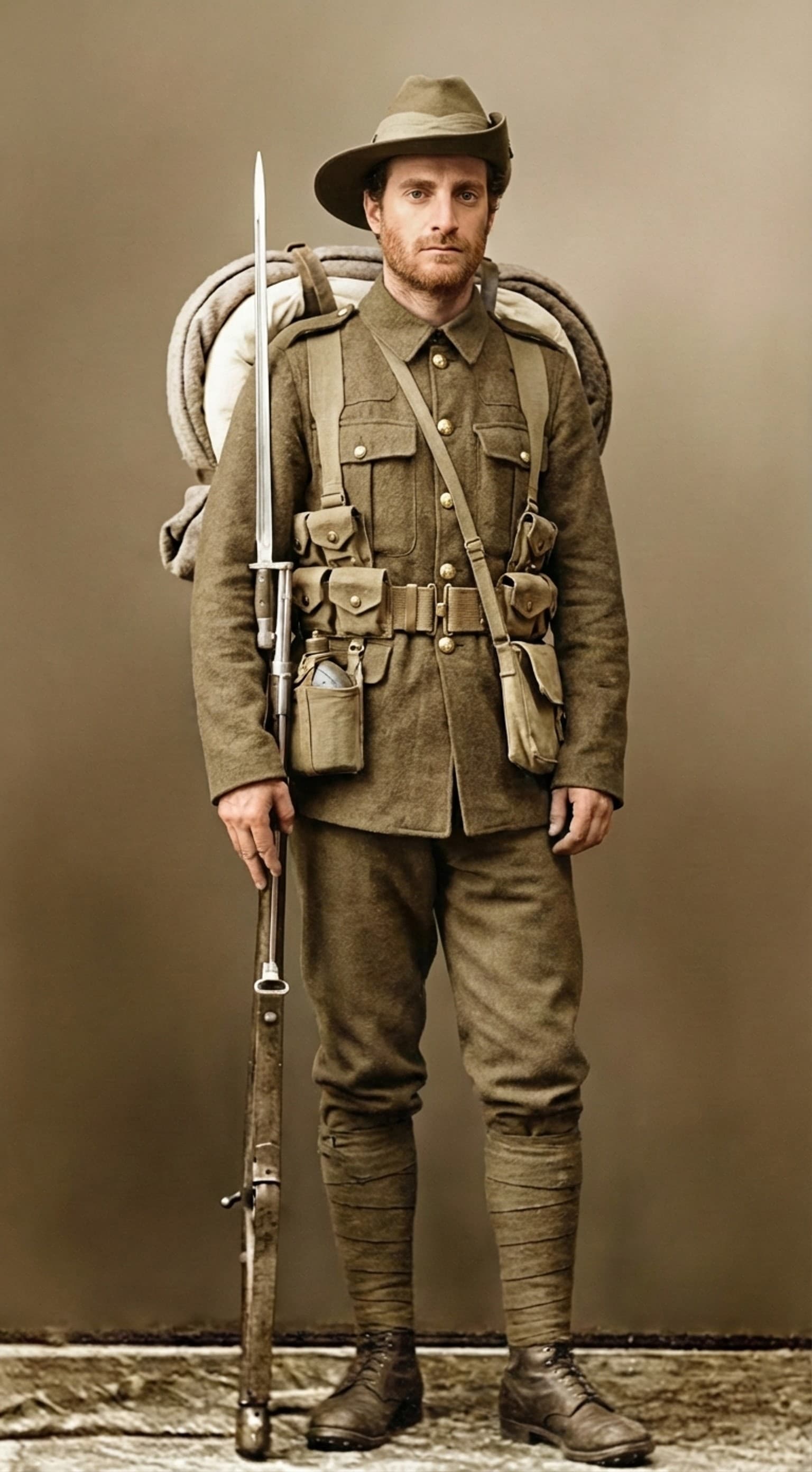
Uniform and equipment
| Uniform | Khaki uniform, slouch hat |
|---|---|
| Dress uniform | N/A |
| Headgear | Slouch hat (pinned up) |
| Equipment | SMLE Rifle, bayonet |
| Insignia and standard | Rising Sun badge (bayonets radiating from crown) |
Service record
| First appeared | 1915 |
|---|---|
| Peak strength | Corps strength |
| Recruited from | Volunteers |
| Primary tactic | Aggressive Trench Raiding |
| Signature engagement | Gallipoli (1915) |
| Motto or battle cry | Cooee! (Bush call) |
| Obsolescence | End of WWI |
Timeline
- 1914: Formation in Egypt. The Australian Imperial Force and New Zealand Expeditionary Force combine in Egypt to form the ANZAC Corps for training.
- 1915: Gallipoli Landing. ANZAC troops land at the Dardanelles, beginning an 8-month campaign of attrition against the Ottoman Empire.
- 1915: Evacuation of Gallipoli. In a masterstroke of stealth, the entire corps withdraws without a single casualty, ending the failed campaign.
- 1916: Transfer to Western Front. The infantry divisions move to France, entering the line at Armentières before the horror of the Somme.
- 1917: Third Battle of Ypres. ANZACs fight through the mud of Passchendaele and Messines, suffering heavy losses for minimal ground.
- 1918: Battle of Le Hamel. Monash executes a textbook combined-arms battle, taking the objective in 93 minutes—3 minutes longer than planned.
- 1918: Breaking the Hindenburg Line. ANZAC troops play a critical role in breaching the final German defensive network, forcing the Armistice.
Battles
Landing at Anzac Cove
The baptism of fire. ANZAC troops stormed steep, scrub-covered cliffs under withering machine-gun fire. While they established a precarious foothold, the failure to seize the high ground led to months of bloody trench stalemate.
Battle of Lone Pine
A diversionary attack that evolved into savage hand-to-hand combat in covered trenches. Seven Victoria Crosses were awarded as Australians held the position against waves of Ottoman grenades and bayonet charges for four days.
Battle of Pozières
The ANZAC introduction to the Western Front's industrial slaughter. In six weeks, the divisions suffered 23,000 casualties to capture a pulverized village, enduring the most concentrated artillery bombardment of the war.
Battle of Amiens
The 'Black Day of the German Army.' Spearheaded by the Australian and Canadian Corps, this combined-arms assault shattered the German lines, advancing 11 kilometers in a single day and signaling the beginning of the end of the war.
Commanders
William Birdwood
The British commander known as the 'Soul of Anzac.' He commanded the corps during the Gallipoli campaign and on the Western Front. Despite his aristocratic background, he was revered by the diggers for his frequent presence in the front lines and relaxed discipline.
William Malone
A fierce disciplinarian and the hero of Chunuk Bair. Malone transformed the Wellington Battalion into an elite fighting force. He died leading his men in a desperate defense of the ridge at Gallipoli, refusing to retreat despite overwhelming Ottoman counterattacks.
Sir John Monash
An intellectual engineer-turned-general who revolutionized modern warfare. Monash viewed battle as a logistical project, prioritizing the protection of his infantry through the meticulous integration of tanks, artillery, and aircraft during the decisive 1918 offensives.
Tactics
Peaceful Penetration
A strategy of constant aggression where small patrols would infiltrate enemy lines, capture posts, and seize territory without major artillery support, eroding enemy morale.
Trench Raiding
Nocturnal hit-and-run attacks using clubs, knives, and grenades to capture prisoners for intelligence and dominate No Man's Land.
Creeping Barrage Integration
Infantry were trained to 'lean on the barrage,' advancing dangerously close to their own falling artillery shells to catch the enemy before they could man their machine guns.
Combined Arms Assault
Perfected by Monash, this involved coordinating tanks to crush wire, aircraft to drown out tank noise, and artillery to suppress defenses, allowing infantry to mop up.